Introduction
Freelance capacity utilization is often misunderstood.
Many freelancers believe that increasing their workload will lead to more stability.
More hours.
More clients.
More revenue.
But in practice, this approach creates the opposite outcome.
Work increases, but predictability does not.
Freelancers find themselves fully booked — yet still uncertain about what happens next month.
This is not a workload problem.
It is a capacity structure problem, as explained in the Capacity Planning System for freelancers.
Freelance capacity utilization is one of the most important metrics for understanding how much work you can take on without creating instability.
What Capacity Utilization Actually Means
Capacity utilization is typically defined as the percentage of available working time spent on client work.
At a surface level:
- 100% utilization means fully booked
- 70% utilization means room for growth
But this definition misses a critical point.
Not all time contributes equally to stability.
And not all work supports long-term sustainability.
If you want a more detailed breakdown, this is explored further in utilization rate for solo consultants.
Capacity utilization is not about how much you work.
It is about how your work is structured over time.
The Hidden Problem Behind High Utilization
Most freelancers aim to maximize utilization.
They assume:
- higher utilization = higher income
- higher income = more security
But this logic breaks under real conditions.
Because high utilization removes flexibility.
It reduces decision space.
And it disconnects your current workload from your future pipeline.
This creates a common but misunderstood situation:
You are fully booked, but your business is unstable.
Why High Utilization Leads to Instability
1. Pipeline Collapse
When utilization is too high, pipeline activity stops.
There is no time for:
- outreach
- follow-ups
- content
- relationship maintenance
This creates a delayed effect.
Work continues in the short term.
But future demand quietly disappears.
By the time you notice, your pipeline is already empty.
This relationship between workload and future demand is explored further in capacity forecasting from pipeline data.
2. No Capacity Buffers
Freelance work is not linear.
Projects expand.
Clients delay feedback.
Scope changes.
Without buffers, even small disruptions create overload.
This leads to:
- missed deadlines
- reduced quality
- increased stress
Buffers are not inefficiency.
They are a structural requirement, which is explained in more detail in delivery buffer design for freelancers.
3. Decision Compression
At high utilization, decisions become reactive.
You start asking:
- Can I fit this in?
- Should I delay something else?
- Do I accept this anyway?
Instead of operating from a system, you operate from pressure.
This degrades both client selection and delivery quality.
4. The Revenue Illusion
High utilization often hides inefficiency.
Freelancers assume:
“I’m fully booked, so things are working.”
But in reality:
- non-billable work increases
- revisions expand
- pricing is not optimized
You may be working more, but earning less per hour.
This is explored further in the freelance capacity model (hours vs revenue).
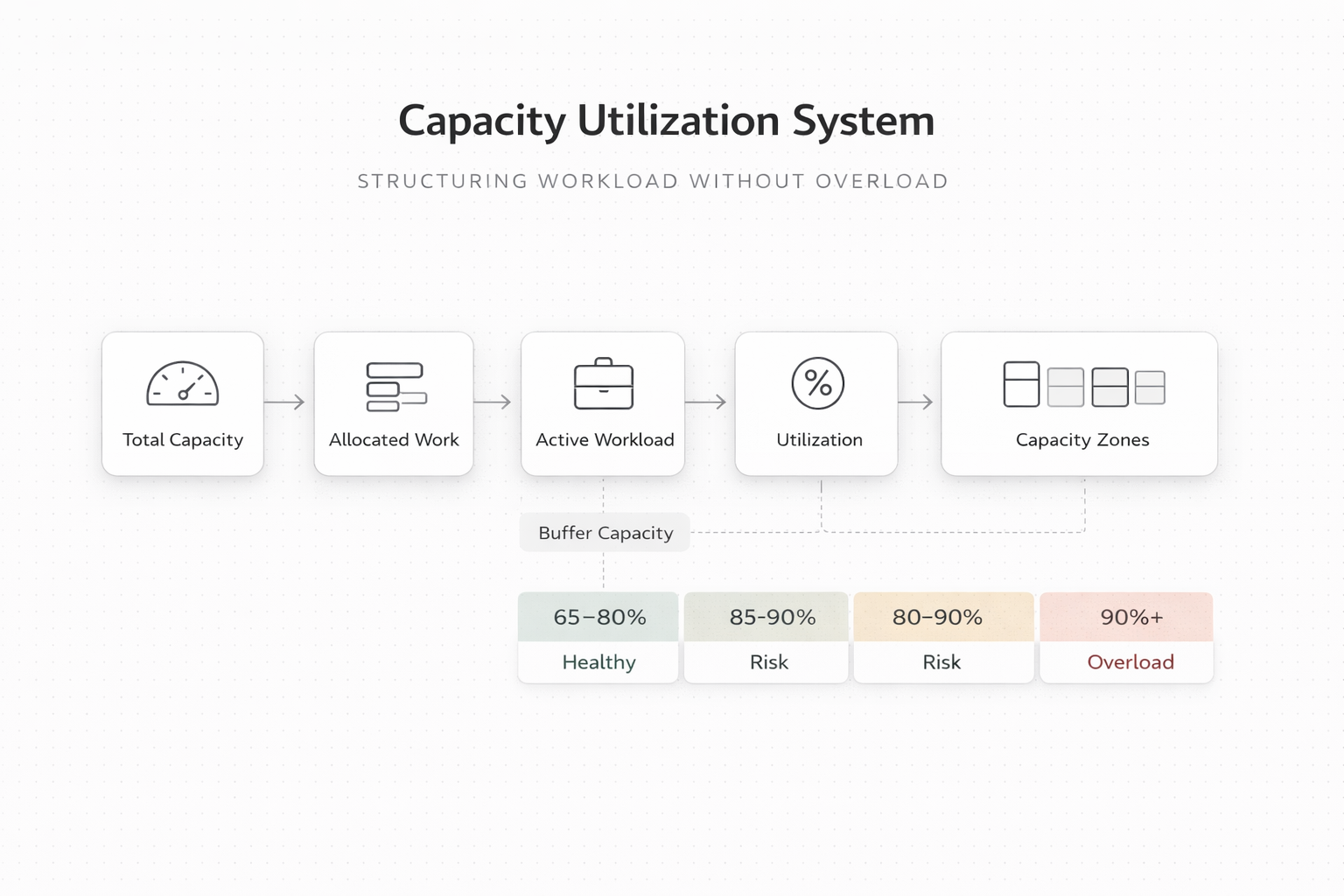
The Capacity Utilization Model
To create stability, utilization must be controlled — not maximized.
Optimal Range: 65%–80%
This range allows:
- consistent delivery
- active pipeline management
- flexibility for changes
Risk Range: 80%–90%
Short-term sustainable.
Long-term unstable.
Small disruptions create pressure.
Overload Range: 90%+
No flexibility.
No pipeline activity.
High burnout risk.
Capacity and Pipeline Must Be Connected
One of the biggest mistakes freelancers make is treating pipeline and capacity as separate systems.
They are not.
Your pipeline generates demand.
Your capacity determines feasibility.
If they are not aligned:
- you accept work you cannot deliver sustainably
- or reject work you could have handled
This creates inconsistency.
A healthy business is not just about generating work.
It is about accepting the right work at the right time.
A Practical Capacity Framework
1. Define True Capacity
Start with total available hours.
Then subtract:
- admin work
- sales activities
- communication
- learning
- recovery time
The remainder is your real delivery capacity.
2. Set Utilization Targets
Define:
- target utilization (70–75%)
- maximum threshold (85%)
This creates boundaries for decision-making.
3. Translate Revenue into Workload
Revenue must be converted into required hours.
Example:
€12,000 target
€120/hour
= 100 hours required
If your capacity is 80 hours:
→ you are already overbooked
4. Forecast Using Pipeline Data
Your pipeline is not just a list of opportunities.
It is a forecasting tool.
Use:
- deal stages
- probabilities
- timelines
To estimate future workload.
5. Protect Buffers
Maintain 10–20% unallocated time.
This absorbs:
- variability
- unexpected work
- delays
Without buffers, systems break.
Common Capacity Failures
Overbooking Without Validation
Work is accepted without checking capacity impact.
This is a common issue, and can be avoided by applying an overbooking prevention framework for freelancers.
Reactive Planning
Work is scheduled week-to-week instead of forecasted.
Ignoring Non-Billable Work
Assuming all hours are deliverable.
Pipeline–Capacity Disconnect
Sales and delivery operate independently.
This becomes especially visible when managing multiple clients as a consultant.
Strategic Outcome
When capacity utilization is structured:
- workload becomes predictable
- revenue becomes more stable
- decisions become easier
Freelancers move from:
reactive execution
to:
controlled operations
Final Perspective
Freelancers often try to solve instability by increasing workload.
But more work does not create stability.
Structure does.
Capacity utilization is not about maximizing output.
It is about maintaining a system that supports both delivery and growth.