Intro
A full pipeline doesn’t mean progress.
It often means confusion.
Deals exist.
Conversations are happening.
Opportunities look real.
But nothing actually moves.
Follow-ups are inconsistent.
Next steps are unclear.
Decisions are delayed.
And over time, something subtle happens:
The pipeline stops being a system.
It becomes a list.
A list of conversations.
A list of potential work.
A list of “things that might happen.”
But not a system that produces outcomes.
The Illusion of Activity
Most freelancers don’t realize their pipeline is broken.
Because from the outside, it looks active.
They are:
- talking to multiple leads
- having calls
- sending proposals
- following up occasionally
This creates the feeling of momentum.
But activity is not the same as movement.
A pipeline filled with inactive deals creates the illusion of progress.
In reality:
nothing is being actively managed
What Pipeline Visibility Actually Means
Pipeline visibility is not about seeing your deals.
It is about understanding their state.
At any given moment, you should be able to answer:
- Where does each deal currently sit?
- What stage is it in?
- What needs to happen next?
- When will that happen?
- What happens if nothing is done?
This transforms your pipeline from a passive list into an active system.
This connects directly to how pipeline stages should be defined and structured:
Without visibility, even well-defined stages lose their meaning.
The Real Problem: No Ownership
Most freelancers think they have a tracking problem.
They don’t.
They have an ownership problem.
❗ No deal is actively owned
Ownership means:
- someone is responsible (you)
- a next action is defined
- a timeline is clear
Without ownership:
- deals drift
- follow-ups become reactive
- opportunities decay over time
The “Next Action” Principle
The most important rule in pipeline visibility is simple:
❗ If there is no next action, the deal is already lost
This is where most pipelines break.
After a call:
- no follow-up is scheduled
- no clear step is defined
- no timeline is agreed
So the deal slows down.
Then stops.
Why Deals Stall (Predictable Patterns)
Deals rarely stall randomly.
They stall in consistent, predictable ways.
1. No Defined Next Step
The conversation ends without direction.
The client is left thinking.
The freelancer is waiting.
Nothing happens.
2. Weak Discovery
The problem was never clearly defined.
So the opportunity lacks clarity.
Which leads to hesitation.
3. No Qualification
Unclear or weak opportunities move forward.
They consume time but never convert.
4. No Prioritization
All deals are treated equally.
High-quality opportunities get lost among low-quality ones.
5. Time Decay
The longer a deal sits inactive:
- the lower the probability of closing
- the higher the likelihood of being forgotten
Time kills deals.
The Cost of Low Visibility
Low pipeline visibility has hidden consequences.
Lost Opportunities
Deals that could have closed are simply forgotten.
Wasted Time
Energy is spent on opportunities that never convert.
Unreliable Forecasting
Revenue becomes unpredictable.
Emotional Friction
Uncertainty creates stress.
Freelancers feel busy but not in control.
The Deal Tracking System
Pipeline visibility does not require complex tools.
It requires structure.
Each deal should include:
- current stage
- last interaction
- next action
- expected timeline
- priority level
This is where deal tracking systems become essential:
The goal is not complexity.
The goal is clarity.
How to Implement Pipeline Visibility (Step-by-Step)
You don’t need a CRM to start.
You need consistency.
Step 1: Centralize Your Pipeline
All deals must exist in one place.
No scattered notes.
No memory-based tracking.
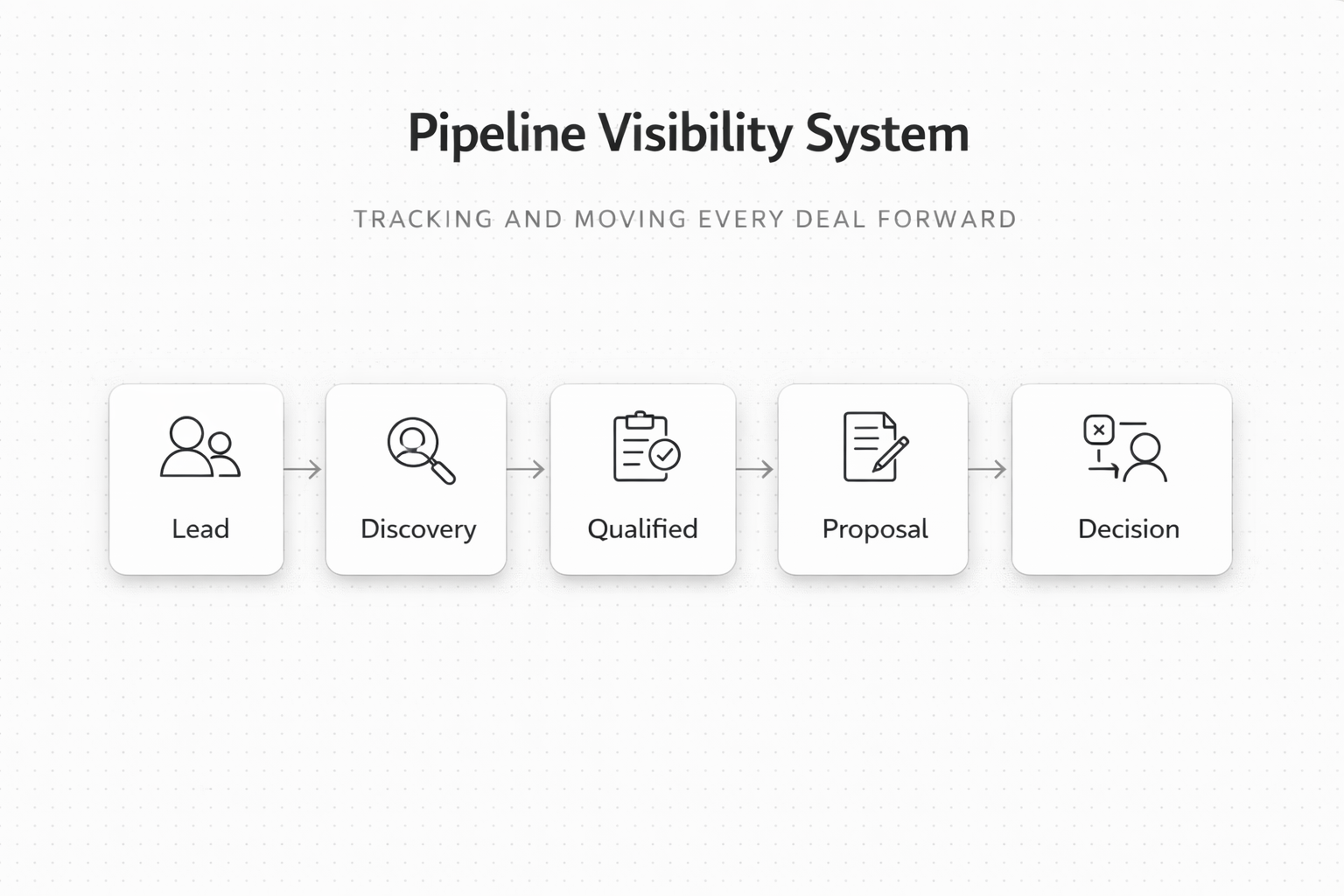
Step 2: Define Clear Stages
Each deal must have a stage.
For example:
- lead
- discovery
- qualified
- proposal
- decision
Step 3: Assign a Next Action
Every deal must have a defined next step.
Without exception.
Step 4: Set a Timeline
A next action without timing is meaningless.
Define when it will happen.
Step 5: Update After Every Interaction
A pipeline is only useful if it reflects reality.
Update consistently.
How Visibility Improves Conversion
When pipeline visibility improves:
- fewer deals are active
- but more deals move forward
This creates:
- higher conversion rates
- faster decisions
- more predictable outcomes
Visibility doesn’t increase opportunities.
It increases effectiveness.
How This Connects to the System
Pipeline visibility is not a standalone concept.
It connects everything:
- discovery → defines the opportunity
- qualification → filters it
- tracking → moves it
- proposals → convert it
- capacity → validates feasibility
This is part of the client pipeline system:
Without visibility:
- decisions become reactive
- pipeline becomes unstable
The Shift: From List to System
The real transformation is simple:
From:
a list of opportunities
To:
a system that produces outcomes
That shift happens when:
- every deal is visible
- every step is defined
- every action is intentional
Conclusion
Most freelancers don’t have a pipeline problem.
They have a visibility problem.
Deals don’t fail because they are bad.
They fail because they are not managed.
A visible pipeline creates control.
Control creates movement.
And movement creates predictable revenue.