Freelance Client Portfolio Strategy (How to Structure a Stable Client Mix)
Introduction
A freelance client portfolio strategy defines how freelancers structure their mix of clients to create stable, predictable revenue.
Many freelancers evaluate performance at the level of individual projects. However, long-term success depends on the composition of clients across the entire business.
Understanding client portfolio strategy for freelancers allows consultants to balance revenue, workload, and risk.
Within the Processome operating model, client portfolio strategy belongs to the → Client Pipeline System, which shapes the types of clients entering the business.
Without a structured approach, client portfolios develop randomly, often leading to instability and misalignment.
What Is a Freelance Client Portfolio Strategy?
A freelance client portfolio strategy is a structured approach to managing the mix of clients and engagements within a consulting business.
Instead of evaluating opportunities individually, freelancers assess how each client contributes to the overall portfolio.
Key considerations include:
- number of active clients
- distribution of revenue
- engagement types
- industry alignment
- revenue concentration
This approach transforms client acquisition from reactive to strategic.
Client portfolio strategy is closely connected to:
→ Freelance Lead Generation System
→ Client Acquisition Channels Compared
The Core Problem
Freelancers often acquire clients opportunistically.
New opportunities are evaluated individually rather than strategically.
This leads to several structural risks.
Revenue Concentration Risk
Dependence on one or two clients.
→ Revenue Concentration Risk Explained
Unbalanced Workload
Periods of overwork and inactivity.
Misaligned Client Types
Clients outside core expertise weaken positioning.
Pipeline Instability
Revenue fluctuates due to inconsistent client mix.
A structured freelance client portfolio strategy addresses these issues.
The Freelance Client Portfolio Framework
A strong client portfolio can be designed across four key dimensions.
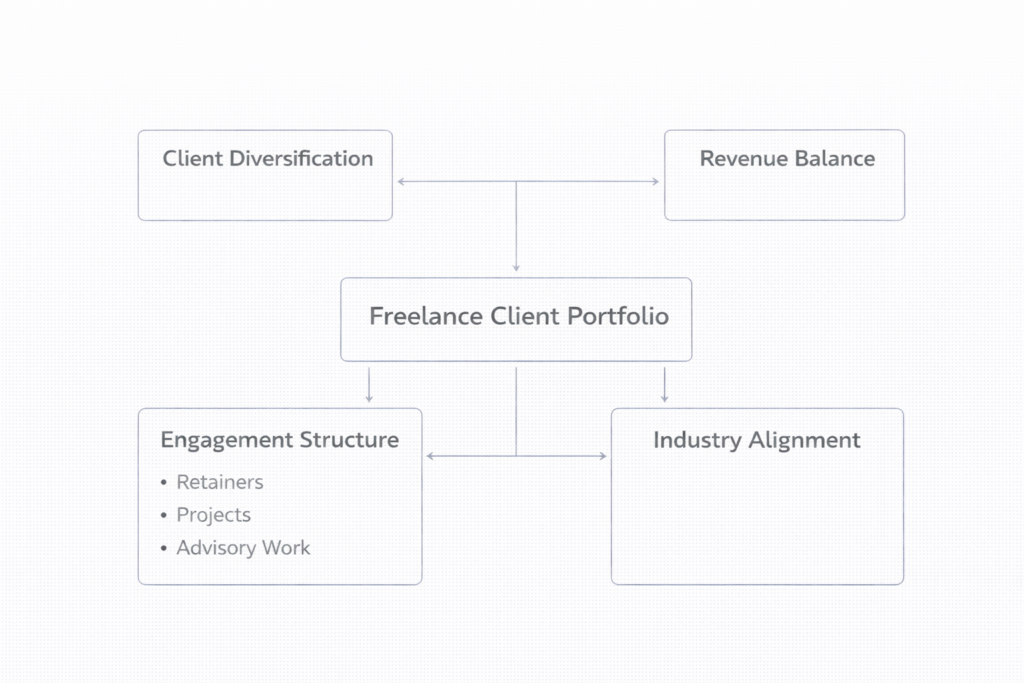
1. Client Diversification
Client diversification determines how many clients contribute to revenue.
Strategies include:
- maintaining multiple active clients
- balancing large and small engagements
- distributing revenue across organizations
Diversification reduces dependency risk.
2. Revenue Balance
Revenue balance defines how income is distributed.
A typical structure may include:
- one anchor client (stable revenue)
- several mid-sized projects
- occasional high-value engagements
Balanced revenue improves financial stability.
3. Engagement Structure
Different engagement types affect predictability.
Common types:
- retainers
- fixed-scope projects
- advisory work
A balanced mix improves both:
- revenue stability
- workload planning
→ Retainers vs Projects: Which Model Creates Stable Freelance Income
→ Revenue Mix Design for Solo Consultants
4. Industry Alignment
Industry focus strengthens:
- positioning
- referrals
- expertise
Aligned portfolios improve acquisition efficiency because:
future clients resemble past clients.
Designing Your Client Portfolio
To implement client portfolio management for freelancers, you should:
- define your ideal client mix
- identify revenue distribution targets
- balance engagement types
- align acquisition channels with portfolio goals
Your acquisition system determines your portfolio.
→ Where Freelancers Find B2B Clients
→ Referral Systems for Consultants
Operational Impact
A structured portfolio strategy improves:
Revenue Stability
Less dependency on individual clients.
Predictable Workload
Better capacity planning.
→ Capacity Planning for Freelancers Explained
→ Utilization Rate for Solo Consultants
Stronger Positioning
Clear specialization improves market perception.
Better Acquisition Focus
Freelancers pursue aligned opportunities.
System-Level Impact Across Processome
Client portfolio strategy influences:
- Client Pipeline System → opportunity selection
- Capacity Planning System → workload distribution
- Profit Tracking System → revenue diversification
- Delivery & Operations System → client stability
Common Failure Patterns
Overdependence on One Client
Creates financial risk.
Random Client Acquisition
Weakens positioning over time.
Ignoring Engagement Mix
Leads to unstable revenue patterns.
No Portfolio Review
Prevents strategic adjustment.
Strategic Outcome
When freelancers implement a client portfolio strategy:
- revenue becomes more stable
- workload becomes predictable
- positioning strengthens
- acquisition becomes intentional
The portfolio becomes a designed system rather than an accidental result.
Final Perspective
Freelance businesses are often built one client at a time. However, long-term stability depends on the structure of the entire client portfolio.
A freelance client portfolio strategy ensures that each new opportunity contributes to a balanced and sustainable business.
Within the Processome operating model, this strategy ensures that the Client Pipeline System continuously generates clients that strengthen the overall business structure.