Pipeline Velocity for Freelancers (How to Measure & Improve Sales Pipeline Speed)
Introduction
Pipeline velocity for freelancers measures how quickly opportunities move through the sales pipeline and convert into revenue.
Many freelancers focus on generating leads or sending proposals. However, even with a full pipeline, slow deal progression can delay revenue significantly.
Understanding sales pipeline velocity for freelancers is essential for building a predictable consulting business.
Within the Processome operating model, pipeline velocity is part of the → Client Pipeline System, the system responsible for converting opportunities into client engagements.
When managed correctly, pipeline velocity helps freelancers identify bottlenecks, improve conversion efficiency, and forecast revenue with greater accuracy.
What Is Pipeline Velocity?
Pipeline velocity measures the speed at which opportunities move through the pipeline and generate revenue.
A typical pipeline velocity formula includes:
- number of opportunities
- average deal value
- conversion rate
- sales cycle length
A simplified representation:
Pipeline Velocity =
(Opportunities × Deal Value × Win Rate) ÷ Sales Cycle Length
This shows that pipeline performance depends on both volume and speed.
Pipeline velocity is closely connected to:
→ Sales Process for Freelancers Explained
→ B2B Freelance Sales Metrics
The Core Problem
Many freelancers track pipeline volume but ignore pipeline speed.
Common metrics include:
- number of leads
- number of proposals
- number of clients
While useful, these do not reveal how efficiently deals progress.
Slow Deal Progression
Deals remain in stages too long.
Stalled Opportunities
Inactive deals inflate pipeline perception.
Revenue Timing Uncertainty
Freelancers cannot predict when deals will close.
Hidden Bottlenecks
Delays in specific stages remain unnoticed.
A structured approach to pipeline velocity for freelancers solves these issues.
The Pipeline Velocity Framework
Pipeline velocity can be analyzed across four key dimensions.
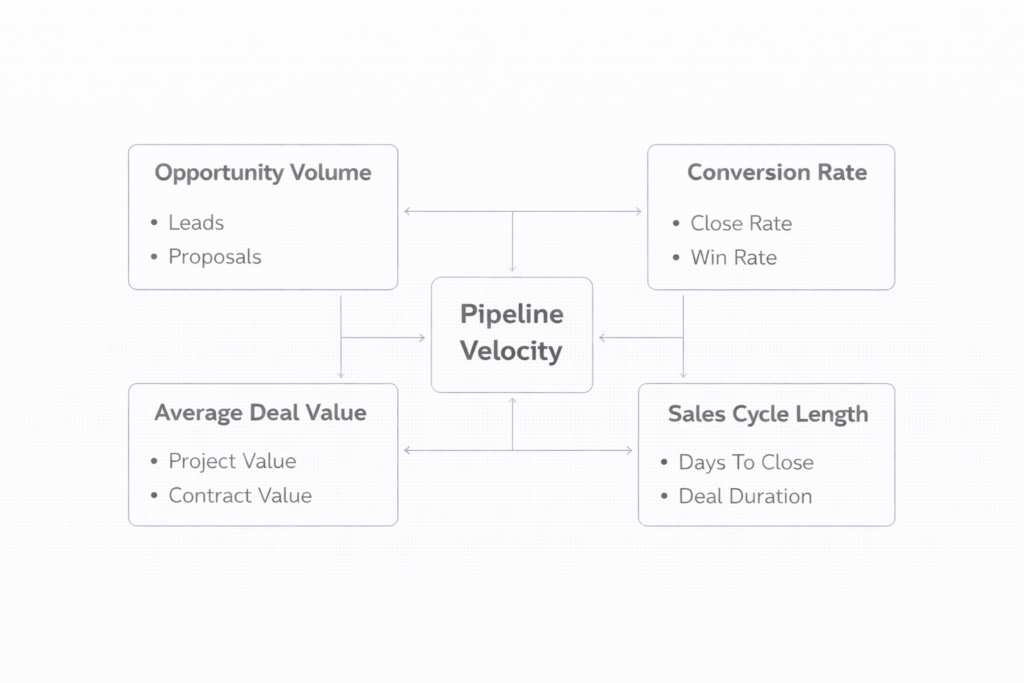
1. Opportunity Volume
This represents the number of active deals in the pipeline.
Driven by:
→ Freelance Lead Generation System
→ Where Freelancers Find B2B Clients
Without sufficient volume, velocity remains low.
2. Conversion Rate
Conversion rate measures how deals move between stages.
Examples:
- discovery → proposal
- proposal → closed
Improving conversion significantly increases pipeline velocity.
→ Client Qualification Framework for Freelancers
→ Structuring Freelance Proposals
3. Average Deal Value
Deal value affects revenue velocity.
Higher-value deals increase revenue output, but may slow down sales cycles.
Balancing value and speed is critical.
→ Revenue Mix Design for Solo Consultants
4. Sales Cycle Length
Sales cycle length measures how long deals take to close.
Long cycles reduce pipeline velocity.
Factors include:
- complexity
- stakeholders
- clarity
- responsiveness
Improving discovery and proposal clarity reduces cycle length.
How Pipeline Velocity Improves Forecasting
A strong understanding of pipeline velocity for consultants improves revenue forecasting.
Instead of asking:
“How much is in my pipeline?”
Freelancers can ask:
“How fast will this pipeline convert into revenue?”
This supports:
→ Forecasting Revenue from Your Pipeline
→ Weighted Revenue Forecasting for Freelancers
Operationalizing Pipeline Velocity
To measure pipeline velocity for freelancers, freelancers should:
- track deal stages consistently
- monitor time spent in each stage
- identify delays
- measure conversion rates
Supporting systems include:
→ Deal Tracking Systems for Freelancers
→ Simple CRM Setup for Freelancers
You can manage supporting tools here:
→ Client Pipeline System Tools
Operational Impact
A structured pipeline velocity framework improves:
Faster Deal Progression
Deals move more efficiently.
More Accurate Forecasting
Revenue timing becomes predictable.
Better Pipeline Health
Stalled deals are identified early.
Improved Capacity Planning
Workload can be anticipated.
System-Level Impact Across Processome
Pipeline velocity influences:
- Client Pipeline System → deal speed
- Capacity Planning System → workload timing
- Profit Tracking System → revenue accuracy
- Delivery & Operations System → onboarding readiness
Common Failure Patterns
Overestimating Pipeline Strength
Volume ≠ performance.
Ignoring Sales Cycle Length
Delays reduce velocity.
Inconsistent Tracking
Prevents accurate measurement.
Weak Qualification
Leads to stalled deals.
Strategic Outcome
When freelancers optimize pipeline velocity:
- deals close faster
- revenue becomes predictable
- pipeline efficiency improves
- planning becomes easier
Pipeline velocity becomes a core metric for managing freelance growth.
Final Perspective
Freelancers often focus on increasing pipeline volume, but volume alone does not determine performance.
The efficiency of a freelance sales system depends on how quickly opportunities convert into revenue.
Pipeline velocity for freelancers provides the missing link between pipeline activity and actual business outcomes.
Within the Processome operating model, it ensures that the Client Pipeline System operates at a predictable and efficient pace.