Sales Pipeline Stages for Freelancers (From Lead to Client)
Introduction
Sales pipeline stages for freelancers define how opportunities move from initial contact to closed client engagements.
Without a structured freelance sales pipeline, deals progress inconsistently, opportunities are lost, and conversion becomes difficult to predict.
For many freelancers, sales activity happens across emails, calls, and scattered notes without a clearly defined process.
This lack of structure reduces visibility into deal progress and makes forecasting unreliable.
A defined pipeline stage system introduces structure by clarifying:
- where each opportunity stands
- what actions are required next
- how likely a deal is to close
Within the Processome operating model, pipeline stages are part of the → Client Pipeline System, ensuring that every opportunity progresses through a consistent and measurable process.
What Are Sales Pipeline Stages?
Sales pipeline stages define the structured lifecycle of an opportunity as it moves from initial contact to deal closure.
Each stage represents a progressively stronger level of opportunity viability.
As deals advance:
- uncertainty decreases
- information quality improves
- probability of closing increases
Pipeline stages function as filters, not milestones.
Each stage answers a key question:
“Does this opportunity still meet the criteria required to progress?”
When stage definitions are clear, freelancers gain visibility into the true health of their pipeline.
Pipeline stages integrate with:
→ Client Qualification Framework for Freelancers
→ Deal Tracking Systems for Freelancers
The Core Problem
Many freelancers operate what is effectively a one-stage pipeline.
All opportunities exist under vague categories such as:
- “potential client”
- “ongoing conversation”
Deals remain there until they are either:
- converted
- abandoned
This creates several operational issues.
Limited Pipeline Visibility
It becomes difficult to distinguish early leads from real opportunities.
Weak Forecasting
Revenue projections become unreliable.
Lack of Decision Structure
Next steps are unclear.
Intake Instability
Unqualified opportunities remain in the pipeline too long.
When everything is “in progress,” the pipeline stops being a decision tool.
The Freelance Sales Pipeline Stage Framework
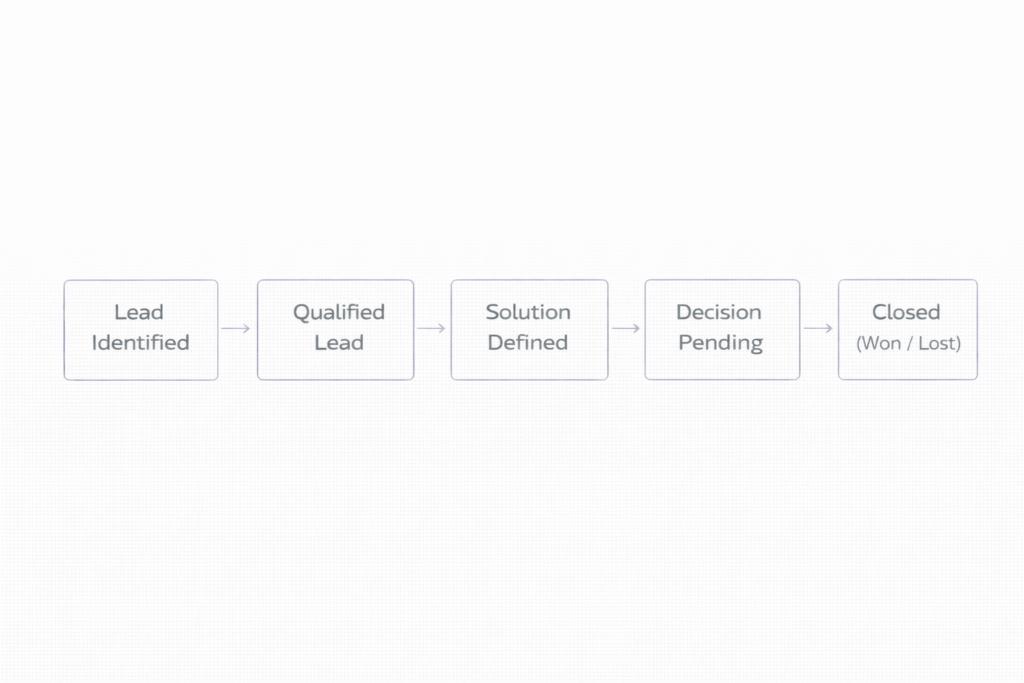
A structured freelance pipeline can be organized into five core stages.
1. Lead Identified
A potential opportunity has been identified.
Sources include:
- referrals
- inbound inquiries
- networking
- outbound outreach
At this stage:
- interest may exist
- fit is unknown
No revenue assumptions should be made.
2. Qualified Lead
The opportunity has passed initial qualification.
Criteria include:
- budget reality
- problem clarity
- decision authority
- scope containment
- timeline feasibility
This process is defined in:
→ How to Qualify Freelance Leads Strategically
Only qualified leads should progress further.
3. Solution Defined
The client’s problem is translated into a structured solution.
This includes:
- defined scope
- clear deliverables
- expected outcomes
- engagement structure
This stage typically leads to a proposal.
→ Structuring Freelance Proposals
4. Decision Pending
The proposal is under review.
This stage includes:
- client evaluation
- stakeholder input
- final clarifications
Follow-up practices are critical:
→ Proposal Follow-Up Strategies
If deals stall here, earlier stages are often weak.
5. Closed (Won or Lost)
The opportunity reaches a final outcome.
- Closed Won → project begins
- Closed Lost → opportunity rejected or postponed
Lost deals should be analyzed:
→ Close-Lost Analysis Framework for Freelancers
Operationalizing Pipeline Stages
Defining stages alone is not sufficient.
Freelancers must consistently track where each opportunity sits within the pipeline.
Without structured tracking, even well-defined stages lose effectiveness.
To support this, freelancers can use the tools available in:
→ Client Pipeline System Tools
These tools help maintain visibility across stages, track deal progress, and enforce consistent pipeline management.
Operational Impact
A structured pipeline improves:
Improved Pipeline Visibility
Clear understanding of deal status.
Reliable Revenue Forecasting
Each stage reflects a different probability of closing.
→ Weighted Revenue Forecasting for Freelancers
Better Capacity Planning
Pipeline visibility helps anticipate future workload.
System-Level Impact Across Processome
Pipeline stages influence:
- Client Pipeline System → structure
- Capacity Planning System → workload anticipation
- Profit Tracking System → revenue context
- Delivery & Operations System → onboarding preparation
Common Failure Patterns
Skipping Qualification
Moving directly to proposals weakens pipeline quality.
Treating Proposals as Commitments
Assuming deals are guaranteed leads to poor forecasting.
Keeping Stalled Deals Active
Inactive opportunities should be closed or requalified.
Inflating Pipeline Value
Overestimating deal probability creates unrealistic expectations.
Strategic Outcome
Clear pipeline stages lead to:
- improved revenue visibility
- more accurate forecasting
- better intake discipline
- reduced delivery pressure
Over time, the pipeline becomes a control system, not just a list of leads.
Final Perspective
Sales pipelines are often treated as tracking tools. In freelance consulting, they function as operational control systems.
Pipeline stages determine:
- which opportunities enter the business
- how reliably revenue can be forecast
- how workload can be planned
Within Processome, structured stages ensure that the Client Pipeline System produces reliable inputs for capacity, profit, and delivery systems.
Without them, the pipeline becomes descriptive rather than operational.