Capacity Planning Metrics for Consultants (Track Workload & Utilization)
Introduction
Capacity planning is a core operational responsibility in freelance consulting. Managing multiple clients, overlapping projects, and variable delivery demand requires clear visibility into how consulting capacity is being used.
Capacity planning metrics for consultants provide the structure needed to evaluate workload objectively rather than relying on intuition.
Within the Processome operating model, capacity measurement belongs to the Capacity Planning System — the framework responsible for structuring how consulting capacity is allocated across time and clients.
Without measurement, workload decisions remain informal. With structured metrics, freelancers gain visibility into capacity usage, delivery risk, and future workload.
What are Capacity Planning Metrics?
Capacity planning metrics are structured indicators used to measure how consulting capacity is:
- allocated across clients
- utilized over time
- projected into the future
Instead of tracking only hours worked, these metrics evaluate:
- utilization levels
- client concentration
- future workload demand
They help answer key questions:
- Is my workload sustainable?
- Can I accept new work?
- Where is delivery risk increasing?
Capacity metrics transform capacity planning into a measurable system.
The Core Problem
Many freelancers evaluate workload based only on working hours.
While this provides basic visibility, it does not reveal structural capacity dynamics.
Several blind spots emerge.
No Visibility into Capacity Utilization
Hours worked are not compared to total available capacity.
Hidden Client Dependency
Workload may rely heavily on a single client without visibility.
Unpredictable Workload Changes
Future demand from pipeline activity is not tracked.
Lack of Benchmarks
Freelancers rarely compare workload to target ranges such as utilization thresholds.
These issues occur when time tracking replaces structured capacity measurement.
Capacity Planning Metrics Framework
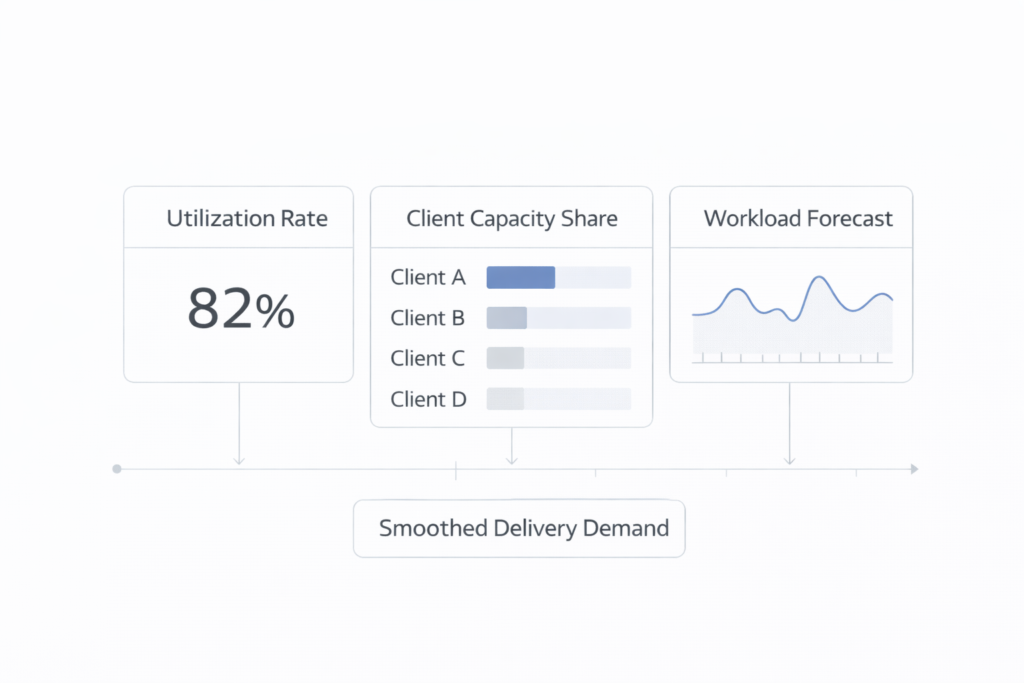
A structured model tracks three core metrics.
1. Capacity Utilization Rate
This measures how much of available capacity is allocated to client work.
| Weekly Capacity | Client Work | Utilization Rate |
|---|---|---|
| 40 hours | 30 hours | 75% |
Typical ranges:
- 60–70% → high flexibility
- 70–85% → balanced workload
- 85–100% → high pressure
→ Utilization Rate for Solo Consultants
2. Client Capacity Share
This measures how capacity is distributed across clients.
| Client | Weekly Hours | Capacity Share |
|---|---|---|
| Client A | 16h | 40% |
| Client B | 12h | 30% |
| Client C | 8h | 20% |
| Client D | 4h | 10% |
This reveals dependency risk.
→ Workload Distribution Across Clients
3. Forecasted Workload
This estimates how future work affects capacity.
| Week | Confirmed Work | Forecasted Work | Total Capacity Usage |
|---|---|---|---|
| Week 1 | 70% | 10% | 80% |
| Week 2 | 65% | 20% | 85% |
| Week 3 | 50% | 30% | 80% |
This provides early warning of overload.
→ Freelance Workload Forecasting
Operational Impact
Tracking capacity metrics improves several operational dimensions.
Capacity Visibility
Freelancers understand how capacity is used and distributed.
Delivery Stability
Future overload becomes visible before it occurs.
Opportunity Evaluation
New work can be assessed against capacity limits.
Portfolio Balance
Workload distribution across clients becomes measurable.
If you want to evaluate your current capacity and workload structure:
→ Use the Freelance Capacity Planner
To track time, monitor workload, and maintain visibility across clients and projects, tools that support:
- time tracking
- planning
- reporting
can help structure your workflow.
→ Explore Time & Capacity Tools for Freelancers
System-Level Impact Across Processome
Capacity metrics connect multiple systems.
- Client Pipeline System → future demand signals
- Capacity Planning System → utilization measurement
- Profit Tracking System → revenue forecasting
- Delivery & Operations System → scheduling stability
Measurement improves coordination across systems.
Common Failure Patterns
Freelancers often struggle due to recurring mistakes.
Tracking Only Hours
Time tracking does not reveal capacity structure.
Ignoring Client Concentration
Dependency risk remains hidden.
No Forward-Looking Metrics
Future workload is not anticipated.
Overreacting to Short-Term Changes
Metrics should be evaluated over time, not daily fluctuations.
These patterns reduce decision quality.
Strategic Outcome
When capacity metrics are used consistently, freelancers gain stronger operational control.
- Improved workload planning
Capacity becomes measurable - Better decision-making
Intake decisions become clearer - Reduced operational risk
Problems become visible early
Over time, consulting becomes data-informed rather than reactive.
Final Perspective
Freelancers often focus on managing projects.
However, stable consulting operations require visibility into how capacity is structured and evolving.
Within the Processome operating model, the Capacity Planning System defines how workload is allocated.
Capacity planning metrics provide the measurement layer that makes this system actionable.
What gets measured can be controlled.