How to Manage Workload as a Freelancer (Without Burnout or Overload)
Introduction
Freelancers often struggle with inconsistent workload.
At times there is too little work. At other times, too many clients and deadlines create overload and stress.
Learning how to manage workload as a freelancer requires more than reacting to incoming work. It requires designing a structure that keeps delivery stable while maintaining long-term sustainability.
Within the Processome operating model, workload sustainability belongs to the Capacity Planning System — the execution engine responsible for aligning delivery commitments with realistic capacity constraints.
Rather than maximizing short-term output, sustainable workload management prioritizes operational stability and consistent delivery performance.
What is Workload Management for Freelancers?
Workload management for freelancers is the process of structuring client work so that delivery commitments remain compatible with available capacity over time.
Instead of accepting work reactively, freelancers define:
- how much work can be delivered sustainably
- how client engagements are distributed
- how much buffer capacity is required
- how workload evolves over time
This transforms workload from a reactive outcome into a designed system.
The Core Problem
Many freelancers treat workload as a reactive result of incoming projects rather than as a structured system.
Typical patterns include:
- accepting work whenever it appears
- increasing working hours during busy periods
- reducing workload only after exhaustion
While this may temporarily increase revenue, it produces several structural problems.
Delivery Instability
High workload reduces attention to detail and affects delivery quality.
Client Experience Decline
Delayed communication and missed deadlines occur when capacity is exceeded.
Margin Erosion
Overload often generates unpaid work and inefficient delivery.
Burnout Cycles
Repeated overwork reduces long-term productivity.
These patterns emerge when workload grows without capacity design.
The Sustainable Workload Design Framework
A sustainable freelance workload depends on four structural elements.
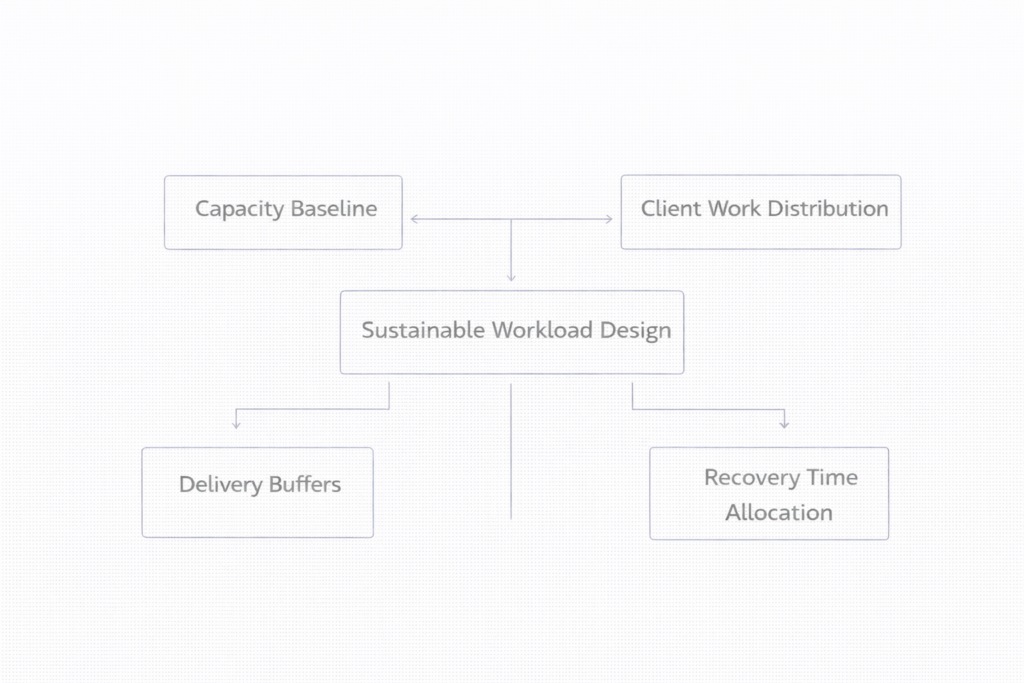
1. Capacity Baseline
Workload management starts with understanding delivery capacity.
This includes:
- total available working hours
- non-billable activities
- realistic delivery capacity
→ Capacity Planning for Freelancers Explained
Without a clear capacity baseline, workload cannot be managed effectively.
2. Client Work Distribution
Client engagements must be distributed across available capacity.
This includes evaluating:
- number of active clients
- workload intensity per client
- overlap between projects
→ How Many Clients Can a Freelancer Handle
→ Workload Distribution Across Clients
Balanced distribution reduces workload spikes.
3. Delivery Buffers
Buffer capacity absorbs variability in project execution.
Typical sources of variation include:
- revisions
- unexpected complexity
- delayed feedback
→ Delivery Buffer Design for Freelancers
Buffers prevent small disruptions from escalating into overload.
4. Recovery Time Allocation
Sustainable workload requires recovery capacity.
This allows freelancers to:
- maintain cognitive performance
- evaluate ongoing work
- prepare future pipeline activity
Ignoring recovery time leads to long-term productivity decline.
Operational Impact
Designing workload deliberately improves several operational dimensions.
Stable Delivery Performance
Workloads remain aligned with realistic capacity.
Improved Client Relationships
Freelancers respond more effectively with sufficient time and focus.
Higher Long-Term Productivity
Avoiding burnout preserves consistent output.
If you’re unsure whether your current workload is sustainable:
→ Use the Freelance Capacity Planner
To maintain visibility into workload, time allocation, and ongoing capacity, tools that support:
- time tracking
- workload planning
can help structure your workflow.
→ Explore Time & Capacity Tools for Freelancers
System-Level Impact Across Processome
Workload management connects multiple systems.
- Client Pipeline System → intake discipline
- Capacity Planning System → workload control
- Profit Tracking System → revenue balance
- Delivery & Operations System → execution stability
These systems work together to maintain sustainable operations.
Common Failure Patterns
Freelancers often experience unsustainable workloads due to recurring mistakes.
Overcommitting to Clients
Accepting more work than capacity allows.
Ignoring Capacity Buffers
Operating at full capacity removes flexibility.
Increasing Hours Instead of Redesigning Workload
Working more temporarily solves overload but creates long-term risk.
Underestimating Cognitive Load
Complex work requires more than time alone.
These patterns gradually destabilize workload sustainability.
Strategic Outcome
When freelancers manage workload as a structured system, several advantages emerge.
- Consistent delivery quality
Work receives proper attention - Improved work-life balance
Workload aligns with personal capacity - Stable client relationships
Communication and execution improve - Reliable long-term revenue
Delivery capacity remains consistent
Over time, workload management becomes a controlled system rather than a reactive process.
Final Perspective
Freelancers often attempt to increase revenue by accepting more work.
Sustainable consulting businesses are built differently.
They are built by structuring workload around capacity.
Within the Processome operating model, the Capacity Planning System ensures that delivery commitments remain sustainable over time.
Sustainability is not achieved by working harder.
It is achieved by structuring work intelligently.