Profit Forecasting from Pipeline Data (How to Estimate Freelance Profit)
Introduction
Profit forecasting from pipeline data helps freelancers estimate how much of their future revenue will actually convert into profit.
Many freelancers forecast revenue based on their sales pipeline. They estimate deal values, expected closing dates, and potential monthly income.
However, revenue forecasts alone do not reveal the financial outcome of those opportunities.
Two pipelines with identical revenue projections can produce very different profit outcomes depending on:
- delivery intensity
- project structure
- client behavior
- operational cost structure
Within the Processome operating model, financial forecasting belongs to the → Profit Tracking System—the financial intelligence layer responsible for translating revenue expectations into realistic financial outcomes.
Revenue forecasting estimates opportunity.
Profit forecasting estimates sustainability.
What is Profit Forecasting from Pipeline Data?
Profit forecasting from pipeline data converts expected sales opportunities into estimated financial outcomes.
Instead of evaluating pipeline value alone, freelancers estimate:
- the revenue likely to be generated
- the delivery effort required
- the resulting contribution margin
The process transforms pipeline visibility into financial planning insight.
Profit forecasting builds on several existing metrics within the Processome system.
The starting point is weighted revenue forecasting:
→ Weighted Revenue Forecasting for Freelancers
Weighted revenue estimates the realistic portion of pipeline opportunities expected to close.
From there, operational factors determine the expected profitability of that revenue.
The Core Problem
Freelancers often evaluate their pipeline by focusing on total deal value.
Typical pipeline questions include:
- How much revenue is currently in the pipeline?
- What deals are likely to close this month?
- What is the expected revenue for the next quarter?
While these questions are useful, they overlook an important factor: profitability varies significantly across projects.
Several structural differences affect the relationship between revenue and profit.
Delivery Effort Variability
Projects may require very different levels of time and effort to complete.
Coordination Overhead
Some engagements involve complex communication and stakeholder management.
Revision Cycles
Projects with extensive revisions often require additional delivery time.
Cost Structure Differences
Subcontractors, tools, or external services may affect project profitability.
When revenue forecasting ignores these variables, financial projections become incomplete.
Strong revenue forecasts can still produce weak profit months.
Profit Forecasting Framework
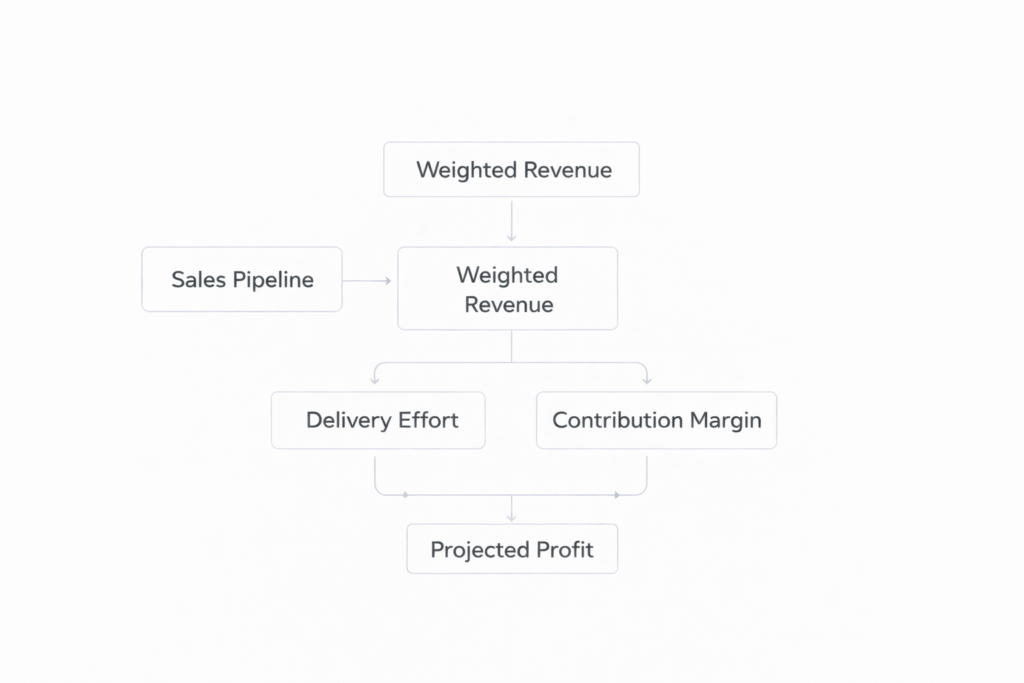
Profit forecasting from pipeline data involves four analytical steps.
1. Weighted Revenue Forecast
Profit forecasting begins with probability-adjusted revenue.
Example:
| Project | Deal Value | Probability | Weighted Revenue |
|---|---|---|---|
| Project A | €10,000 | 70% | €7,000 |
| Project B | €6,000 | 40% | €2,400 |
Weighted forecasting produces a more realistic starting point than raw pipeline totals.
→ Weighted Revenue Forecasting for Freelancers
2. Delivery Effort Estimation
Revenue projections must then be translated into expected delivery effort.
Typical variables include:
- project delivery hours
- coordination and meetings
- revision cycles
Delivery effort estimation connects directly with:
→ Freelance Capacity Model (Hours vs Revenue)
→ Capacity Forecasting from Pipeline Data
Execution effort determines whether revenue translates into profitable work.
3. Contribution Margin Modeling
Once delivery effort is estimated, freelancers can approximate contribution margin.
Contribution margin represents the revenue remaining after delivery costs.
→ Contribution Margin in Freelance Businesses
Not all revenue contributes equally to profit.
Projects with similar revenue may produce very different margins.
4. Client Profitability Patterns
Profit forecasts become more accurate when historical client behavior is considered.
Some clients typically generate:
- predictable delivery effort
- minimal coordination overhead
- stable margins
Others consistently produce hidden effort.
→ Client Profitability Analysis for Freelancers
Incorporating these patterns improves forecast reliability.
Operational Impact
Profit forecasting improves several strategic decisions within a freelance consulting business.
Financial Planning
Freelancers gain visibility into whether upcoming work will produce sustainable profit levels.
Pricing Decisions
Weak projected margins may indicate the need for pricing adjustments.
Client Selection
Consultants can prioritize pipeline opportunities with stronger profitability potential.
Capacity Allocation
Workload planning can focus on projects that produce higher financial returns.
Profit forecasting links pipeline visibility with financial decision-making.
System-Level Impact Across Processome
Profit forecasting connects multiple operational systems within the Processome architecture.
- Client Pipeline System → pipeline opportunities translated into revenue expectations
- Capacity Planning System → estimation of delivery workload for forecasted deals
- Profit Tracking System → modeling expected contribution margins
- Delivery & Operations System → preparation for upcoming project execution
Integrating pipeline data with profit forecasting improves coordination between sales activity, delivery planning, and financial management.
Common Failure Patterns
Freelancers often undermine profit forecasting through overly simplified assumptions.
Several recurring mistakes appear.
Relying on Pipeline Totals
Raw pipeline value often exaggerates future revenue expectations.
Ignoring Delivery Effort
Revenue projections sometimes exclude the time required to complete the work.
Assuming Uniform Margins
Freelancers may assume that all projects generate similar profitability.
Forecasting Beyond Capacity
Pipeline forecasts may exceed the freelancer’s realistic delivery capacity.
These behaviors produce overly optimistic financial projections.
Profit forecasting should remain conservative.
Strategic Outcome
When freelancers integrate profit forecasting with pipeline analysis, financial planning becomes significantly more accurate.
Instead of reacting to revenue fluctuations, consultants anticipate how upcoming deals will affect profitability.
This produces several advantages.
- Improved financial visibility → expected profit becomes visible before projects begin
- More realistic revenue expectations → grounded in delivery effort and margin analysis
- Better strategic decision-making → adjust pricing, pipeline, and client selection proactively
Over time, profit forecasting transforms pipeline visibility into financial intelligence.
Final Perspective
Revenue forecasting predicts how much work may be sold.
Profit forecasting predicts how much value that work will create.
Within the Processome operating model, the → Profit Tracking System converts pipeline visibility into realistic financial expectations.
By integrating revenue projections, delivery effort, and margin analysis, freelancers gain a clearer view of the sustainability of their consulting business.
Revenue forecasting measures activity.
Profit forecasting measures outcome.