How Many Clients Can a Freelancer Handle? (Capacity-Based Answer)
Introduction
One of the most common operational questions freelancers ask is simple:
How many clients can a freelancer realistically handle at the same time?
The answer is rarely a fixed number. Capacity is not determined by client count alone, but by how much delivery workload each client requires.
Within the Processome operating model, this question belongs to the Capacity Planning System — the execution framework responsible for aligning client demand with available consulting capacity.
For solo consultants, managing multiple clients requires balancing delivery commitments, project timelines, and operational workload. Accepting too many clients creates delivery pressure and scheduling instability. Accepting too few leads to underutilized capacity and inconsistent revenue.
The correct approach is not to define a client limit.
It is to understand how capacity is allocated across clients.
What is Freelancer Client Capacity?
Freelancer client capacity refers to how many clients can be supported based on available delivery capacity — not client count alone.
Instead of counting clients, freelancers should evaluate:
- how much delivery capacity each client consumes
- how client timelines interact
- how much operational overhead each relationship requires
This shifts the question from:
“How many clients can I handle?”
to:
“How much capacity does each client consume?”
For example, a freelancer with 30 hours of weekly execution capacity may allocate workload as follows:
| Client | Weekly Hours | Capacity Share |
|---|---|---|
| Client A | 12h | 40% |
| Client B | 8h | 27% |
| Client C | 6h | 20% |
| Client D | 4h | 13% |
In this scenario, four clients represent a balanced workload.
However, if one client requires 20 hours per week, the total number of manageable clients decreases significantly.
This concept connects closely with:
→ Workload Distribution Across Clients
→ Utilization Rate for Solo Consultants
Together, these models help evaluate client capacity realistically.
Capacity allocation becomes clearer when modeled explicitly:→ Use the Freelance Capacity Planner
This tool evaluates whether your current and expected workload fits within your available capacity.
The Core Problem
Many freelancers attempt to answer this question using simple assumptions.
Common approaches include:
- choosing an arbitrary client limit
- estimating based on past experience
- accepting clients until the schedule feels full
These approaches ignore how consulting workload actually functions.
Several structural factors determine how many clients a freelancer can handle.
Workload Variability
Different clients require different levels of delivery effort.
For example:
| Client Type | Typical Workload |
|---|---|
| Advisory client | Low |
| Retainer client | Medium |
| Large project | High |
A freelancer may handle several advisory clients simultaneously but struggle to manage multiple large projects at once.
Timeline Overlap
Projects rarely progress at identical speeds.
When several projects reach high-intensity phases simultaneously, delivery pressure increases.
Coordination Overhead
Each additional client increases communication, meetings, and coordination time.
This overhead reduces available delivery capacity.
Capacity Miscalculation
Freelancers often evaluate workload through working hours without subtracting operational activities such as administration and sales.
These factors make simple client limits unreliable.
Freelance Client Capacity Model
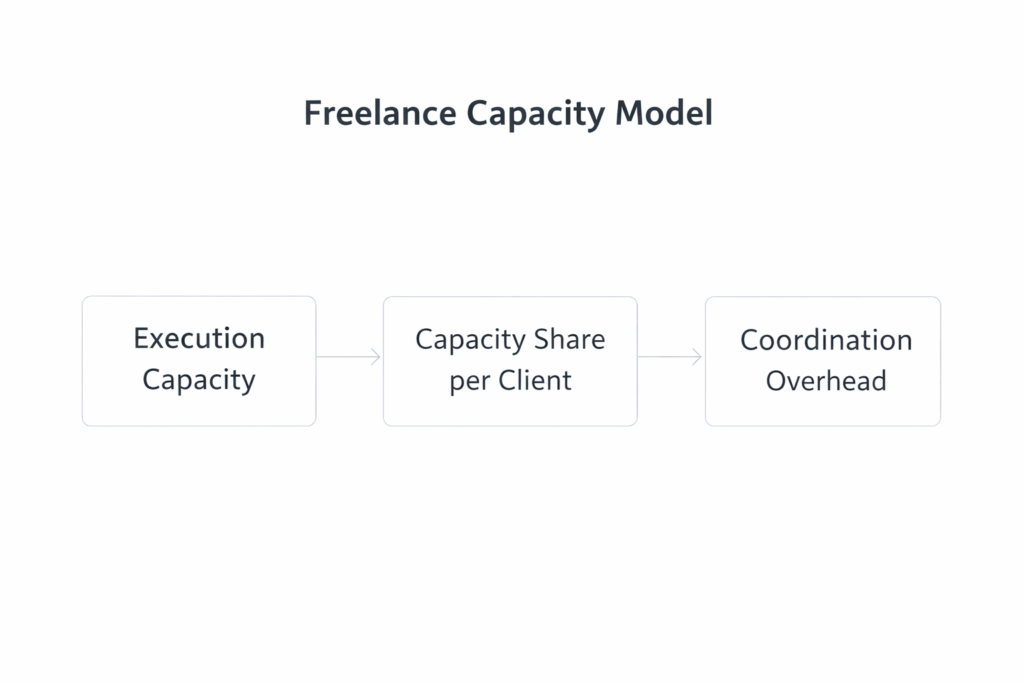
A structured client capacity model evaluates three operational dimensions.
1. Execution Capacity
The starting point is determining true delivery capacity.
Execution capacity represents the portion of working time available for client work after subtracting operational activities.
For many freelancers this ranges between 25–35 delivery hours per week.
Capacity modeling methods are explained in:
→ Freelance Capacity Model (Hours vs Revenue)
2. Capacity Share per Client
Each client consumes a portion of available delivery capacity.
Example:
| Client | Capacity Share |
|---|---|
| Client A | 40% |
| Client B | 30% |
| Client C | 20% |
| Client D | 10% |
When one client exceeds 50% of total capacity, dependency risk increases significantly.
Capacity distribution is discussed further in:
→ Workload Distribution Across Clients
3. Coordination Overhead
Each client relationship requires time for:
- meetings
- communication
- feedback cycles
- reporting
As the number of clients increases, coordination overhead grows.
This overhead must be included in capacity planning.
Operational Impact
Understanding client capacity improves several operational aspects of a freelance consulting business.
Delivery Stability
Balanced client portfolios reduce the risk of delivery overload.
Revenue Diversification
Multiple clients distribute revenue sources more evenly.
Workload Predictability
Capacity planning prevents sudden scheduling pressure caused by excessive client commitments.
Client Relationship Quality
Freelancers maintain sufficient attention for each client engagement.
To manage multiple clients effectively over time, tools that support:
- workload planning
- time tracking
- capacity allocation
can help maintain balance across client engagements.
→ Explore Time & Capacity Tools for Freelancers
System-Level Impact Across Processome
Client portfolio size influences coordination between pipeline demand, delivery capacity, and workload stability within the Processome operating architecture.
- Client Pipeline System → client acquisition balanced with delivery feasibility
- Capacity Planning System → allocation of consulting capacity across multiple clients
- Profit Tracking System → revenue diversification and client concentration visibility
- Delivery & Operations System → stable management of concurrent client engagements
Understanding client capacity improves coordination between client acquisition, workload planning, and delivery execution.
Common Failure Patterns
Freelancers often miscalculate client capacity due to several common assumptions.
Counting Clients Instead of Capacity
Managing workload by limiting client count instead of evaluating delivery capacity.
Ignoring Project Intensity
Not all client engagements require equal effort.
Large projects can consume significantly more capacity than advisory relationships.
Accepting Clients Opportunistically
New clients are accepted whenever opportunities appear, without evaluating how delivery timelines interact.
Underestimating Coordination Work
Meetings and communication can consume substantial time when several clients are active simultaneously.
Strategic Outcome
When freelancers manage client portfolios through structured capacity planning, consulting operations become significantly more stable.
Instead of reacting to delivery pressure, freelancers control how capacity is distributed across clients.
This produces several advantages.
- Balanced client portfolios
Workload remains manageable even with multiple concurrent clients. - Reduced dependency risk
Revenue is distributed across several relationships. - Predictable delivery schedules
Client commitments remain aligned with available capacity.
Over time, freelancers transition from client accumulation to portfolio design.
Final Perspective
The question “How many clients can a freelancer handle?” does not have a universal answer.
The real constraint is not client count, but how much consulting capacity each client consumes.Within the Processome operating model, the Capacity Planning System ensures that client demand is evaluated against realistic delivery capacity. By structuring client portfolios around capacity constraints, freelancers create consulting businesses that remain both scalable and sustainable.
Managing client count is therefore not about limiting growth.
It is about allocating finite capacity intelligently.