Overbooking Prevention for Freelancers: How to Avoid Taking on Too Much Work
Introduction
Overbooking is one of the most common operational risks in freelance consulting.
When new opportunities appear, freelancers often accept additional work before evaluating how those commitments interact with existing delivery obligations.
In the short term, overbooking appears productive. The pipeline grows, revenue expectations increase, and the calendar fills quickly.
However, without structured capacity controls, overbooking introduces delivery pressure that eventually destabilizes consulting operations.
Within the Processome operating model, overbooking prevention belongs to the Capacity Planning System — the execution framework responsible for ensuring that incoming demand remains aligned with delivery feasibility.
For solo consultants, preventing overbooking is not a matter of tracking workload.
It requires a decision framework that controls when new work can be accepted.
Revenue creates opportunity.
Capacity determines feasibility.
What is Overbooking Prevention?
Overbooking prevention is the structured control of client intake based on available delivery capacity.
Instead of accepting work reactively, freelancers evaluate whether new engagements can be integrated into the delivery schedule without exceeding sustainable utilization levels.
This requires visibility into:
- structural delivery capacity
- current client commitments
- pipeline opportunities that may convert into projects
- expected project timelines
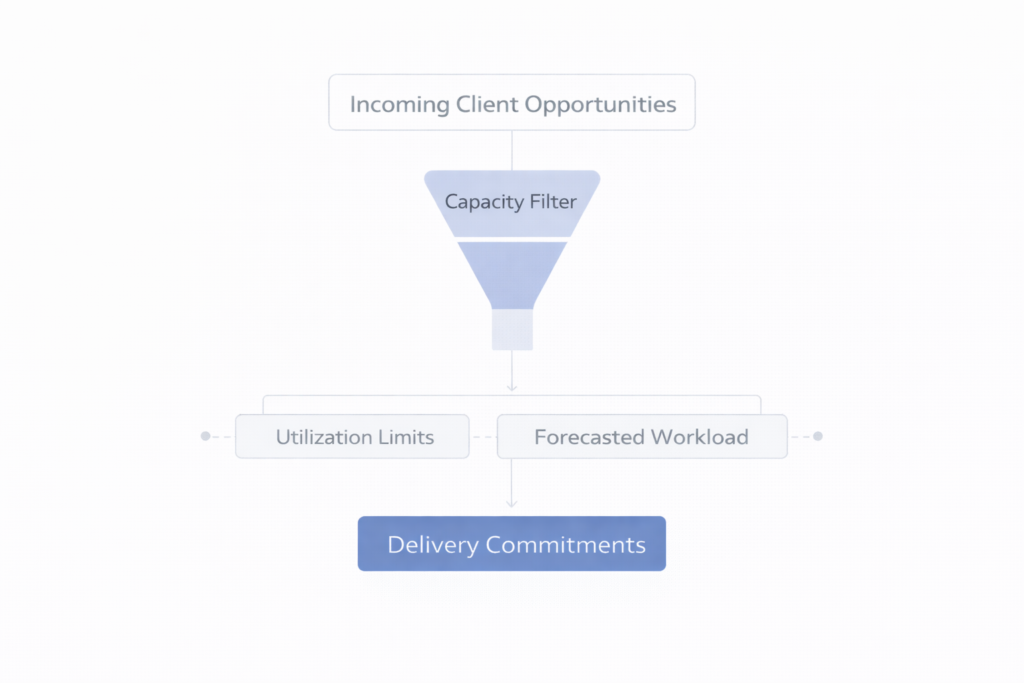
Overbooking prevention acts as an intake filter between sales and delivery.
If forecasted workload exceeds safe capacity levels, upstream decisions must change.
These adjustments may include:
- delaying project start dates
- tightening client qualification criteria
- increasing pricing thresholds
This intake control mechanism connects closely with:
→ Freelance Workload Forecasting
→ Utilization Rate for Solo Consultants
Together, these frameworks help anticipate workload pressure before commitments are made.
The Core Problem
Many freelancers accept new work based on opportunity timing rather than capacity availability.
When a potential client appears, the decision process often focuses on revenue potential rather than delivery feasibility.
Several structural factors contribute to overbooking.
Optimistic Capacity Assumptions
Freelancers assume that future capacity will become available by the time a project begins.
If several projects start earlier than expected, delivery pressure increases rapidly.
Pipeline Conversion Clusters
Multiple deals may close within a short period.
Without capacity planning, this creates sudden delivery overload.
Compressed Timelines
Clients often request accelerated start dates.
Accepting these timelines without evaluating existing commitments increases scheduling pressure.
Incremental Overload
Overbooking rarely occurs through a single large decision.
It emerges gradually as freelancers add “one more project” or “one more retainer.”
Each additional commitment increases workload pressure.
Overbooking Prevention Framework
Preventing overbooking requires monitoring three operational checkpoints.
1. Current Capacity Allocation
The first step is evaluating how much delivery capacity is already committed.
Example:
| Structural Capacity | Allocated Work | Utilization |
|---|---|---|
| 120 hours/month | 84 hours | 70% |
This establishes the baseline workload level.
Capacity planning principles are explained in:
→ Capacity Planning for Freelancers Explained
2. Forecasted Workload
Pipeline opportunities may convert into new projects in the near future.
If forecasted workload pushes utilization beyond safe levels, accepting additional work will create delivery pressure.
Forecasting models are discussed in:
→ Freelance Workload Forecasting
3. Intake Decision Control
Once current and forecasted workload are evaluated, intake decisions must follow capacity constraints.
Possible actions include:
- delaying project start dates
- declining opportunities
- adjusting pricing thresholds
Capacity — not revenue pressure — must guide these decisions.
To evaluate whether new work fits within your current and projected capacity:
→ Use the Freelance Capacity Planner
This helps determine if your workload is within safe limits before accepting additional commitments.
Operational Impact
Preventing overbooking improves several operational aspects of freelance consulting businesses.
Delivery Stability
Workloads remain realistic and executable.
Client Experience
Projects progress according to planned timelines without delays caused by overloaded schedules.
Revenue Quality
Controlled intake supports stronger pricing decisions and avoids reactive discounting.
Workload Sustainability
Consultants avoid periods of extreme delivery pressure.
To prevent overbooking consistently, tools that support:
- workload planning
- pipeline visibility
- capacity tracking
can help structure intake decisions over time.
→ Explore Time & Capacity Tools for Freelancers
System-Level Impact Across Processome
Overbooking prevention influences coordination between pipeline demand, delivery capacity, and workload stability within the Processome operating architecture.
- Client Pipeline System → opportunity intake filtered by capacity constraints
- Capacity Planning System → workload allocation within safe utilization limits
- Profit Tracking System → revenue stability through controlled client intake
- Delivery & Operations System → stable project execution schedules
Preventing overbooking improves coordination between sales activity, capacity planning, and delivery operations.
Common Failure Patterns
Freelancers often experience overbooking because intake decisions are made without explicit capacity constraints.
Several recurring mistakes appear.
Accepting Work Opportunistically
Projects are accepted whenever opportunities appear rather than when capacity is available.
Ignoring Forecasted Workload
Pipeline opportunities are excluded from capacity evaluations until deals close.
Selling Future Capacity
Freelancers assume that future availability will solve current overload risk.
Gradual Scope Expansion
Existing clients request additional work that slowly increases delivery pressure.
Overbooking typically emerges through these incremental decisions rather than a single major commitment.
Strategic Outcome
When overbooking prevention becomes part of the consulting workflow, freelancers gain greater control over their delivery schedule.
Instead of reacting to workload pressure, consultants filter client demand through explicit capacity constraints.
This produces several advantages.
- Stable delivery timelines
Projects progress without unexpected delays - Improved pricing discipline
Freelancers avoid accepting underpriced work under pressure - Predictable workload patterns
Capacity utilization remains within sustainable limits
Over time, the consulting business transitions from reactive intake decisions to controlled workload management.
Final Perspective
Freelancers often assume that accepting more work automatically leads to business growth.
In reality, uncontrolled intake decisions create delivery instability and operational stress.
Within the Processome operating model, the Capacity Planning System ensures that incoming client demand remains aligned with realistic execution capacity. The overbooking prevention framework acts as a control mechanism that filters opportunities before they become delivery commitments.
Growth does not come from accepting every opportunity.
It comes from accepting only the work that can be delivered sustainably.