Workload Risk Management for Freelancers
Introduction
Freelance consulting businesses operate with a fundamental constraint: a single individual must deliver all client work. This makes delivery capacity limited and sensitive to disruption.
Workload risk management for freelancers focuses on identifying structural risks in how work is distributed — not just how much work exists.
Within the Processome operating model, workload risk management belongs to the Capacity Planning System — the framework responsible for structuring how consulting capacity is allocated across clients and projects.
Without structured risk awareness, vulnerabilities remain hidden until they disrupt delivery. With it, freelancers can maintain stable operations despite changing client demand.
What is Workload Risk Management?
Workload risk management is the process of identifying and reducing risks that may destabilize delivery capacity or revenue.
Instead of focusing only on workload volume, freelancers evaluate:
- how capacity is distributed across clients
- how close they are to full utilization
- how projects interact across time
- how pipeline uncertainty affects future workload
The goal is to design a workload structure that remains stable under changing conditions.
The Core Problem
Many freelancers evaluate workload based only on current client commitments.
This provides visibility into active work but not into underlying risks.
Several structural risks commonly appear.
Client Dependency Risk
A large portion of capacity depends on a single client.
Delivery Overload Risk
Utilization is too high, leaving no margin for variability.
Timeline Collision Risk
Projects reach critical phases at the same time.
Pipeline Uncertainty
Future workload depends on deals that may or may not close.
These risks emerge when workload is managed as scheduling rather than as a system.
Workload Risk Management Framework
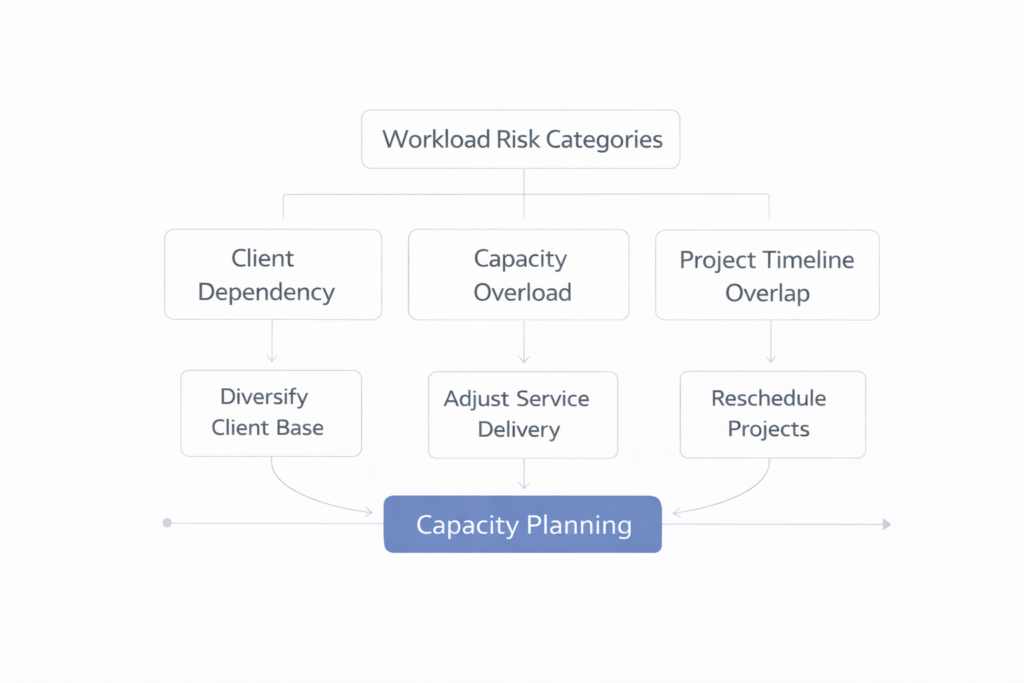
Managing risk requires evaluating three key dimensions.
1. Client Concentration Risk
This measures how dependent workload is on specific clients.
| Client | Capacity Share |
|---|---|
| Client A | 50% |
| Client B | 30% |
| Client C | 20% |
High concentration increases vulnerability.
→ Workload Distribution Across Clients
→ Freelance Client Portfolio Strategy
2. Capacity Utilization Risk
This evaluates how close workload is to maximum capacity.
| Weekly Capacity | Client Work | Utilization |
|---|---|---|
| 40 hours | 38 hours | 95% |
At high utilization levels, small changes create overload.
3. Timeline Collision Risk
This evaluates how projects interact across time.
Risk increases when:
- deliverables overlap
- feedback cycles align
- deadlines cluster
Balancing timelines reduces delivery pressure.
Operational Impact
Managing workload risk improves several operational dimensions.
Delivery Resilience
Freelancers absorb changes without destabilizing schedules.
Revenue Stability
Balanced client portfolios reduce dependency risk.
Capacity Sustainability
Buffers prevent overload and burnout.
Strategic Visibility
Freelancers understand how workload may evolve.
If you want to evaluate whether your current workload structure is risky:
→ Use the Freelance Capacity Planner
To maintain visibility into workload, client distribution, and capacity usage, tools that support:
- time tracking
- planning
- reporting
can help structure your workflow.
→ Explore Time & Capacity Tools for Freelancers
System-Level Impact Across Processome
Workload risk connects multiple systems.
- Client Pipeline System → demand uncertainty
- Capacity Planning System → workload structure
- Profit Tracking System → revenue stability
- Delivery & Operations System → execution continuity
Risk management improves coordination across systems.
Common Failure Patterns
Freelancers often overlook risk due to recurring mistakes.
Single Client Dependence
Creates hidden vulnerability.
Operating at Maximum Utilization
Leaves no room for variability.
Ignoring Project Interactions
Projects are planned independently.
Pipeline Overconfidence
Future work is assumed rather than evaluated.
These patterns reduce resilience.
Strategic Outcome
When workload risk is managed deliberately, consulting operations become more stable.
- Reduced operational vulnerability
Less dependence on single clients - Improved delivery stability
Fewer overload situations - Stronger business continuity
Stable operations under changing demand
Over time, capacity planning evolves into risk-aware decision-making.
Final Perspective
Freelancers often focus on maximizing workload.
However, sustainable consulting requires balancing growth with risk awareness.
Within the Processome operating model, the Capacity Planning System structures how capacity is allocated. Workload risk management extends this by identifying vulnerabilities within that structure.
Stability comes from managing risk, not just managing work.