Managing Delivery Peaks and Valleys for Freelancers
Introduction
Freelance consulting work rarely follows a stable delivery pattern. Workload often fluctuates between periods of intense activity and periods of reduced client demand.
These fluctuations — known as delivery peaks and valleys — create operational instability. During peaks, freelancers experience overload, tight deadlines, and competing priorities. During valleys, capacity remains underutilized and revenue slows.
Managing delivery peaks and valleys for freelancers requires structuring workload across time rather than reacting to incoming work.
Within the Processome operating model, this belongs to the Capacity Planning System — the framework responsible for aligning delivery demand with available capacity.
Without structured planning, freelancers alternate between overload and inactivity. With it, workload becomes balanced and predictable across the consulting calendar.
What are Delivery Peaks and Valleys?
Delivery peaks and valleys refer to fluctuations in workload intensity over time.
- Peaks occur when multiple client activities require attention simultaneously
- Valleys occur when delivery demand drops below available capacity
These fluctuations are influenced by:
- pipeline conversion timing
- project timeline alignment
- retainer workload variability
- client scheduling cycles
The goal is not to eliminate fluctuations entirely, but to reduce extreme variations.
Managing peaks and valleys means distributing workload more evenly across time.
The Core Problem
Many freelancers evaluate workload based only on current projects.
This provides visibility into present commitments, but not how workload evolves.
Several structural patterns create fluctuations.
Pipeline Conversion Clusters
Multiple deals close at the same time, creating sudden workload increases.
Project Deadline Convergence
Projects align around similar deadlines, causing temporary spikes.
Retainer Request Surges
Retainer clients request work simultaneously, increasing pressure.
Pipeline Gaps
Periods with limited new work reduce utilization and revenue.
These issues occur when pipeline demand is not connected to capacity planning.
Delivery Peak Management Framework
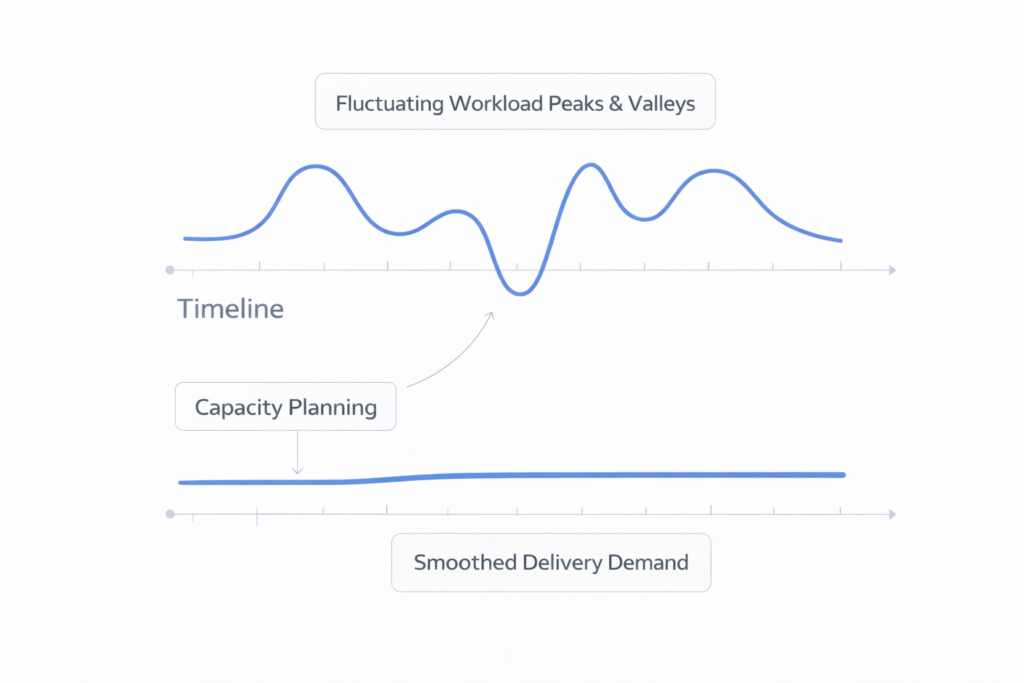
Managing fluctuations requires focusing on three key dimensions.
1. Pipeline-to-Capacity Alignment
New projects should be evaluated relative to existing commitments.
If multiple deals close simultaneously, peaks occur.
→ Freelance Workload Forecasting
Forecasting helps distribute project starts more evenly.
2. Project Timeline Smoothing
Projects contain high-intensity phases.
If these phases overlap, workload spikes.
Spreading milestones across different weeks reduces pressure.
3. Buffer Capacity
Buffers absorb fluctuations in workload.
They provide flexibility during:
- unexpected client requests
- timeline shifts
- delivery delays
Buffers prevent peaks from becoming overload.
Operational Impact
Managing peaks and valleys improves several operational dimensions.
Workload Sustainability
Balanced workload prevents burnout during peak periods.
Delivery Stability
Projects progress more consistently across time.
Revenue Consistency
Smoother workload leads to more predictable income.
Opportunity Readiness
During valleys, freelancers can pursue new opportunities.
If you’re unsure whether your current and future workload creates peaks or unused capacity:
→ Use the Freelance Capacity Planner
To maintain visibility into workload patterns, scheduling, and pipeline activity, tools that support:
- time tracking
- planning
- forecasting
can help structure your workflow.
→ Explore Time & Capacity Tools for Freelancers
System-Level Impact Across Processome
Delivery fluctuations connect multiple systems.
- Client Pipeline System → deal timing
- Capacity Planning System → workload distribution
- Profit Tracking System → revenue stability
- Delivery & Operations System → execution consistency
Balancing workload improves coordination across systems.
Common Failure Patterns
Freelancers often experience instability due to recurring mistakes.
Reactive Project Acceptance
Projects are accepted without evaluating timing.
Ignoring Pipeline Signals
Future demand is not anticipated.
No Capacity Buffers
Schedules lack flexibility.
Overcorrecting During Valleys
Freelancers accept too much work after slow periods.
These patterns create unstable workload cycles.
Strategic Outcome
When peaks and valleys are managed deliberately, operations become more stable.
- Predictable workload patterns
Workload becomes consistent - Improved delivery quality
Adequate time is available - Stronger operational control
Future workload becomes visible
Over time, consulting shifts from reactive cycles to structured planning.
Final Perspective
Freelance consulting naturally includes fluctuations in workload.
However, unmanaged peaks and valleys create operational stress and revenue instability.
Within the Processome operating model, the Capacity Planning System ensures that workload is distributed across time rather than concentrated.
Managing delivery peaks and valleys allows freelancers to maintain stable, predictable consulting operations.
Consistency is designed.