Monthly Capacity Planning for Freelancers: A Capacity Allocation Model
Introduction
Freelance consultants often plan their work at a short-term level, focusing primarily on weekly schedules or immediate project deadlines. While weekly planning is necessary for execution, it does not provide sufficient visibility into medium-term workload dynamics.
Monthly capacity planning for freelancers fills this gap.
Within the Processome operating model, monthly capacity allocation belongs to the Capacity Planning System — the execution engine responsible for ensuring that client work remains compatible with available delivery capacity.
A monthly capacity model translates structural capacity constraints into medium-term workload forecasts. It allows freelancers to evaluate how projects, retainers, and pipeline opportunities may affect delivery capacity over the coming weeks.
Without this level of planning, capacity conflicts often appear too late — after commitments have already been made.
Monthly capacity allocation acts as a bridge between long-term capacity strategy and weekly execution.
What is Monthly Capacity Planning?
Monthly capacity planning for freelancers is the process of allocating available delivery capacity across all expected work within a given month.
It translates structural capacity into a forward-looking workload plan.
This includes:
- active client projects
- recurring retainers
- expected pipeline opportunities
- non-billable operational work
- buffer capacity
Monthly capacity planning ensures that workload remains aligned with realistic delivery limits before projects begin.
The Core Problem
Many freelancers operate without a structured monthly view of their workload.
Planning typically occurs in two disconnected layers:
- long-term revenue goals
- short-term weekly scheduling
This gap creates several operational risks.
Hidden Capacity Conflicts
Multiple engagements may overlap unexpectedly when projects start or expand.
Unreliable Forecasting
Pipeline opportunities are accepted without understanding their impact on future workload.
Inconsistent Utilization
Some weeks become overloaded while others remain underutilized.
Delivery Stress
Workload spikes occur when multiple deliverables converge.
These issues occur because capacity planning happens too late.
Monthly planning introduces a structured medium-term planning horizon.
The Monthly Capacity Allocation Framework
A structured monthly model includes four key components.
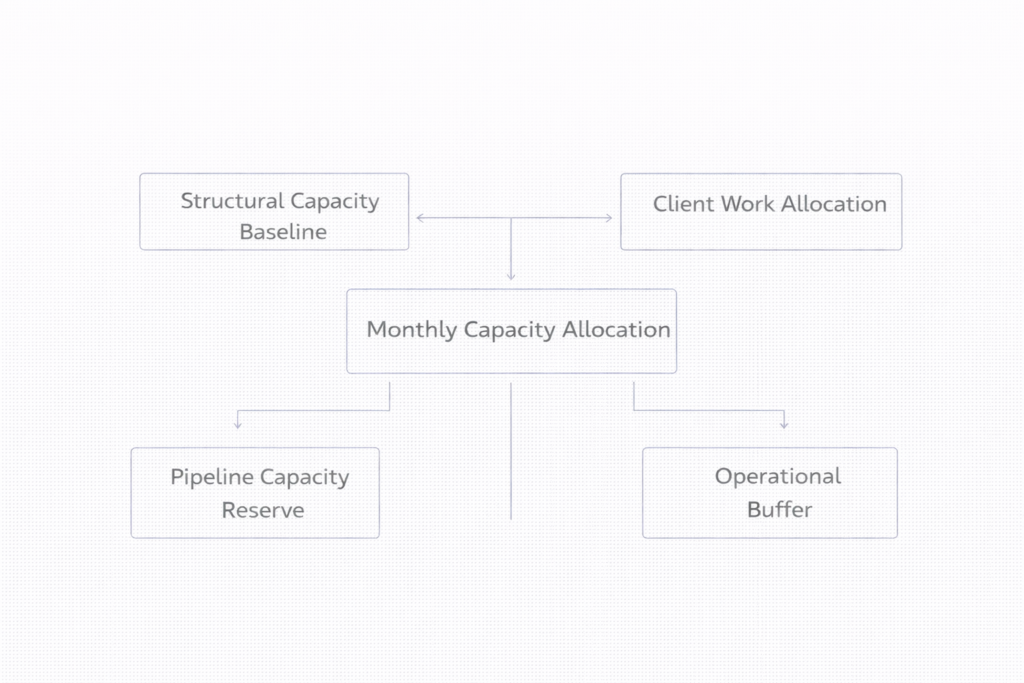
1. Structural Capacity Baseline
The first step is defining total delivery capacity for the month.
This should reflect realistic availability.
| Capacity Variable | Value |
|---|---|
| Total working hours | 160 |
| Non-billable activities | 40 |
| Structural capacity | 120 |
→ Utilization Rate for Solo Consultants
This baseline ensures workload planning remains realistic.
2. Client Work Allocation
Existing commitments are mapped against available capacity.
This includes:
- retainer obligations
- project milestones
- scheduled deliverables
This step reveals how much capacity is already allocated.
3. Pipeline Capacity Reserve
Future work is not always confirmed.
Pipeline opportunities from the:
may convert into projects.
A portion of capacity should therefore be reserved.
→ Capacity Forecasting from Pipeline Data
This prevents overload when deals close.
4. Operational Buffer
Monthly plans must include buffer capacity.
Buffers absorb:
- scope expansion
- revision cycles
- delayed feedback
Without buffers, small disruptions create larger delivery issues.
Operational Impact
Monthly capacity planning improves several operational dimensions.
Early Identification of Capacity Conflicts
Workload issues become visible weeks in advance.
Improved Intake Decisions
New work can be evaluated based on real capacity.
If you’re unsure whether your current or expected workload fits within your capacity:
→ Use the Freelance Capacity Planner
More Stable Delivery Schedules
Workload is distributed more evenly across the month.
To maintain visibility into workload, planning, and capacity over time, tools that support:
- time tracking
- scheduling
- forecasting
can help structure your workflow.
→ Explore Time & Capacity Tools for Freelancers
System-Level Impact Across Processome
Monthly capacity allocation connects multiple systems.
- Client Pipeline System → opportunity inflow
- Capacity Planning System → workload forecasting
- Profit Tracking System → revenue alignment
- Delivery & Operations System → execution planning
This coordination improves overall stability.
Common Failure Patterns
Freelancers often undermine monthly planning due to recurring mistakes.
Planning Only Weekly
Without a monthly view, future conflicts remain hidden.
Ignoring Pipeline Risk
Failing to reserve capacity leads to overbooking.
Underestimating Retainer Workload
Recurring work often exceeds initial expectations.
Eliminating Buffers
Short-term gains create long-term instability.
Strategic Outcome
When freelancers implement a structured monthly capacity model, several advantages emerge.
- Improved delivery predictability
Workload is balanced across the month - Better pipeline control
New work is accepted with confidence - Reduced workload volatility
Capacity conflicts are identified early - More reliable revenue planning
Workload aligns with expected income
Over time, monthly planning strengthens execution stability.
Final Perspective
Freelancers often assume short-term planning is sufficient.
In practice, stable execution requires multiple planning horizons.
- Weekly planning → manages immediate workload
- Monthly planning → ensures future feasibility
Within the Processome operating model, the Capacity Planning System relies on monthly capacity allocation to align revenue expectations with delivery capability.
Effective capacity planning begins before work begins.