Weekly Capacity Planning for Freelancers: A Practical Framework for Managing Workload
Introduction
Freelance consultants often manage their workload reactively. Tasks are handled as they appear, and client commitments are scheduled informally based on perceived availability.
While this approach may function temporarily, it often leads to unpredictable workloads and uneven delivery quality.
Weekly capacity planning for freelancers provides a structured way to allocate work across available time before delivery pressure appears.
Within the Processome operating model, weekly capacity planning belongs to the Capacity Planning System — the execution engine responsible for ensuring that accepted work remains compatible with available delivery capacity.
Where monthly or quarterly models define structural limits, weekly capacity planning determines how that capacity is actually allocated across active client work.
It converts capacity strategy into daily execution.
What is Weekly Capacity Planning?
Weekly capacity planning for freelancers is the process of allocating available delivery capacity across client work, buffers, and operational activities within a single week.
It translates structural capacity into short-term execution decisions.
Instead of reacting to incoming tasks, freelancers define:
- how many hours are available for delivery
- how that time is distributed across clients
- how much capacity remains reserved as buffer
- when non-billable work should occur
Weekly capacity planning ensures that delivery execution remains aligned with broader capacity constraints.v
The Core Problem
Many freelancers operate without a consistent planning rhythm for managing weekly workload.
Typical patterns include:
- scheduling tasks as deadlines approach
- responding to client requests immediately
- underestimating delivery time requirements
- overloading specific days while leaving others underutilized
These habits often produce several operational risks.
Uneven Workload Distribution
Freelancers experience intense delivery pressure during certain periods while other periods remain underutilized.
Missed Delivery Deadlines
Without structured planning, it becomes difficult to allocate sufficient time for each engagement.
Reduced Strategic Time
Administrative tasks, sales activities, and professional development are neglected when delivery work dominates the schedule.
Limited Capacity Visibility
Freelancers accept additional work without understanding whether weekly capacity remains available.
Weekly capacity planning provides a structured mechanism for preventing these issues.
The Weekly Capacity Planning Framework
Effective weekly capacity planning follows a structured four-step process.
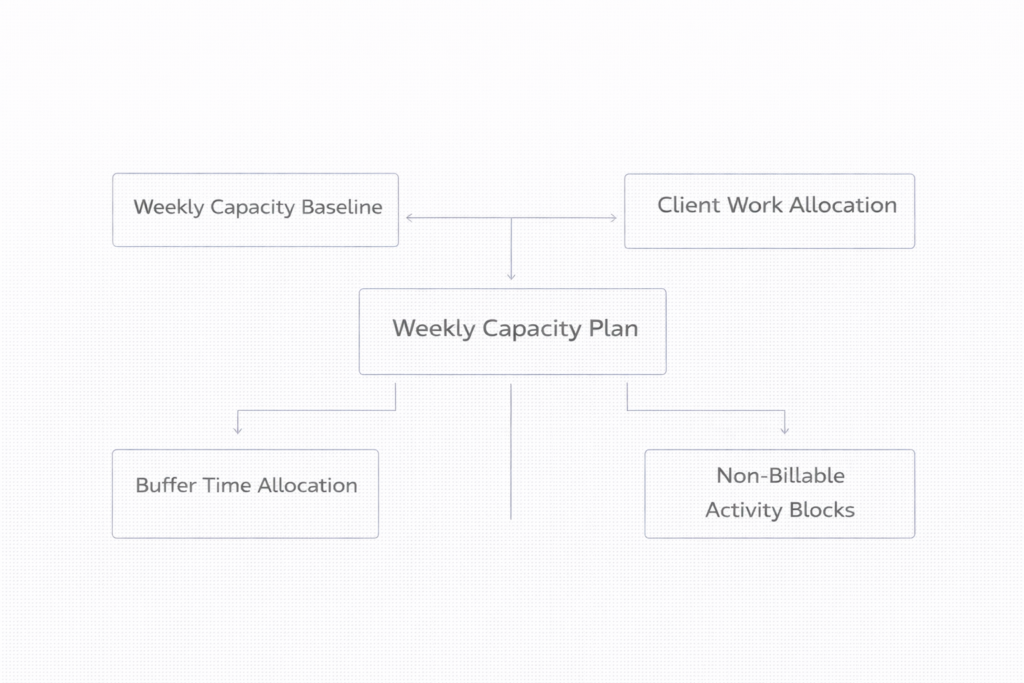
1. Weekly Capacity Baseline
The first step is determining total available hours for the upcoming week.
This baseline should reflect structural capacity rather than theoretical working hours.
Example:
| Capacity Variable | Value |
|---|---|
| Total working hours | 40 |
| Non-billable activities | 12 |
| Structural capacity | 28 |
Utilization thresholds are explored in:
→ Utilization Rate for Solo Consultants
Understanding the weekly baseline ensures that delivery expectations remain realistic.
2. Client Work Allocation
Once structural capacity is defined, delivery hours are distributed across active client engagements.
Typical allocation decisions include:
- prioritizing projects with imminent deadlines
- distributing time across multiple retainers
- reserving time for complex tasks
This step translates commitments into scheduled delivery blocks.
→ Workload Distribution Across Clients
3. Buffer Time Allocation
Every weekly capacity plan should include buffer time.
Buffers absorb disruptions such as:
- client feedback cycles
- scope adjustments
- unplanned meetings
Without buffers, minor disruptions cascade into delays.
4. Non-Billable Activity Blocks
Freelance businesses require regular non-delivery work.
Examples include:
- proposal preparation
- pipeline management
- administrative tasks
- professional development
These activities should be scheduled explicitly.
This prevents operational work from interfering with delivery commitments.
Operational Impact
A structured weekly capacity planning process improves several operational dimensions.
Improved Delivery Reliability
Freelancers gain clarity about how much time is available for each engagement.
Better Capacity Awareness
Weekly planning reveals whether additional work can realistically be accepted.
If you’re unsure whether your current workload fits within your weekly capacity:
→ Use the Freelance Capacity Planner
Reduced Workload Stress
Balanced schedules prevent extreme delivery pressure during short periods.
To maintain visibility into how your time and workload evolve throughout the week, tools that support:
- time tracking
- workload planning
can help structure your workflow.
→ Explore Time & Capacity Tools for Freelancers
System-Level Impact Across Processome
Weekly capacity planning connects multiple systems within the Processome architecture.
- Capacity Planning System → workload allocation
- Client Pipeline System → intake feasibility
- Profit Tracking System → time-to-revenue alignment
- Delivery & Operations System → execution stability
Short-term planning ensures system alignment.
Common Failure Patterns
Freelancers frequently undermine weekly planning due to several mistakes.
Ignoring Capacity Limits
Accepting additional work without revising the weekly plan produces overload.
Underestimating Task Duration
Delivery tasks require more time than initially expected.
Omitting Buffer Time
Schedules become fragile and easily disrupted.
Mixing Planning and Execution
Planning while already executing tasks leads to incomplete schedules.
A consistent weekly planning ritual prevents these issues.
Strategic Outcome
When freelancers implement structured weekly capacity planning, several advantages emerge.
- Greater delivery predictability
Workload is distributed deliberately - Improved project execution
Tasks receive appropriate time allocation - Clear capacity boundaries
Freelancers evaluate new work realistically - Better work-life balance
Daily workloads remain manageable
Over time, weekly planning becomes a routine control mechanism.
Final Perspective
Freelancers often assume that time management tools alone will solve workload problems.
In practice, stable execution requires structured capacity planning.
Weekly capacity planning transforms abstract capacity limits into practical delivery decisions.
Within the Processome operating model, this discipline ensures that the Capacity Planning System remains connected to daily execution.
Planning workload deliberately creates sustainable delivery rhythms.