Reducing Client Chaos with Better Operations
Introduction
Freelance consulting work often involves multiple clients, overlapping requests, and evolving project priorities. Without structured operational processes, this complexity can quickly turn into delivery chaos.
Freelancers may experience:
- constant interruptions from client requests
- shifting project priorities
- unclear expectations
- reactive work schedules
These issues are rarely caused by demanding clients alone. In most cases, they emerge from weak operational structure.
Within the Processome operating model, operational stability is governed by the → Delivery & Operations System, the framework responsible for organizing how consulting work is executed and managed.
When delivery processes remain informal, client requests create operational turbulence.
When operational systems are structured, client complexity becomes manageable.
Better operations reduce chaos.
The Core Problem
Freelancers often manage multiple client engagements simultaneously.
Each client may require:
- regular communication
- deliverable reviews
- feedback cycles
- coordination with stakeholders
Without structured operational systems, freelancers respond to these demands reactively.
Typical patterns include:
- responding immediately to incoming requests
- switching constantly between projects
- adjusting schedules based on urgency rather than priorities
This reactive workflow introduces several problems.
Constant Context Switching
Frequent interruptions reduce focus and slow progress on deliverables.
Unclear Prioritization
Projects compete for attention without structured scheduling.
Client Expectation Drift
Clients may expect immediate responses when communication norms are unclear.
Delivery Instability
Work becomes driven by incoming requests rather than structured project plans.
These problems are operational design issues rather than workload issues.
Chaos often reflects missing systems.
Concept Explanation
Reducing client chaos requires structured operational processes that govern how consulting work is organized and communicated.
Operational systems establish rules for:
- how projects are planned
- how client communication occurs
- how deliverables progress through milestones
- how unexpected requests are handled
These structures ensure that work progresses according to defined processes rather than constant reactive coordination.
Several operational frameworks contribute to this stability, including:
→ Client Onboarding System for Freelancers
→ Scope Control Framework for Solo Consultants
→ Change Request Management for Freelancers
Together, these frameworks define how projects begin, evolve, and remain controlled during delivery.
Operational structure transforms unpredictable client activity into manageable workflows.
Operational Stability Framework
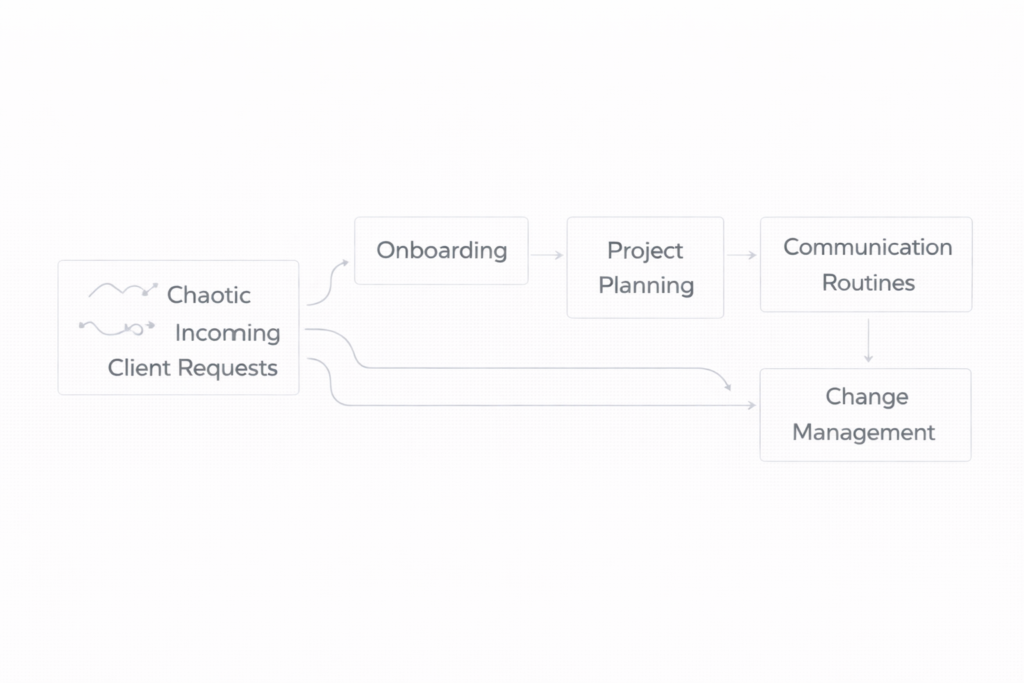
Operational stability typically depends on four structural components.
1. Structured Project Planning
Projects should begin with defined milestones, timelines, and deliverables.
Structured planning provides visibility into:
- project progress
- upcoming deadlines
- workload allocation
This framework is explained in:
→ Project Planning for Freelancers
Planning prevents projects from becoming reactive sequences of tasks.
2. Defined Communication Channels
Clear communication structures reduce interruptions and confusion.
Freelancers may establish guidelines for:
- response time expectations
- communication platforms
- scheduled update meetings
When communication norms are clear, clients understand how and when interaction occurs.
3. Controlled Scope Management
Many operational disruptions originate from uncontrolled scope expansion.
Structured scope control ensures that new requests are evaluated before being incorporated into the project.
This concept is explored in:
→ Scope Control Framework for Solo Consultants
Scope discipline protects delivery stability.
4. Change Management Processes
Projects inevitably evolve as new insights emerge.
Instead of allowing ad-hoc changes, structured change management defines how project adjustments are evaluated and implemented.
This process is explained in:
→ Change Request Management for Freelancers
Change management transforms evolving requirements into structured decisions.
Operational Impact
Structured operational systems significantly improve the stability of freelance consulting businesses.
Reduced Interruptions
Clear communication structures reduce constant client requests.
Improved Focus
Freelancers can concentrate on structured work blocks rather than reacting continuously.
Predictable Project Progress
Defined milestones maintain delivery momentum.
Stronger Client Confidence
Clients gain visibility into project progress and decision processes.
Operational structure therefore benefits both freelancers and clients.
System-Level Impact Across Processome
Operational stability improves coordination across the Processome operating architecture.
Client Pipeline System → qualified projects enter delivery with clearer expectations
Capacity Planning System → workload becomes easier to schedule and control
Profit Tracking System → reduced chaos protects margin and delivery efficiency
Delivery & Operations System → structured processes stabilize execution
Better operations connect client demand with structured delivery execution.
Common Failure Patterns
Freelancers frequently experience operational chaos because systems are missing or inconsistently applied.
Several patterns are common.
Reactive Work Habits
Freelancers respond immediately to every incoming client request.
Weak Project Structure
Projects begin without clear milestones or timelines.
Unstructured Communication
Clients contact freelancers across multiple channels without clear expectations.
Informal Scope Changes
Additional work is accepted without evaluation or documentation.
These behaviors gradually increase operational complexity.
Strategic Outcome
When operational systems are implemented effectively, freelance consulting work becomes far more manageable.
Instead of reacting continuously to incoming requests, freelancers operate through defined processes that guide project execution.
This produces several advantages.
Improved delivery focus
Work progresses through structured milestones.
Reduced operational stress
Freelancers spend less time managing unexpected disruptions.
Stronger client collaboration
Clear systems help clients understand how projects progress.
Higher delivery quality
Structured processes support consistent outcomes.
Operational systems convert chaotic client activity into manageable workflows.
Final Perspective
Freelance consulting often involves complex client interactions and evolving project requirements.
However, operational chaos is rarely inevitable.
Within the Processome operating model, the → Delivery & Operations System ensures that consulting engagements are governed by structured processes rather than constant reactive coordination.
Clients may generate complexity.
Operational systems transform that complexity into stability.