Revenue Mix Design for Solo Consultants (How to Structure Freelance Income)
Introduction
Freelance consulting businesses are often evaluated using a single metric: monthly revenue.
However, revenue alone does not describe how a business actually operates.
Two freelancers may generate the same income while relying on completely different structures.
For example:
- one freelancer earns €10,000 from two long-term retainers
- another earns €10,000 from multiple project engagements
- a third earns €10,000 from smaller advisory sessions
Each represents a different freelance revenue mix, with different outcomes in:
- income stability
- workload predictability
- capacity utilization
- profit behavior
Understanding revenue mix design for solo consultants is essential for building a stable and scalable freelance business.
Within the Processome operating model, revenue mix design belongs to the → Client Pipeline System, the system responsible for shaping how opportunities translate into long-term income.
What Is Revenue Mix Design?
Revenue mix design for solo consultants refers to the intentional structure of different engagement types within a freelance business.
Rather than allowing revenue to develop randomly, freelancers design a portfolio of work that balances:
- stability
- flexibility
- profitability
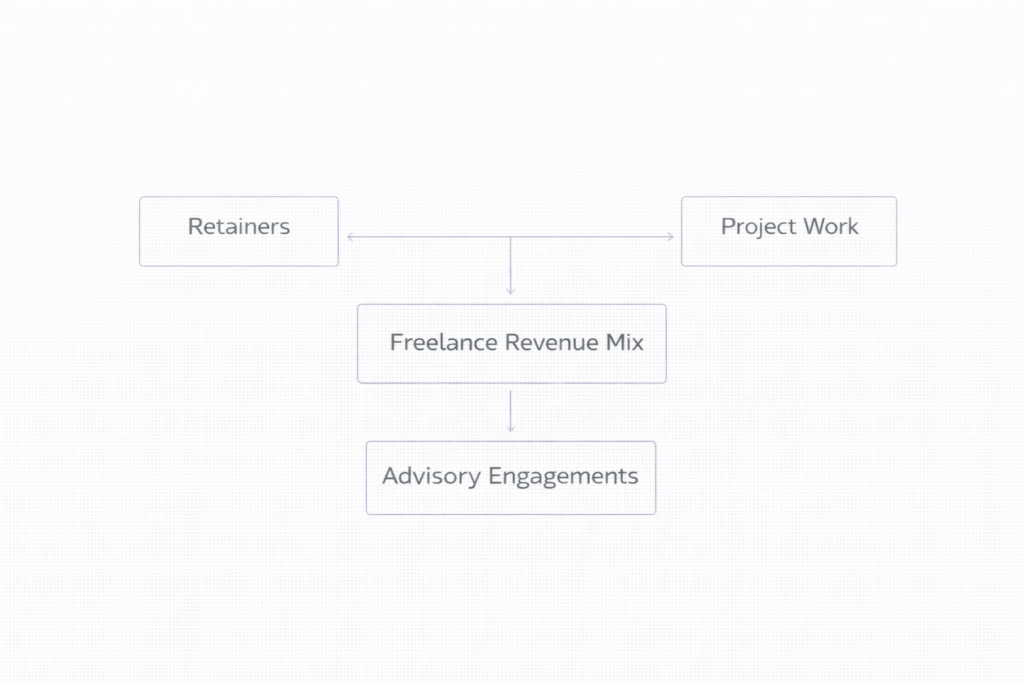
Most freelance revenue falls into three categories:
- retainer engagements
- project-based work
- advisory engagements
Each type:
- consumes capacity differently
- produces different revenue patterns
- affects overall business stability
Revenue mix design is therefore not just a financial concept—it is a structural decision.
It connects closely to:
→ Retainers vs Projects: Which Model Creates Stable Freelance Income
→ Freelance Client Portfolio Strategy
The Core Problem
Many freelancers do not intentionally design their revenue mix.
Instead, revenue evolves through:
- opportunistic client acquisition
- random project opportunities
- occasional retainers
While this can generate income, it often leads to instability.
Workload Volatility
Delivery demands fluctuate unpredictably.
Income Fluctuation
Revenue spikes and gaps become common.
Capacity Pressure
Multiple engagements overlap unexpectedly.
Margin Inconsistency
Different engagement types produce uneven profitability.
These issues arise when revenue structure is driven by opportunity rather than design.
The Revenue Mix Design Framework
A structured freelance revenue mix can be evaluated across three core engagement types.
1. Retainers
Retainers provide recurring engagements with ongoing client relationships.
Characteristics:
- predictable monthly revenue
- consistent client interaction
- long-term engagement
Retainers improve income stability but require careful capacity allocation.
→ Retainer Capacity Planning Model
2. Project Work
Projects involve delivering defined outcomes within a fixed timeframe.
Characteristics:
- clear scope
- finite duration
- capacity released after completion
Projects can generate strong revenue but introduce variability.
→ Contribution Margin in Freelance Businesses
3. Advisory Engagements
Advisory work includes short, high-value consulting interactions.
Examples:
- strategy sessions
- audits
- expert consultations
These engagements often produce high effective hourly rates with low time commitment.
However, they tend to be less predictable and less scalable.
Advisory work typically complements retainers and projects within a balanced revenue mix.
Designing a Balanced Freelance Revenue Mix
A strong revenue mix for solo consultants typically combines:
- retainers → stability
- projects → growth
- advisory work → flexibility
The objective is not to maximize one category, but to create a structure where:
- baseline income is secured
- additional revenue can be layered on
- capacity remains manageable
This turns revenue into a portfolio system, not a collection of isolated engagements.
Operational Impact
Revenue mix design influences multiple operational dimensions.
Income Stability
Retainers provide baseline income, while projects and advisory work add variability.
Capacity Management
Different engagement types consume time differently.
Pipeline Strategy
Pipeline activity must align with the desired revenue mix.
When retainers are full → focus on projects
When projects decline → increase pipeline generation
Forecasting frameworks such as:
→ Weighted Revenue Forecasting for Freelancers
help coordinate pipeline activity with revenue mix targets.
System-Level Impact Across Processome
Revenue mix design affects:
- Client Pipeline System → engagement structure
- Capacity Planning System → workload allocation
- Profit Tracking System → margin visibility
- Delivery & Operations System → engagement management
A well-designed revenue mix improves stability across all systems.Capacity Planning System
Common Failure Patterns
Freelancers often experience instability due to poor revenue mix design.
Overreliance on Projects
Creates significant income volatility.
Overdependence on a Single Retainer
Introduces concentration risk.
→ Revenue Concentration Risk Explained
Ignoring Advisory Opportunities
Misses flexible, high-margin work.
Ignoring Capacity Constraints
Leads to overload and delivery pressure.
Strategic Outcome
When freelancers design their freelance revenue mix intentionally, several advantages emerge.
Greater Income Stability
Recurring revenue provides a reliable baseline.
Balanced Workload
Different engagement types distribute effort more evenly.
Improved Forecasting
Structured revenue makes planning easier.
Reduced Risk
Diversification reduces dependency on individual clients.
Over time, most freelancers adopt a hybrid revenue model that balances stability and flexibility.
Final Perspective
Freelance revenue is often evaluated by how much is earned. However, long-term business stability depends on how that revenue is structured.
Revenue mix design for solo consultants transforms freelance income into a deliberate portfolio of engagements.
Within the Processome operating model, this strengthens the Client Pipeline System by ensuring that new opportunities contribute to long-term stability.
Revenue is not only about volume—it is about structure.