Retainer Client Management
Introduction
Retainer agreements are often seen as a solution to revenue volatility in freelance consulting. Monthly retainers can provide predictable income and reduce the constant pressure of acquiring new clients.
However, retainers also introduce a different operational challenge.
Unlike projects, which have a defined start and end, retainers create ongoing delivery commitments. Without structured management, these recurring engagements can gradually expand in scope, consume increasing capacity, and reduce delivery efficiency.
Within the Processome operating model, retainer client management belongs to the → Delivery & Operations System, the framework responsible for maintaining stable client relationships and consistent delivery processes.
Retainers require operational structure.
Without clear management systems, recurring engagements can become unpredictable workloads.
Effective retainer management ensures that recurring client relationships remain sustainable for both the consultant and the client.
The Core Problem
Freelancers often accept retainers because they promise revenue stability.
However, once a retainer begins, its operational structure may remain loosely defined.
Over time, several issues may appear.
Expanding Workload
Clients may gradually request additional work beyond the original retainer scope.
Continuous Availability Expectations
Clients may assume the consultant is available at any time.
Fragmented Task Requests
Work may arrive as small, reactive tasks instead of structured deliverables.
Hidden Capacity Consumption
Recurring coordination and communication may consume more time than expected.
These issues rarely appear immediately.
They typically emerge gradually as the retainer relationship evolves.
Without structured management, retainers can become difficult to control operationally.
Concept Explanation
Retainer client management is the operational process used to structure recurring consulting engagements.
Instead of responding reactively to ongoing requests, freelancers establish systems that define:
- how retainer work is delivered
- how tasks are prioritized
- how communication occurs
- how scope boundaries are maintained
These systems ensure that recurring engagements remain predictable and sustainable.
Retainer management connects closely with frameworks such as:
→ Retainer Capacity Planning Model
→ Scope Control Framework for Solo Consultants
Capacity planning ensures that retainers fit within delivery limits, while scope control prevents workload expansion.
Together, these frameworks create sustainable retainer relationships.
Retainer Client Management Framework
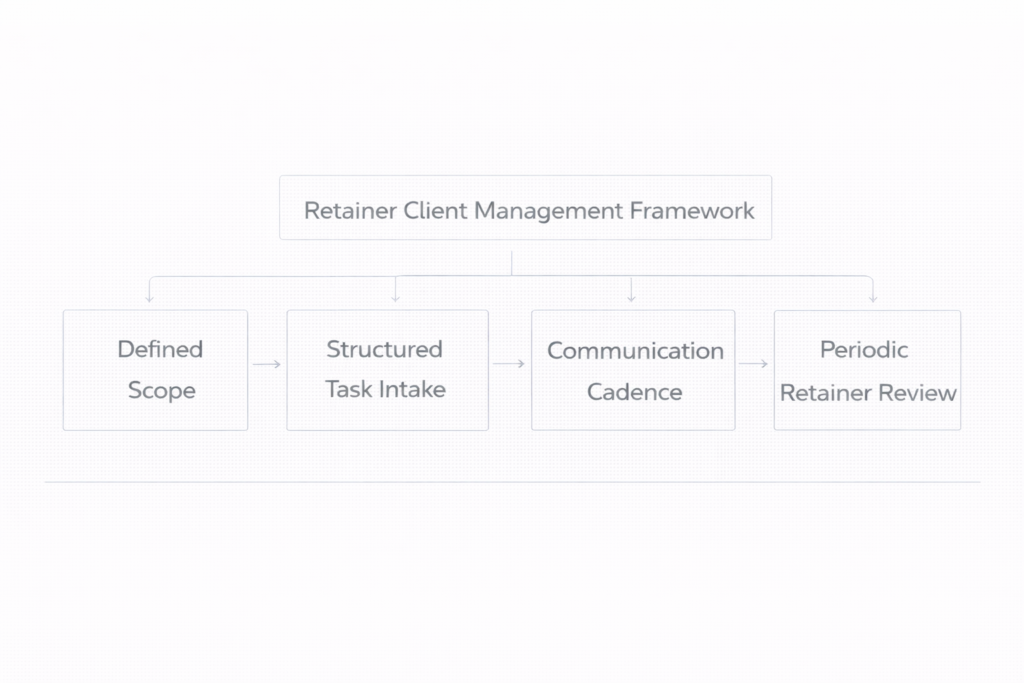
A structured retainer management framework typically includes four operational components.
1. Defined Retainer Scope
Every retainer should clearly define what work is included.
This may specify:
- monthly deliverables
- types of advisory support
- hours allocated per month
Clear scope boundaries reduce ambiguity and prevent uncontrolled expansion of the engagement.
2. Structured Task Intake
Retainer work should follow a structured intake process.
Instead of responding immediately to incoming requests, freelancers may:
- collect tasks during scheduled intervals
- prioritize requests based on strategic importance
- schedule work within available delivery capacity
This process maintains delivery discipline.
3. Communication Cadence
Retainer relationships benefit from consistent communication rhythms.
Typical communication structures include:
- scheduled check-in meetings
- monthly planning discussions
- milestone reviews
Structured communication ensures that both consultant and client remain aligned.
This connects closely to:
→ Client Communication Systems
4. Periodic Retainer Reviews
Retainer engagements should be evaluated periodically.
Review discussions may include:
- evaluating delivered value
- reviewing workload levels
- adjusting scope or priorities
Regular reviews ensure that the retainer continues to serve both parties effectively.
Operational Impact
Implementing structured retainer management systems improves several operational aspects of freelance consulting businesses.
Sustainable Workload
Defined scope and task prioritization prevent uncontrolled workload growth.
Clear Client Collaboration
Structured communication improves alignment between consultant and client.
Predictable Delivery
Retainer work follows consistent operational rhythms.
Stronger Long-Term Relationships
Clear systems create trust and transparency.
Retainer management therefore supports both operational stability and relationship quality.
System-Level Impact Across Processome
Retainer client management influences coordination across the Processome operating architecture.
Client Pipeline System → retainer clients may generate follow-up opportunities
Capacity Planning System → recurring engagements require structured capacity allocation
Profit Tracking System → retainer profitability depends on controlled workload
Delivery & Operations System → structured retainer management stabilizes delivery processes
Effective retainer management ensures that recurring engagements remain operationally sustainable.
Common Failure Patterns
Freelancers often struggle with retainers because operational systems are missing.
Several patterns frequently appear.
Undefined Scope
Retainers begin without clear boundaries for included work.
Reactive Task Handling
Freelancers respond immediately to every client request.
Unlimited Availability
Clients assume the consultant is always accessible.
No Periodic Reviews
Retainer relationships continue indefinitely without evaluation.
These patterns gradually reduce delivery stability and profitability.
Strategic Outcome
When retainer client management systems are implemented consistently, recurring consulting engagements become significantly more stable.
Instead of evolving into uncontrolled workloads, retainers operate through structured delivery systems.
This produces several advantages.
Predictable workload
Tasks follow structured intake and prioritization.
Stronger collaboration
Communication rhythms maintain alignment.
Improved profitability
Controlled scope protects effective hourly yield.
Long-term relationship stability
Retainers evolve into reliable consulting partnerships.
Retainer management transforms recurring engagements into sustainable delivery systems.
Final Perspective
Retainers are often promoted as a solution to freelance income volatility.
However, predictable revenue alone does not guarantee sustainable operations.
Within the Processome operating model, the → Delivery & Operations System ensures that recurring consulting relationships operate through clear scope boundaries, structured task intake, and regular review cycles.
Retainers create stability only when supported by structured operational systems.