Preventing Scope Creep in Freelance Projects
Introduction
Scope creep is one of the most common operational challenges in freelance consulting. Projects often begin with clearly defined objectives and deliverables, but additional requests, revisions, and new expectations may gradually expand the workload.
While individual changes may appear minor, their cumulative impact can significantly increase delivery effort and reduce project margins.
Within the Processome operating model, scope discipline belongs to the → Delivery & Operations System, the operational framework responsible for maintaining stable project execution.
Preventing scope creep requires more than simply refusing additional work. It requires structured processes that define project boundaries, evaluate changes, and maintain alignment between deliverables and compensation.
Without these systems, projects gradually expand beyond their original design.
With them, scope remains controlled.
The Core Problem
Scope creep typically emerges gradually rather than through large, explicit changes.
Freelancers often encounter requests such as:
- additional analysis or research
- extra deliverables or presentations
- expanded revision cycles
- new stakeholder involvement
Each request may appear reasonable on its own. However, when these additions accumulate, the project can expand far beyond the originally defined scope.
This introduces several operational risks.
Increased Workload
Delivery effort grows without corresponding changes to project structure.
Margin Erosion
Additional work may be absorbed without additional compensation.
Timeline Disruption
New tasks extend project timelines and compress other commitments.
Capacity Pressure
Unexpected workload may interfere with other active engagements.
Scope creep therefore affects both operational stability and financial performance.
Concept Explanation
Preventing scope creep involves establishing operational mechanisms that maintain project boundaries throughout delivery.
Rather than reacting to expanding requirements, freelancers proactively design project structures that limit uncontrolled scope expansion.
These mechanisms typically include:
- clearly defined deliverables
- structured revision limits
- formal change request processes
- milestone-based project reviews
Scope discipline does not prevent legitimate project evolution. Instead, it ensures that changes occur through structured decisions rather than informal agreements.
Several operational frameworks contribute to scope control, including:
→ Scope Control Framework for Solo Consultants
→ Change Request Management for Freelancers
Together, these systems maintain alignment between project scope, timelines, and compensation.
Scope Creep Prevention Framework
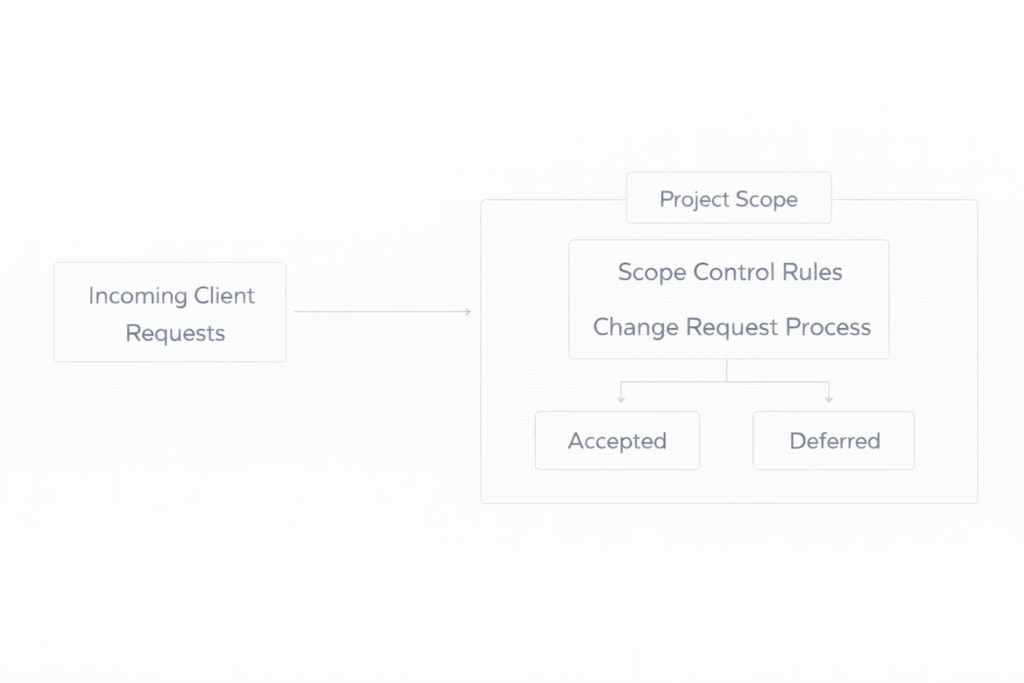
Preventing scope creep typically involves four operational practices.
1. Clear Scope Definition
Projects must begin with explicit definitions of deliverables.
Scope definitions should include:
- detailed deliverable descriptions
- number of revision cycles
- project milestones
Clear scope definitions reduce ambiguity about what is included in the engagement.
2. Structured Revision Limits
Revision cycles are one of the most common sources of scope expansion.
Freelancers should define:
- number of revision rounds included
- timelines for feedback
- expectations for consolidated feedback
Clear revision policies help maintain delivery efficiency.
3. Change Request Processes
When new requirements emerge, they should be evaluated through a structured process.
Change requests may result in:
- updated deliverables
- revised timelines
- additional compensation
Formal change management is explained in:
→ Change Request Management for Freelancers
This ensures that project changes remain transparent and controlled.
4. Milestone-Based Reviews
Milestones provide natural checkpoints where project progress and scope alignment can be reviewed.
These checkpoints allow freelancers and clients to confirm:
- deliverable expectations
- progress toward project objectives
- any necessary adjustments
Milestone reviews prevent scope changes from accumulating unnoticed.
Operational Impact
When scope creep prevention systems are implemented effectively, freelance consulting projects become far more stable.
Margin Protection
Additional work is identified and priced appropriately.
Delivery Stability
Projects remain aligned with defined timelines and milestones.
Capacity Control
Unexpected workload expansion is minimized.
Clear Client Expectations
Clients understand the boundaries of the project engagement.
Scope discipline therefore improves both financial and operational outcomes.
System-Level Impact Across Processome
Scope creep prevention influences coordination across the Processome operating architecture.
Client Pipeline System → clearer project definitions during qualification
Capacity Planning System → workload remains aligned with delivery capacity
Profit Tracking System → margin visibility improves through controlled scope expansion
Delivery & Operations System → execution stability through structured scope boundaries
Scope discipline ensures that consulting engagements remain aligned with both operational and financial constraints.
Common Failure Patterns
Freelancers often experience scope creep because project boundaries are not actively managed.
Several patterns frequently appear.
Vague Deliverable Definitions
Ambiguous scope descriptions invite interpretation.
Unlimited Revision Cycles
Freelancers accept repeated revisions without limits.
Informal Change Acceptance
Additional requests are accepted without evaluation.
Fear of Client Friction
Consultants may hesitate to enforce scope boundaries.
These patterns gradually undermine delivery discipline.
Strategic Outcome
When freelancers implement structured scope creep prevention systems, project execution becomes significantly more predictable.
Instead of absorbing expanding workloads, consultants manage project changes through structured decision processes.
This produces several advantages.
Protected margins
Additional work receives appropriate compensation.
Stable delivery timelines
Projects progress according to planned milestones.
Improved operational control
Freelancers maintain authority over project boundaries.
Stronger client relationships
Clear expectations reduce misunderstandings.
Scope control transforms project expansion from a hidden risk into a manageable operational process.
Final Perspective
Scope creep is often treated as an unavoidable feature of freelance consulting.
In reality, it is usually the result of missing operational structure.
Within the Processome operating model, the → Delivery & Operations System ensures that consulting engagements maintain clearly defined boundaries and structured change management.
Defined scope protects delivery stability.