Freelance Financial Planning System (How to Plan Revenue, Costs and Profit)
Introduction
A freelance financial planning system helps you plan revenue, costs, and profit instead of reacting to income fluctuations.
Freelancers often manage finances reactively. Income arrives through projects, expenses are paid as they occur, and financial decisions are made based on short-term visibility.
While this may work during stable periods, it creates vulnerability when revenue fluctuates or unexpected costs appear.
Financial planning introduces structure to these decisions.
Within the Processome operating model, financial management belongs to the → Profit Tracking System—the financial intelligence layer responsible for translating operational activity into long-term economic sustainability.
A freelance financial planning system integrates revenue forecasts, cost structures, and profitability metrics into a structured decision framework.
Instead of reacting to financial events, freelancers gain the ability to plan and manage the economic trajectory of their business.
Revenue describes activity.
Financial planning defines direction.
What is a Freelance Financial Planning System?
A freelance financial planning system integrates multiple financial frameworks into a structured management process.
Rather than analyzing individual metrics separately, the system combines them into a comprehensive financial overview.
Key components include:
- revenue forecasting
- profit forecasting
- cost structure analysis
- margin monitoring
These metrics are derived from core financial frameworks:
→ Break-Even Analysis for Freelancers
→ Contribution Margin in Freelance Businesses
→ Forecasting Profit from Pipeline Data
Financial planning connects these indicators into a coherent planning process.
The objective is to align revenue expectations with cost structures and delivery capacity.
The Core Problem
Many freelancers operate without a structured financial planning framework.
Common patterns include:
- tracking revenue but not profit
- reacting to cash flow changes
- setting revenue targets without cost awareness
- making pricing decisions without financial projections
This reactive approach creates several risks.
Revenue Volatility
Irregular income makes it difficult to plan expenses or investments.
Weak Financial Visibility
Freelancers may struggle to understand how revenue translates into profit.
Short-Term Decision Making
Pricing and project decisions prioritize immediate income over long-term sustainability.
Limited Strategic Planning
Without structured forecasts, planning growth or managing risk becomes difficult.
A financial planning system introduces structure to these decisions.
Freelance Financial Planning Framework
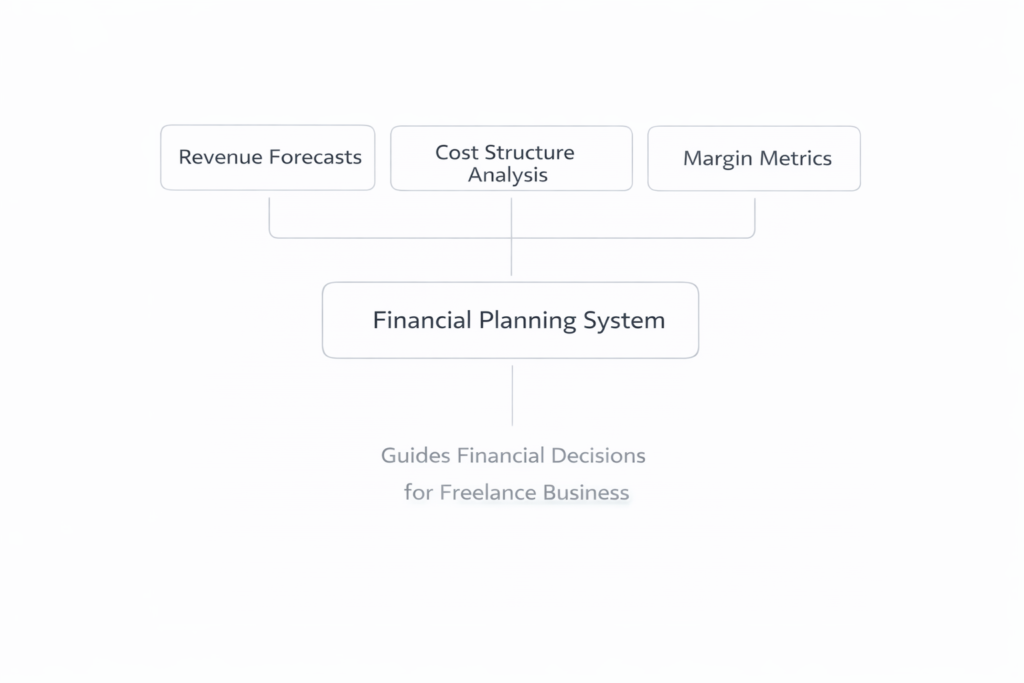
A financial planning system typically includes four analytical components.
1. Revenue Forecasting
Revenue forecasts estimate expected income based on pipeline visibility and historical performance.
→ Forecasting Profit from Pipeline Data
Revenue forecasts help anticipate future financial conditions—but do not indicate sustainability on their own.
2. Cost Structure Analysis
Financial planning requires understanding the full cost structure of the business.
Costs may include:
- fixed operational expenses
- variable project costs
- subcontractor payments
- software and infrastructure
→ Break-Even Analysis for Freelancers
Cost visibility determines whether revenue targets are financially viable.
3. Margin Monitoring
Margin analysis evaluates how efficiently revenue converts into profit.
Key indicators include:
- contribution margin
- gross margin
- effective hourly yield
→ Gross Margin for Freelancers
These metrics reveal whether pricing and delivery structures are sustainable.
4. Profit Forecasting
Profit forecasting combines revenue projections, delivery effort, and cost structure.
This reveals the expected financial outcome of upcoming work.
Profit forecasting enables decision-making before projects begin—not after.
Operational Impact
A structured financial planning system improves several operational outcomes.
Financial Stability
Revenue fluctuations become easier to manage when future income and expenses are anticipated.
Strategic Pricing
Pricing decisions can be evaluated relative to financial projections.
Capacity Alignment
Revenue targets align with realistic delivery capacity.
Investment Planning
Freelancers can allocate resources more deliberately across tools, training, and growth.
Financial planning connects day-to-day decisions with long-term sustainability.
System-Level Impact Across Processome
Financial planning integrates signals across multiple systems.
- Client Pipeline System → revenue forecasts from pipeline activity
- Capacity Planning System → alignment between workload and financial targets
- Profit Tracking System → margin, cost, and profitability visibility
- Delivery & Operations System → execution efficiency affecting cost structure
Financial planning coordinates these systems into a unified financial view.
Common Failure Patterns
Freelancers often weaken financial planning through incomplete or inconsistent data.
Revenue-Only Planning
Ignoring cost structure leads to misleading financial conclusions.
Ignoring Capacity Constraints
Revenue targets exceed realistic workload capacity.
Infrequent Financial Reviews
Plans become outdated when not updated regularly.
Optimistic Forecasting
Overestimating pipeline conversions or margins distorts projections.
Effective financial planning requires conservative assumptions and regular updates.
Strategic Outcome
When freelancers implement a structured financial planning system, decision-making becomes significantly more deliberate.
Instead of reacting to revenue fluctuations, consultants gain visibility into the long-term financial trajectory of their business.
This produces several advantages.
- Improved financial predictability → clearer revenue and cost expectations
- Stronger pricing discipline → align pricing with financial goals
- Better resource allocation → investments based on financial insight
Over time, financial planning transforms freelance consulting into a structured, predictable business.
Final Perspective
Freelancers often track revenue but rarely manage their business through structured financial planning.
Within the Processome operating model, the → Profit Tracking System provides the frameworks required to translate operational activity into financial insight.
A financial planning system integrates these metrics into a coherent decision structure.
Financial clarity allows freelancers to build consulting businesses that are stable, profitable, and resilient.
Planning defines direction.
Execution brings it to life.