Value-Based Pricing for Consultants (How to Price Based on Value, Not Time)
Introduction
Value-based pricing for consultants means pricing your services based on the results you create—not the time you spend.
Many freelancers price their services based on time. They calculate hourly rates, estimate project hours, and multiply effort by a predefined rate.
While this approach is straightforward, it often fails to reflect the actual value created for the client.
Consulting work frequently produces outcomes that exceed the time required to deliver them. Strategic insights, operational improvements, or revenue growth can generate significant business value.
Within the Processome operating model, pricing strategy belongs to the → Profit Tracking System—the financial intelligence layer responsible for aligning revenue with profitability.
Value-based pricing shifts the model from effort-based compensation to outcome-based value creation.
Instead of charging for time, consultants price based on impact.
What is Value-Based Pricing?
Value-based pricing sets fees based on the economic value created for the client rather than the time required to deliver the service.
Instead of asking:
“How many hours will this project take?”
Consultants ask:
“What business outcome will this project create?”
Examples of measurable value include:
- increased revenue
- reduced operational costs
- improved efficiency
- strategic decision support
When pricing reflects these outcomes, revenue becomes less dependent on delivery time.
Value-based pricing creates the potential for significantly higher margins.
Financial metrics used to evaluate pricing outcomes include:
→ Contribution Margin in Freelance Businesses
→ Effective Hourly Rate for Freelancers
These metrics help validate whether value-based pricing produces stronger profitability in practice.
The Core Problem
Most freelancers default to effort-based pricing.
Typical approaches include:
- hourly rates multiplied by delivery hours
- project quotes based on estimated time
- day rates based on market benchmarks
While simple, these approaches introduce structural limitations.
Income Tied to Time
Revenue increases only when additional hours are sold.
Efficiency Penalty
Becoming more efficient reduces billable hours and therefore income.
Value Misalignment
High-impact outcomes may be priced similarly to low-impact work.
Revenue Ceiling
Time-based pricing constrains income by available capacity.
These limitations occur because pricing is linked to effort rather than value.
Value-based pricing addresses this misalignment.
Value-Based Pricing Framework
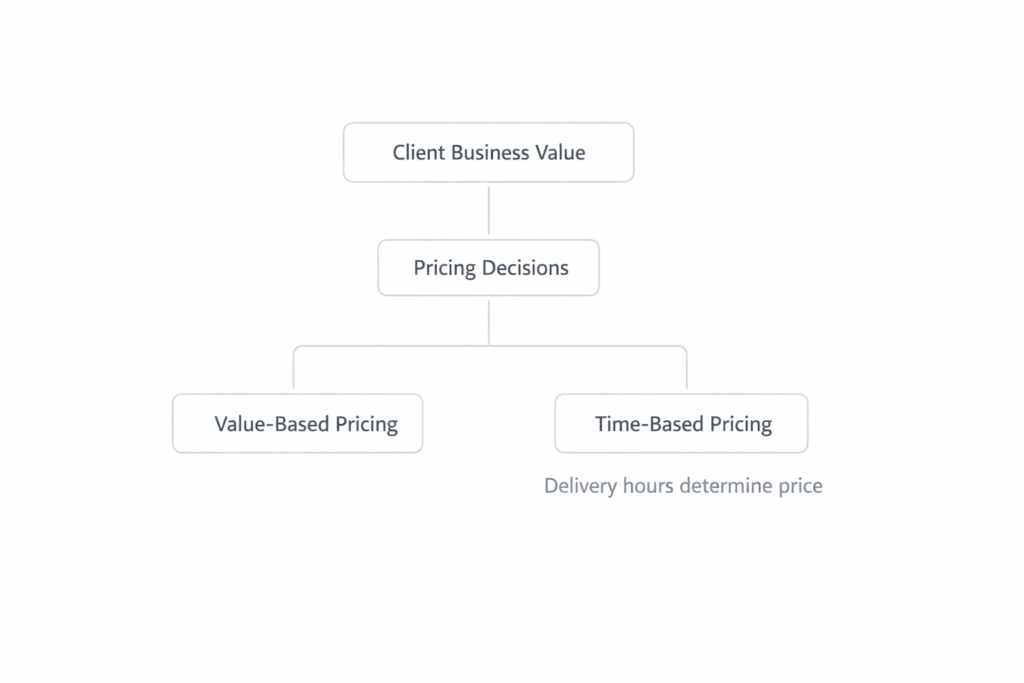
Value-based pricing typically involves three analytical steps.
1. Identify the Client Outcome
The first step is defining the business outcome the engagement aims to produce.
Examples include:
- increasing conversion rates
- improving operational efficiency
- reducing costs
- enabling strategic decisions
Clear outcomes provide the foundation for value-based pricing discussions.
2. Estimate the Economic Value
Consultants estimate the potential economic value created for the client.
For example:
- a marketing improvement may increase revenue by €200,000
- a process optimization may reduce costs by €50,000 annually
Pricing can then reflect a portion of that value rather than the effort required.
This ensures alignment between pricing and business impact.
3. Define the Pricing Structure
Once value is estimated, pricing must be structured appropriately.
Common value-based structures include:
- fixed project fees aligned with expected value
- performance-based pricing
- strategic advisory retainers
The structure must balance value potential with delivery feasibility.
→ Pricing Models for Freelancers
To validate whether value-based pricing actually improves your financial outcomes, you can use:
→ Client Profitability Calculator
This helps compare value-based pricing against delivery effort and profitability.
Operational Impact
Value-based pricing influences several operational dimensions of a consulting business.
Profit Margins
Pricing based on value rather than effort can significantly increase margins.
Revenue Scalability
Income becomes less constrained by available working hours.
Client Alignment
Pricing discussions focus on outcomes and results instead of time.
Market Positioning
Consultants position themselves as strategic partners rather than service providers.
To maintain visibility into how value-based pricing affects profitability over time, structured Profit Tracking Tools for Freelancers can support ongoing analysis.
System-Level Impact Across Processome
Value-based pricing influences multiple operational systems within the Processome architecture.
- Client Pipeline System → attraction of clients seeking strategic outcomes
- Capacity Planning System → higher revenue per unit of capacity
- Profit Tracking System → evaluation of margin improvements
- Delivery & Operations System → focus on delivering measurable outcomes
Pricing becomes closely linked to both strategic positioning and operational execution.
Common Failure Patterns
Freelancers sometimes misunderstand value-based pricing and apply it incorrectly.
Several patterns appear frequently.
Overestimating Client Value
Consultants may assume value levels that clients do not recognize.
Weak Outcome Definition
If outcomes are vague, value-based pricing becomes difficult to justify.
Ignoring Delivery Effort
Pricing must still account for the effort required to deliver results.
Applying Value-Based Pricing to Commodity Work
Routine execution tasks rarely justify value-based pricing.
Value-based pricing works best when services produce measurable business impact.
Strategic Outcome
When value-based pricing is implemented successfully, several structural advantages emerge.
- Higher margins → pricing reflects value, not time
- Stronger client relationships → shift toward strategic partnerships
- Improved scalability → income less dependent on hours worked
Over time, consultants transition from selling labor to delivering outcomes.
Final Perspective
Freelancers often begin by selling time.
More advanced consulting businesses sell value.
Within the Processome operating model, the → Profit Tracking System evaluates how pricing structures influence profitability and long-term sustainability.
Value-based pricing represents a shift from effort-based revenue to outcome-based value creation.
Consultants who implement this model align their income with the impact they deliver.
Time measures effort.
Value measures impact.