Capacity Buffers for Freelancers Explained (Why You Should Never Plan at 100%)
Introduction
Freelance capacity planning is often approached as a problem of maximizing utilization. Many freelancers aim to keep their schedules fully booked to secure predictable income.
However, operating at full utilization creates a fragile delivery structure.
Capacity buffers for freelancers solve this problem by introducing controlled flexibility into workload planning.
Within the Processome operating model, capacity buffers belong to the Capacity Planning System — the framework responsible for structuring how consulting capacity is allocated and protected.
Without a buffer, even minor changes in client demand can disrupt schedules, create delays, or force unsustainable working hours.
With buffers, capacity becomes structured for stability rather than constant utilization.
What are Capacity Buffers?
A capacity buffer is the portion of consulting capacity intentionally left unallocated to absorb variability in workload.
Instead of planning at 100% utilization, freelancers reserve a percentage of their capacity for:
- unexpected scope expansion
- urgent client requests
- coordination and communication
- onboarding new opportunities
For example:
A freelancer with 40 available hours per week may allocate only 32–36 hours to client work, leaving the rest as buffer.
Capacity buffers function as flexibility reserves within the delivery system.
The Core Problem
Many freelancers evaluate capacity primarily through booked hours or utilization.
This leads to the assumption that all available hours should be filled with client work.
While this appears efficient, it introduces structural risks.
Delivery Disruptions
Projects rarely follow perfect timelines. Without buffers, small changes disrupt schedules.
Overwork Cycles
Freelancers compensate for overload by working evenings or weekends.
Inability to Accept New Work
New opportunities cannot be accepted without overloading the schedule.
Delivery Stress
Operating at full capacity reduces flexibility and quality.
These issues occur when capacity is maximized instead of structured.
The Capacity Buffer Framework
A structured capacity model separates workload into three zones.
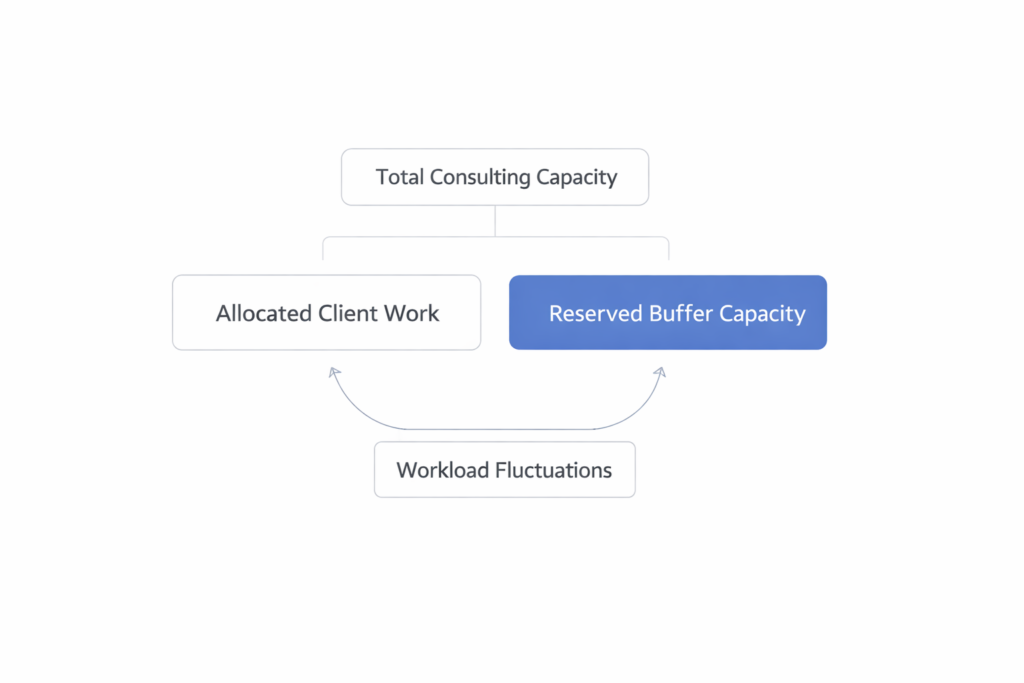
1. Core Client Allocation
This is the capacity assigned to active client work.
It includes:
- retainers
- project work
- recurring engagements
This forms the baseline workload.
2. Buffer Capacity
Buffer capacity is intentionally unallocated time.
| Capacity Model | Buffer Range |
|---|---|
| Aggressive utilization | 5–10% |
| Balanced workload | 10–20% |
| High flexibility model | 20–30% |
For most freelancers, 10–20% buffer provides optimal balance.
This absorbs variability without reducing utilization too much.
3. Flexible Opportunity Space
Part of the buffer supports growth.
This allows freelancers to:
- onboard new clients
- accept short-term work
- handle workload spikes
→ Workload Distribution Across Clients
Buffers support both stability and flexibility.
Operational Impact
Structured buffer capacity improves several operational dimensions.
Delivery Stability
Schedules remain stable despite unexpected changes.
Workload Sustainability
Freelancers avoid constant overload.
Opportunity Flexibility
New work can be accepted without disruption.
If you’re unsure whether your workload leaves enough buffer:
→ Use the Freelance Capacity Planner
To maintain visibility into utilization, workload, and available capacity over time, tools that support:
- time tracking
- workload monitoring
can help structure your workflow.
→ Explore Time & Capacity Tools for Freelancers
System-Level Impact Across Processome
Capacity buffers influence multiple systems.
- Client Pipeline System → intake flexibility
- Capacity Planning System → workload balance
- Profit Tracking System → sustainable revenue
- Delivery & Operations System → execution stability
Buffers improve coordination across the system.
Common Failure Patterns
Freelancers often mismanage buffers due to recurring mistakes.
Full Utilization Planning
Scheduling every hour removes flexibility.
Hidden Workload
Operational work is not accounted for.
Reactive Buffer Creation
Buffers are created only after overload occurs.
Misinterpreting Utilization
High utilization is mistaken for efficiency.
These patterns create fragile systems.
Strategic Outcome
When buffers are implemented deliberately, freelancers gain a more stable structure.
- Reduced delivery risk
Variability no longer disrupts schedules - Improved sustainability
Work remains manageable over time - Greater flexibility
New opportunities can be accepted
Over time, buffers transform capacity planning into a controlled system.
Final Perspective
Freelancers often equate efficiency with fully booked schedules.
In reality, stable consulting operations require controlled flexibility.
Within the Processome operating model, the Capacity Planning System structures how capacity is allocated.
Capacity buffers ensure that freelancers operate with resilience rather than fragility.
Planning less than 100% is not inefficiency.
It is operational control.