Capacity Planning vs Time Management (What Freelancers Get Wrong)
Introduction
Freelancers often try to solve workload problems by improving their time management. They experiment with productivity techniques, scheduling tools, and task systems to become more efficient.
While these approaches can improve daily organization, they rarely solve deeper workload instability.
Capacity planning vs time management is not a question of efficiency — it is a question of control.
Time management focuses on how tasks are scheduled.
Capacity planning focuses on how much work can be accepted.
Within the Processome operating model, capacity planning belongs to the Capacity Planning System — the execution engine responsible for aligning client commitments with realistic delivery capacity.
Time management operates at the task level.
Capacity planning operates at the structural level.
Understanding this distinction is essential for maintaining stable freelance operations.
What is Capacity Planning vs Time Management?
Capacity planning vs time management describes two different layers of workload control.
Capacity planning defines how much work can be accepted based on available delivery capacity.
Time management determines how that work is organized and executed on a daily basis.
Capacity planning evaluates:
- available delivery hours
- workload distribution across clients
- pipeline intake decisions
- buffer capacity
Time management focuses on:
- task prioritization
- scheduling
- calendar organization
- productivity routines
Capacity planning sets the limits.
Time management operates within those limits.
→ Capacity Planning for Freelancers Explained
The Core Problem
Many freelancers experience workload stress even while actively managing their schedules.
Typical responses include:
- adopting new productivity tools
- reorganizing task lists
- using calendar blocking
While these improve short-term organization, they do not address the root cause of overload.
Several structural issues remain.
Excessive Workload Intake
More work is accepted than capacity allows.
Unrealistic Capacity Assumptions
Working hours are mistaken for delivery capacity.
Lack of Buffer Time
Schedules leave no room for variability.
Reactive Scheduling
Client requests constantly interrupt planned work.
These problems occur because workload instability originates from capacity design, not scheduling technique.
The Capacity vs Time Management Framework
The difference can be understood across four operational dimensions.
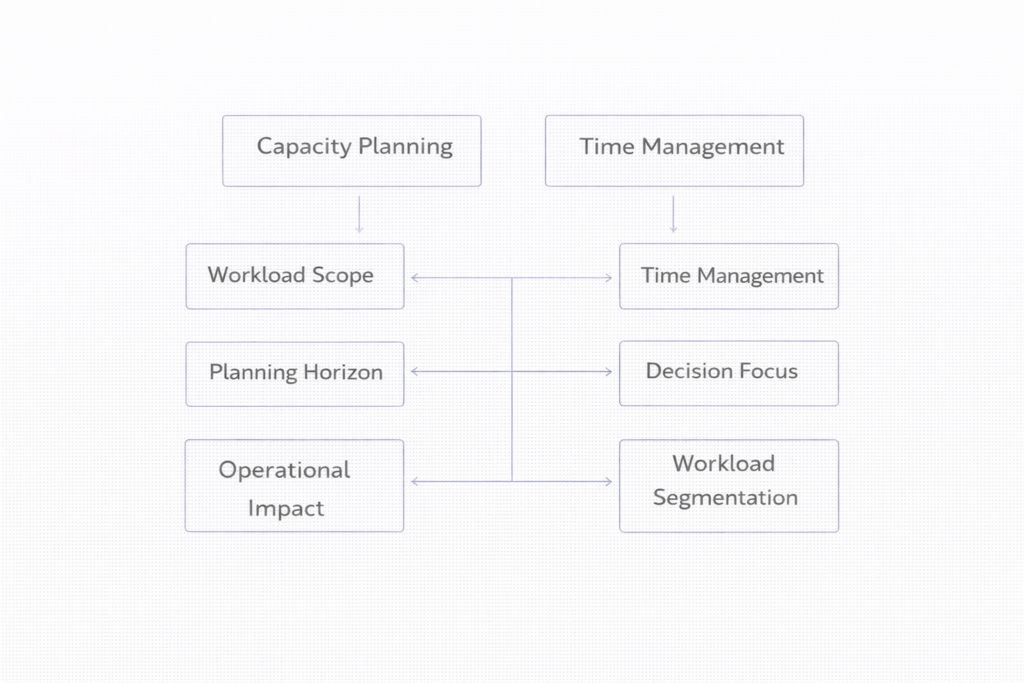
1. Workload Scope
Capacity planning determines the total volume of work that can be accepted.
It defines how many client engagements can realistically be delivered.
Time management focuses on how tasks are scheduled within that workload.
Capacity planning defines the boundaries.
2. Planning Horizon
Capacity planning operates on longer horizons:
- monthly capacity allocation
- pipeline-based forecasting
→ Monthly Capacity Allocation Model
Time management focuses on:
- daily scheduling
- weekly planning
Both are necessary, but they operate at different levels.
3. Decision Focus
Capacity planning informs decisions such as:
- whether to accept new work
- how many projects to manage
- how much buffer to maintain
Time management focuses on:
- task prioritization
- scheduling
- calendar organization
Capacity planning controls intake.
Time management controls execution.
4. Operational Impact
Capacity planning stabilizes workload at a structural level.
When capacity limits are respected:
- schedules remain realistic
- workload spikes decrease
- delivery becomes predictable
Time management improves efficiency within those constraints.
Without capacity planning, better time management often accelerates overload.
Operational Impact
Understanding this distinction improves several operational dimensions.
More Realistic Workload Design
Work is accepted only when capacity exists.
Reduced Delivery Pressure
Schedules remain aligned with realistic limits.
Improved Client Expectations
Deadlines become easier to maintain.
If you’re unsure whether your workload already exceeds your capacity:
→ Use the Freelance Capacity Planner
To support execution, organization, and time visibility, tools that help with:
- time tracking
- scheduling
- task management
can improve daily workflow.
→ Explore Time & Capacity Tools for Freelancers
System-Level Impact Across Processome
Capacity planning integrates multiple systems.
- Client Pipeline System → opportunity intake
- Capacity Planning System → workload feasibility
- Profit Tracking System → revenue alignment
- Delivery & Operations System → execution stability
Time management operates within this broader system.
Common Failure Patterns
Freelancers often misunderstand the relationship between capacity planning and time management.
Treating Productivity Tools as Capacity Solutions
Tools cannot compensate for excessive workload.
Overestimating Billable Time
Not all working hours are available for delivery.
Eliminating Buffer Time
Fully scheduled calendars create fragile systems.
Confusing Efficiency With Feasibility
Working faster does not increase capacity.
Recognizing these patterns improves workload stability.
Strategic Outcome
When freelancers separate capacity planning from time management, several advantages emerge.
- Better workload control
Capacity determines how much work enters the system - More effective scheduling
Time management operates within realistic limits - Improved delivery stability
Workloads remain sustainable - Stronger business resilience
Fluctuations become manageable
Capacity planning becomes the structural foundation.
Final Perspective
Freelancers often attempt to solve workload problems by improving how they schedule tasks.
Time management improves execution.
Capacity planning protects feasibility.
Within the Processome operating model, the Capacity Planning System ensures that workload remains compatible with delivery capacity.
Understanding this distinction allows freelancers to build stable, scalable consulting operations.