How to Increase Proposal Conversion Rate as a Freelancer
Introduction
Many freelance consultants focus heavily on generating new leads. Outreach, networking, and visibility are often treated as the primary drivers of growth.
But pipeline volume alone does not generate revenue. Opportunities only create income when they convert into signed client engagements.
That is why learning how to increase your proposal conversion rate as a freelancer is critical. Improving your freelance proposal conversion rate allows you to generate more revenue from the opportunities you already have—without relying solely on new leads.
Within the Processome operating model, proposal conversion belongs to the → Client Pipeline System, the system responsible for turning qualified opportunities into client work.
The proposal stage is a key transition point in the freelance sales pipeline. At this stage, the client decides whether your proposal provides enough clarity, confidence, and value to move forward.
Improving your proposal conversion rate is not about writing longer proposals. It is about making it easier for clients to make a decision.
What Is Proposal Conversion Rate in Freelancing?
Proposal conversion rate refers to the percentage of proposals that result in accepted client engagements.
For freelancers, this metric reflects both sales effectiveness and pipeline quality.
A low freelance proposal conversion rate often indicates upstream issues:
- the opportunity was poorly qualified
- the client’s problem is unclear
- expectations are misaligned
- pricing is introduced too late
This is why improving proposal conversion is not just about proposal writing.
It starts earlier in the pipeline, especially in:
→ How to Qualify Freelance Leads Strategically
→ Client Qualification Framework for Freelancers
Strong proposals are usually the result of strong qualification and structured discovery—not persuasion alone.
Why Freelance Proposal Conversion Rates Stay Low
Many freelancers struggle to improve proposal conversion rates because proposals are treated as informational documents rather than decision tools.
Typical proposals include:
- long service descriptions
- detailed capability explanations
- extensive background information
While these may demonstrate expertise, they do not necessarily help clients decide.
Clients rarely reject proposals because they lack information. More often, they do not move forward because decision clarity is missing.
Common causes of low proposal conversion rate
Unclear Value
The proposal describes services without linking them to business outcomes.
Excessive Complexity
Long or technical proposals increase cognitive load and delay decisions.
Weak Scope Definition
Ambiguous deliverables create uncertainty.
Pricing Resistance
When value is unclear, pricing appears harder to justify.
These issues often result in stalled proposals instead of clear acceptance or rejection.
The Proposal Conversion Framework
To increase proposal conversion rate as a freelancer, proposals must reduce uncertainty and support decision-making.
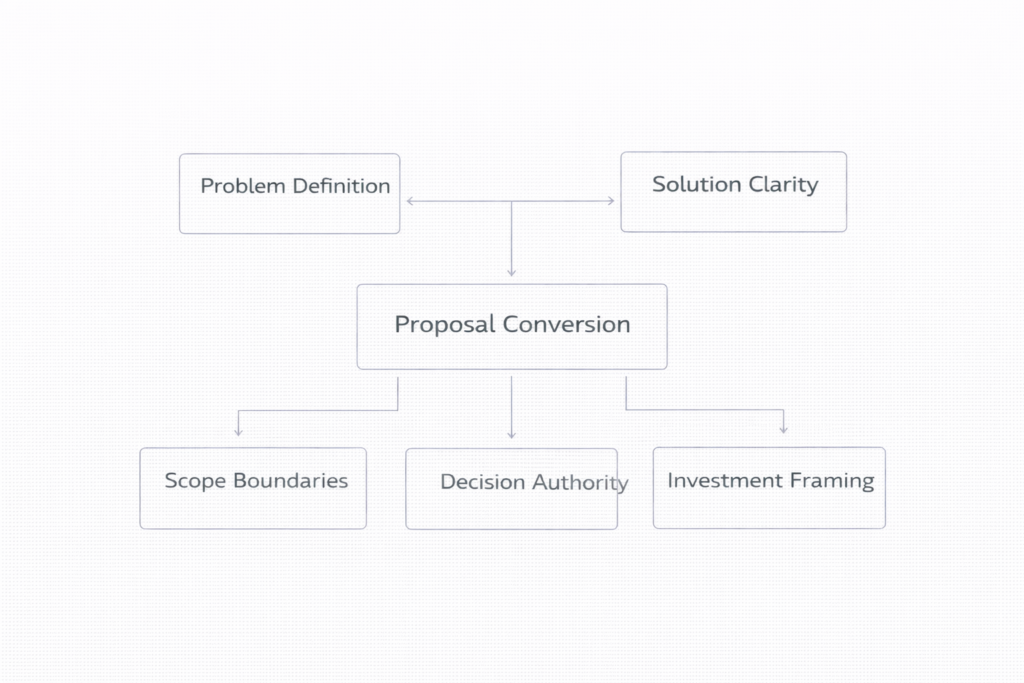
A high-performing freelance proposal conversion framework includes four structural elements.
1. Problem Definition
The proposal must clearly define the client’s problem.
Include:
- current situation
- consequences of inaction
- desired outcome
A clearly defined problem increases proposal relevance and improves conversion probability.
2. Solution Clarity
The proposed solution should be easy to understand.
Key elements:
- clear phases or steps
- transparent approach
- defined outcomes
Clarity reduces friction and improves freelance proposal success rate.
3. Scope Boundaries
Clear scope improves both conversion and delivery performance.
Define:
- deliverables
- timelines
- revision limits
- responsibilities
Strong scope boundaries reduce hesitation during approval.
This also connects to:
→ Delivery & Operations System
4. Investment Framing
Pricing should be framed as an investment in solving a problem.
Emphasize:
- outcomes
- business impact
- strategic value
This makes pricing easier to justify and improves conversion.
For more structured decision support around pricing and deal quality, refer to:
→ Client Pipeline System Tools
Improving Proposal Conversion Earlier in the Pipeline
A key insight:
You cannot consistently increase proposal conversion rate if earlier stages are weak.
Poorly qualified opportunities often lead to low conversion because:
- the problem is unclear
- scope is unstable
- budget is misaligned
- expectations differ
This means improving freelance proposal conversion often requires improving:
- lead qualification
- discovery quality
- pipeline discipline
Not just proposal structure.
Operational Impact of Higher Proposal Conversion Rates
Improving your proposal conversion rate as a freelancer has direct operational benefits.
Increased Pipeline Efficiency
More deals convert without increasing lead volume.
Improved Revenue Predictability
Consistent conversion improves forecasting accuracy.
→ Weighted Revenue Forecasting for Freelancers
Reduced Lead Generation Pressure
Revenue becomes less dependent on constant lead generation.
System-Level Impact Across Processome
Proposal conversion influences multiple systems:
- Client Pipeline System → deal progression
- Capacity Planning System → workload forecasting
- Profit Tracking System → revenue predictability
- Delivery & Operations System → onboarding readiness
Higher conversion strengthens the entire system.
Common Failure Patterns
Freelancers often struggle to improve proposal conversion due to:
Overly Long Proposals
Too much information slows decisions.
Excessive Self-Focus
Focusing on capabilities instead of the client’s problem.
Vague Outcomes
Unclear results reduce perceived value.
Delayed Pricing Discussion
Late pricing introduces friction.
These patterns reduce freelance proposal conversion rates.
Strategic Outcome
When you improve your proposal conversion rate as a freelancer, several advantages emerge:
Higher Revenue Efficiency
More opportunities convert into paying clients.
Better Pipeline Visibility
Conversion becomes a reliable performance signal.
Reduced Acquisition Pressure
Less dependence on constant lead generation.
Stronger Client Alignment
Expectations are clearer before delivery begins.
Over time, this leads to a more stable and predictable consulting business.
Final Perspective
Freelancers often assume growth depends on generating more leads. In reality, a significant portion of growth comes from improving how effectively existing opportunities convert.
Learning how to increase proposal conversion rate as a freelancer allows you to turn more qualified opportunities into real revenue.
Within the Processome operating model, proposal conversion strengthens the Client Pipeline System—ensuring that opportunities move consistently from interest to engagement.