Retainer Capacity Planning Model: How to Manage Recurring Freelance Workload
Introduction
Retainers are often presented as the solution to freelance income volatility. They create predictable revenue, reduce sales pressure, and support longer client relationships.
However, retainers also introduce a structural constraint: recurring delivery commitments that permanently occupy consulting capacity.
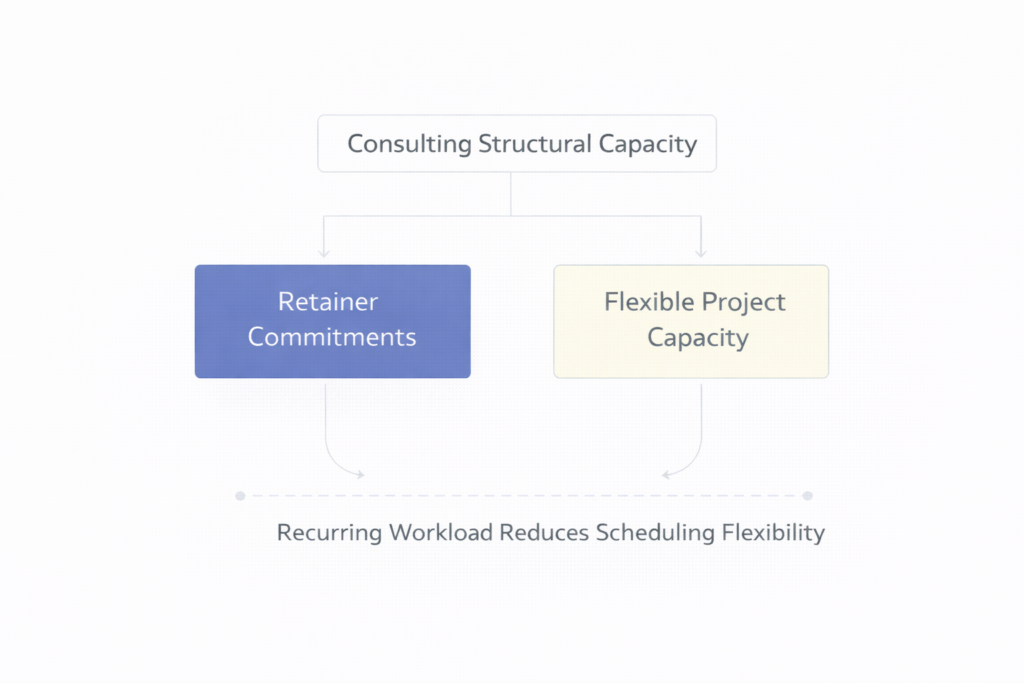
Unlike projects, retainers do not reset after completion. They remain active month after month, gradually consuming structural capacity and reducing scheduling flexibility.
Within the Processome operating model, retainer capacity planning belongs to the Capacity Planning System — the execution framework responsible for aligning recurring workload with sustainable delivery capacity.
For solo consultants, retainers must be modeled carefully. When structured correctly, they stabilize revenue. When accepted without capacity modeling, they create hidden rigidity inside the delivery schedule.
Understanding how to plan retainer capacity for freelancers is essential for maintaining both predictable income and flexible workload management.
Retainers reduce volatility.
They also increase structural obligation.
What is a Retainer Capacity Planning Model?
A retainer capacity planning model evaluates how recurring client commitments interact with structural consulting capacity.
Instead of focusing only on revenue, freelancers assess how retainers consume delivery capacity over time.
This includes evaluating:
- actual delivery hours required by each retainer
- coordination and communication overhead
- cumulative impact across multiple clients
- remaining flexible capacity for project work
For example:
| Retainer Client | Contract Hours | Actual Delivery Hours |
|---|---|---|
| Client A | 10 hours | 14 hours |
| Client B | 8 hours | 10 hours |
| Client C | 12 hours | 15 hours |
Capacity planning must reflect actual execution time — not nominal contract hours.
This connects closely with:
→ Freelance Capacity Model (Hours vs Revenue)
→ Profit Tracking System
A retainer capacity planning model ensures that recurring commitments remain within sustainable delivery limits.
The Core Problem
Freelancers often accept retainers based on their financial appeal.
Common decision drivers include:
- predictable monthly revenue
- perceived lower delivery intensity
- strategic client relationships
However, many freelancers do not evaluate how multiple retainers interact within their capacity structure.
Several structural issues appear over time.
Hidden Capacity Consumption
Each retainer occupies recurring delivery capacity, often exceeding its nominal contract hours.
Gradual Utilization Increase
As retainers accumulate, overall utilization increases gradually without triggering immediate overload signals.
Reduced Scheduling Flexibility
Recurring commitments reduce the amount of flexible capacity available for project work or new clients.
Coordination Overhead
Each retainer introduces meetings, communication cycles, and decision overhead.
Individually, retainers appear manageable.
Collectively, they consume a significant portion of structural capacity.
Retainers rarely create sudden overload.
They create gradual rigidity.
Retainer Capacity Planning Framework
Retainer planning requires evaluating three operational dimensions.
1. Retainer Workload Definition
Each retainer must be defined in operational terms.
This includes estimating:
- monthly delivery hours
- coordination and meeting time
- revision cycles and adjustments
Planning models must reflect actual delivery effort, not contractual expectations.
2. Structural Capacity Allocation
Retainers consume recurring structural capacity.
Example capacity model:
| Capacity Variable | Value |
|---|---|
| Structural capacity | 120 hours |
| Target utilization | 75% |
| Safe delivery capacity | 90 hours |
If retainers consume 60 hours per month:
→ 30 hours remain available for projects and buffers
Remaining capacity must absorb:
- project work
- workload variability
- delivery buffers
Retainers reduce maneuverability within the delivery schedule.
Capacity modeling is explained in:
→ Freelance Capacity Model (Hours vs Revenue)
3. Concurrency Effects
Retainers rarely operate independently.
Multiple retainers introduce parallel coordination cycles, including:
- separate communication channels
- independent deadlines
- context switching
- decision overhead
For example, four 10-hour retainers are not equivalent to one 40-hour project.
Parallel client relationships increase cognitive load and coordination time.
Client portfolio complexity is explored in:
→ How Many Clients Can a Freelancer Handle
Capacity constraints are not only quantitative.
They are also structural.
Operational Impact
Structured retainer capacity planning improves several aspects of freelance consulting operations.
Revenue Stability
Recurring retainers provide predictable income while maintaining sustainable workload levels.
Capacity Visibility
Freelancers gain clarity about how much flexible capacity remains available.
Workload Stability
Delivery commitments remain aligned with structural capacity.
Strategic Flexibility
Consultants maintain the ability to accept project work alongside recurring commitments.
System-Level Impact Across Processome
Retainer capacity planning influences coordination between recurring revenue, delivery capacity, and client portfolio structure.
- Client Pipeline System → retainer qualification aligned with capacity constraints
- Capacity Planning System → allocation of recurring delivery commitments
- Profit Tracking System → predictable revenue through recurring agreements
- Delivery & Operations System → stable scheduling of ongoing client work
Modeling retainer capacity improves coordination between client acquisition, delivery planning, and consulting operations.
Common Failure Patterns
Retainers often create hidden capacity pressure because they appear stable and predictable.
Several recurring mistakes appear.
Accepting Retainers Without Modeling Hours
Contract hours are accepted without measuring actual execution time.
Increasing Utilization Because Revenue Feels Stable
Stable income creates the illusion that higher utilization is safe.
Ignoring Coordination Overhead
Each retainer increases communication, reporting, and context switching.
Eliminating Buffers
Project work is added on top of retainers without preserving structural buffers.
Buffer discipline is explained in:
→ Delivery Buffer Design for Freelancers
Stability without buffers eventually becomes rigidity.
Strategic Outcome
When retainer capacity is modeled explicitly, freelancers maintain both revenue stability and operational flexibility.
Instead of allowing recurring commitments to dominate their schedule, consultants allocate retainer work within defined capacity limits.
This produces several advantages.
- Controlled utilization
Retainers remain aligned with sustainable workload levels - Preserved scheduling flexibility
Project work and strategic opportunities remain possible - Stable revenue foundation
Recurring income supports predictable financial planning
Over time, retainers become strategic assets rather than structural constraints.
Final Perspective
Retainers create predictable revenue.
However, predictable revenue without capacity modeling introduces hidden operational pressure.
Within the Processome operating model, the Capacity Planning System ensures that recurring client commitments remain aligned with delivery capacity. The retainer capacity planning model translates revenue agreements into execution constraints.
Freelancers who model retainer capacity deliberately:
- control structural rigidity
- preserve scheduling flexibility
- protect long-term sustainability
Stability must be engineered.
Otherwise it becomes limitation.