Effective Hourly Rate for Freelancers (How to Calculate Your Real Earnings)
Introduction
Effective hourly rate for freelancers reveals how much you actually earn per hour of work—not just what you charge.
Freelancers often evaluate pricing through stated hourly rates or project fees. However, the rate a consultant charges is rarely the same as the rate they actually earn.
Client work frequently includes revisions, coordination, research, and other activities that extend beyond the originally estimated delivery effort. As a result, real earnings per hour can differ significantly from the listed price.
Within the Processome operating model, financial visibility belongs to the → Profit Tracking System—the framework responsible for translating revenue into measurable profitability.
The effective hourly rate (EHR) measures the real financial yield of consulting work by dividing revenue by the total delivery effort required to produce that revenue.
For solo consultants, this metric provides one of the clearest indicators of whether pricing and delivery effort are aligned.
Listed rates represent expectations.
Effective hourly rate reveals reality.
What is Effective Hourly Rate?
The effective hourly rate (EHR) measures the real revenue generated per hour of work required to deliver client services.
The formula is straightforward:
Effective Hourly Rate = Project Revenue ÷ Total Hours Spent
The key variable is total hours spent, which must include all delivery-related activities such as:
- production work
- research and analysis
- revisions
- meetings and communication
- project management tasks
For example:
| Project | Revenue | Hours Worked | Effective Hourly Rate |
|---|---|---|---|
| Project A | €4,000 | 40h | €100 |
| Project B | €4,000 | 65h | €61.5 |
Although both projects generate identical revenue, their profitability differs substantially.
To calculate this accurately for your own projects, you can use:
→ Client Profitability Calculator
This helps translate revenue and total delivery time into your real hourly earnings.
Time measurement methods are discussed in:
→ Time Tracking vs Capacity Planning
The Core Problem
Many freelancers evaluate pricing based on nominal hourly rates or total project value.
For example:
- €100 per hour
- €5,000 project fee
- €2,000 monthly retainer
However, these numbers do not reflect how much time is actually required to deliver the work.
Several factors distort the relationship between price and real earnings.
Scope Expansion
Clients often request additional changes or clarifications beyond the original scope.
Communication Overhead
Meetings, emails, and coordination often require significant time not included in estimates.
Underestimated Delivery Effort
Complex projects frequently require more analysis and revisions than initially expected.
Non-Billable Operational Work
Sales conversations, proposal writing, and onboarding reduce real financial return.
When these factors are ignored, freelancers may believe they are earning higher rates than they actually achieve in practice.
The effective hourly rate exists to reveal this gap.
Effective Hourly Rate Framework
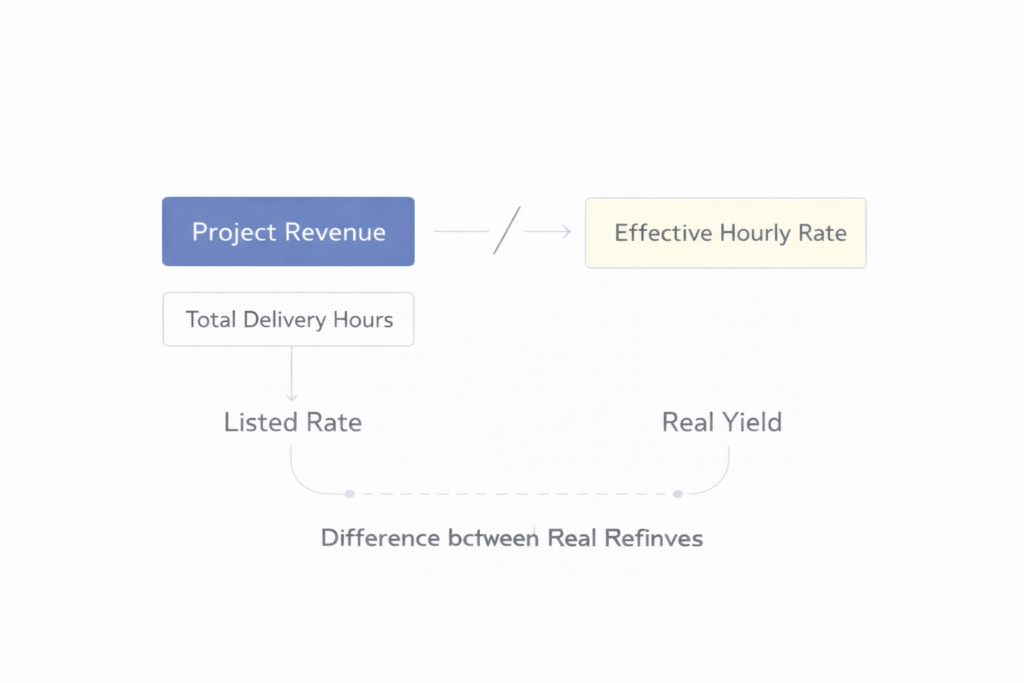
Calculating effective hourly rate requires evaluating three operational components.
1. Project Revenue
Revenue represents the total amount paid by the client for a project or engagement.
Examples include:
- project fees
- retainers
- advisory engagements
Revenue provides the numerator of the calculation—but does not indicate efficiency.
2. Total Delivery Hours
Total delivery hours include every hour required to complete the project.
This includes:
- core delivery work
- revisions and adjustments
- communication and meetings
- internal coordination
Many freelancers underestimate this value, leading to inflated expectations about earnings.
3. Effective Hourly Yield
Once total hours are calculated, the effective hourly rate becomes visible.
This metric allows freelancers to compare projects based on financial efficiency rather than revenue size.
For example:
| Project | Revenue | Hours | Effective Rate |
|---|---|---|---|
| Project A | €5,000 | 50h | €100 |
| Project B | €5,000 | 80h | €62.5 |
Although both projects generate identical revenue, their financial performance differs significantly.
This concept connects directly to:
→ Contribution Margin in Freelance Businesses
Operational Impact
Tracking effective hourly rate improves several operational decisions.
Pricing Strategy
Freelancers gain insight into whether project pricing reflects actual delivery effort.
Client Profitability
Consultants can identify which engagements produce the highest financial return.
Workload Allocation
High-yield projects can be prioritized within limited consulting capacity.
Financial Forecasting
Understanding effective hourly yield improves the accuracy of revenue and profit projections.
If you are managing multiple projects, structured Profit Tracking Tools for Freelancers can help maintain visibility into time usage and financial performance.
System-Level Impact Across Processome
Effective hourly rate connects revenue performance with workload allocation and profitability across the Processome architecture.
- Client Pipeline System → prioritization of high-value opportunities
- Capacity Planning System → allocation of delivery time toward profitable work
- Profit Tracking System → measurement of financial yield per hour of work
- Delivery & Operations System → control of scope expansion and delivery efficiency
Effective hourly rate improves coordination between pricing strategy, workload planning, and financial performance.
Common Failure Patterns
Freelancers frequently misinterpret their financial performance because effective hourly rate is not measured consistently.
Several patterns appear frequently.
Relying on Nominal Hourly Rates
Freelancers evaluate projects using listed rates rather than actual delivery time.
Ignoring Coordination Time
Meetings, emails, and project management are excluded from time calculations.
Underestimating Revisions
Complex projects require multiple iterations that increase delivery hours.
Evaluating Revenue Instead of Yield
High-revenue projects may still produce weak financial returns.
These patterns obscure the real profitability of freelance work.
Strategic Outcome
When freelancers calculate effective hourly rate consistently, financial decision-making improves significantly.
Instead of focusing only on revenue growth, consultants begin optimizing for financial efficiency.
This produces several advantages.
- More accurate pricing decisions → align pricing with delivery effort
- Better client selection → identify low-yield engagements
- Improved workload allocation → prioritize high-return work
Over time, effective hourly rate transforms freelance pricing from assumption-based to data-driven.
Final Perspective
Freelancers often define their value through listed rates or project fees.
However, real financial performance depends on how much time is required to deliver that work.
Within the Processome operating model, the → Profit Tracking System translates project revenue into measurable profitability.
The effective hourly rate provides one of the clearest indicators of whether pricing, delivery effort, and workload allocation are aligned.
Rates describe intention.
Effective hourly rate reveals outcome.