Project Retrospectives for Consultants
Introduction
Consulting engagements often conclude once deliverables have been presented and accepted by the client. At that point, freelancers typically move immediately to the next project without formally evaluating how the engagement performed.
However, every completed project contains valuable operational insight. Without structured reflection, freelancers may repeat the same delivery inefficiencies, scope challenges, or coordination issues across multiple engagements.
Within the Processome operating model, retrospective analysis belongs to the → Delivery & Operations System, the operational framework responsible for continuously improving delivery processes.
Project retrospectives create a structured opportunity to review what worked well, what created friction, and how future engagements can improve.
Instead of treating projects as isolated events, freelancers use retrospectives to strengthen their operational systems.
Continuous improvement depends on systematic reflection.
The Core Problem
Many freelancers focus primarily on project execution and client satisfaction.
Once a project is completed, attention shifts quickly to:
- new client work
- ongoing engagements
- pipeline activity
As a result, the delivery process itself is rarely evaluated.
This creates several operational risks.
Repeated Operational Friction
Recurring problems such as scope confusion or delayed feedback may appear in multiple projects.
Inefficient Workflows
Delivery processes that consume excessive time may remain unchanged.
Missed Improvement Opportunities
Freelancers may overlook patterns that could improve future projects.
Inconsistent Learning
Lessons learned from one engagement may not transfer to future work.
Without structured retrospectives, operational improvement occurs slowly and inconsistently.
Concept Explanation
A project retrospective is a structured review conducted after a consulting engagement has been completed.
The purpose of the retrospective is to evaluate the project from an operational perspective.
Instead of focusing only on outcomes, retrospectives analyze the processes used during delivery.
Typical evaluation areas include:
- project planning effectiveness
- communication with the client
- scope management
- delivery workflow efficiency
Retrospectives transform project experience into operational knowledge.
This framework complements other delivery systems such as:
→ Delivery Workflow Systems
→ Quality Assurance for Freelancers
Workflows guide execution, while retrospectives refine those workflows over time.
Project Retrospective Framework
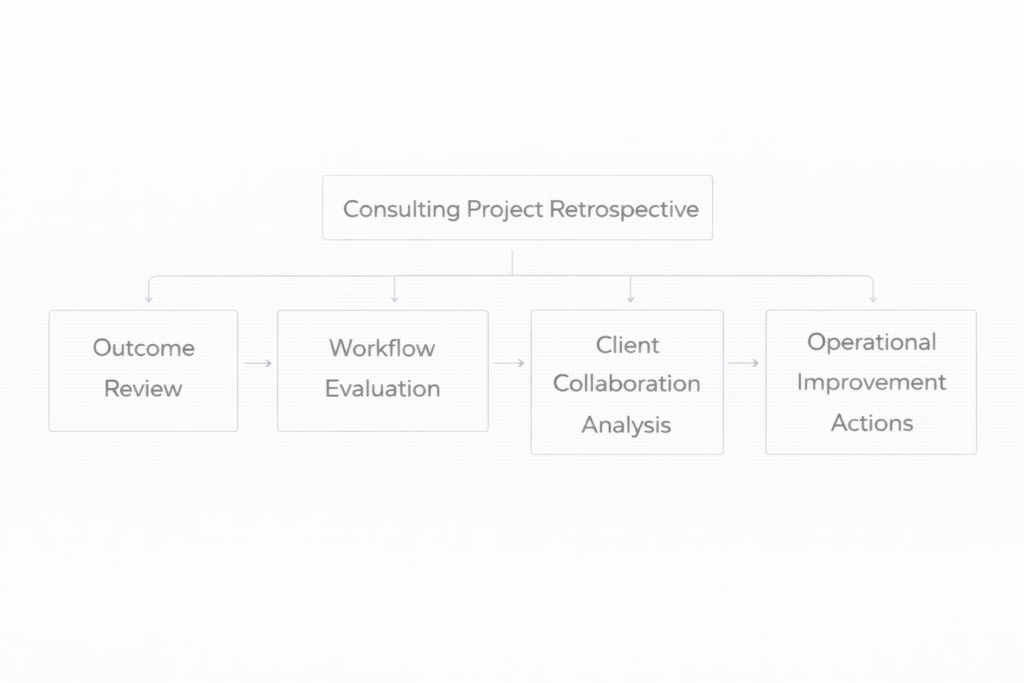
A structured retrospective framework typically includes four evaluation dimensions.
1. Outcome Evaluation
The first step is evaluating whether the project achieved its intended objectives.
Freelancers may review:
- whether the deliverables addressed the client’s problem
- whether the outcomes met expectations
- client satisfaction with the final results
Outcome evaluation confirms the effectiveness of the engagement.
2. Delivery Workflow Analysis
Next, the delivery process itself should be reviewed.
Questions may include:
- Did the workflow structure support efficient execution?
- Were there delays between project stages?
- Did tasks progress smoothly across milestones?
This analysis helps identify operational inefficiencies.
3. Client Collaboration Review
Consulting projects involve continuous interaction with clients.
Retrospectives should therefore evaluate collaboration patterns.
Freelancers may review:
- communication clarity
- responsiveness of feedback cycles
- expectation alignment
Collaboration review helps improve future client interactions.
4. Operational Improvements
Finally, insights from the retrospective should translate into concrete operational adjustments.
Possible improvements include:
- refining project planning frameworks
- adjusting communication structures
- improving workflow systems
Operational improvements ensure that lessons learned translate into better future delivery.
Operational Impact
Implementing structured project retrospectives improves several aspects of freelance consulting operations.
Continuous Process Improvement
Freelancers refine operational systems based on real project experience.
Reduced Delivery Friction
Recurring operational issues are identified and addressed.
Stronger Delivery Systems
Insights from retrospectives strengthen project workflows and planning frameworks.
Higher Consulting Quality
Improved processes lead to more reliable project outcomes.
Retrospectives therefore transform experience into structured operational improvement.
System-Level Impact Across Processome
Project retrospectives strengthen coordination across the Processome operating architecture.
Client Pipeline System → insights improve client qualification and project alignment
Capacity Planning System → delivery lessons improve future workload planning
Profit Tracking System → project analysis reveals profitability patterns
Delivery & Operations System → operational processes improve through structured reflection
Retrospectives ensure that consulting systems evolve over time.
Common Failure Patterns
Freelancers often overlook retrospectives because project completion feels like the end of the work.
Several patterns frequently appear.
Skipping Post-Project Reviews
Freelancers immediately begin new work after delivery.
Focusing Only on Client Satisfaction
Operational processes remain unexamined.
Informal Reflection
Insights are considered briefly but not documented.
No System Changes
Even when issues are identified, operational processes remain unchanged.
These patterns prevent delivery systems from improving.
Strategic Outcome
When project retrospectives become a consistent operational practice, freelance consulting operations evolve more rapidly.
Instead of repeating the same delivery patterns, freelancers systematically refine their workflows and collaboration structures.
This produces several advantages.
Improved operational efficiency
Workflows become more effective over time.
Stronger client collaboration
Communication patterns improve through reflection.
Better project outcomes
Lessons from past projects improve future delivery.
Continuous system improvement
Operational frameworks evolve through real project experience.
Retrospectives transform project completion into a learning process.
Final Perspective
Freelancers often focus heavily on starting projects but overlook the importance of reviewing them after completion.
However, long-term consulting performance depends not only on execution but also on continuous improvement.
Within the Processome operating model, the → Delivery & Operations System ensures that each completed engagement contributes to stronger delivery systems.
Every project contains operational insight.
Retrospectives convert that insight into improvement.