Quality Assurance for Freelancers
Introduction
Consulting clients expect consistent, reliable, and high-quality deliverables. However, in many freelance consulting businesses, quality control remains informal. Deliverables may be prepared quickly and sent to clients without structured review processes.
While this approach may work in simple engagements, it becomes increasingly risky as project complexity grows.
Within the Processome operating model, quality control belongs to the → Delivery & Operations System, the operational framework responsible for maintaining execution stability and consistent delivery standards.
Quality assurance systems ensure that consulting deliverables meet defined standards before they are presented to clients.
Instead of relying solely on expertise and experience, freelancers implement structured processes that verify deliverable quality.
Consistent quality is rarely accidental.
It is the result of structured operational controls.
The Core Problem
Many freelancers perform quality checks informally.
A deliverable may be reviewed briefly before sending it to the client, but no structured verification process exists.
As project complexity increases, this approach introduces several operational risks.
Inconsistent Deliverable Quality
Different projects may receive different levels of review and refinement.
Overlooked Errors
Small mistakes or inconsistencies may remain unnoticed until clients review the deliverable.
Increased Revision Cycles
Clients may request additional revisions due to quality issues that could have been addressed earlier.
Reputational Risk
Repeated quality issues may reduce client confidence in the consulting work.
These issues rarely arise from lack of expertise.
They usually reflect the absence of structured quality control processes.
Concept Explanation
Quality assurance is the structured process of reviewing consulting deliverables before they are shared with the client.
Instead of relying on last-minute checks, freelancers implement defined review procedures that verify:
- accuracy of analysis
- clarity of communication
- consistency of deliverable structure
- alignment with project objectives
Quality assurance ensures that deliverables meet both professional standards and client expectations.
Quality control is closely connected with other delivery frameworks such as:
→ Delivery Workflow Systems
→ Project Planning for Freelancers
Workflows define how work progresses, while quality assurance verifies the outputs of those workflows.
Together, they create reliable delivery systems.
Quality Assurance Framework
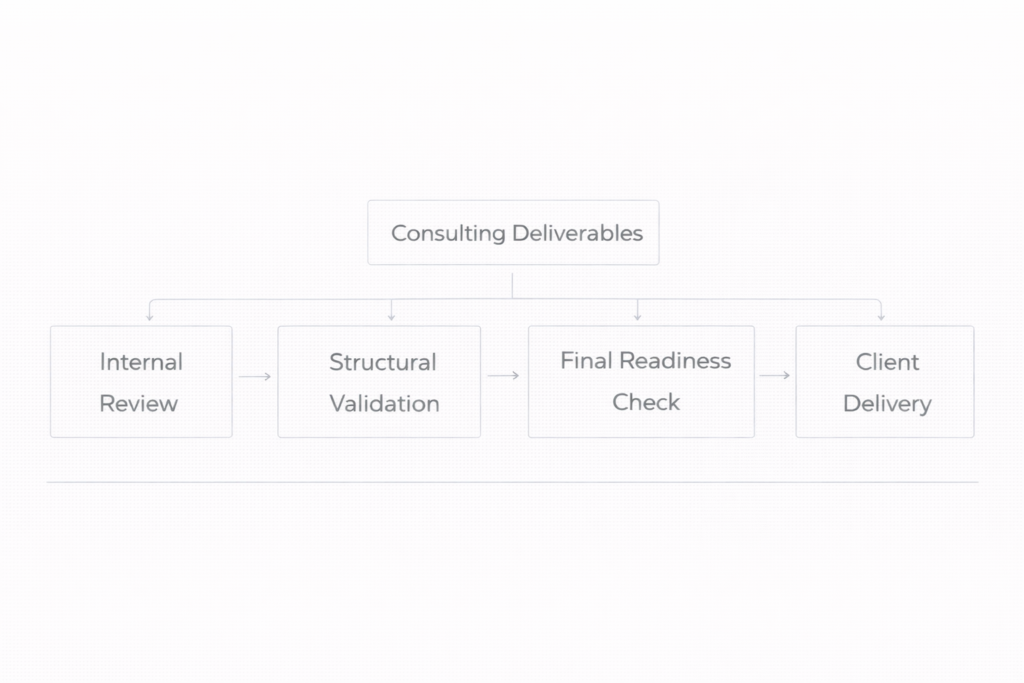
A structured quality assurance framework typically includes four operational stages.
1. Deliverable Self-Review
Before sharing work externally, freelancers should perform an internal review.
This review may verify:
- accuracy of data or analysis
- completeness of deliverables
- clarity of explanations
Self-review ensures that the deliverable meets basic professional standards.
2. Structural Review
Consulting deliverables should also be evaluated for structural clarity.
This review may assess:
- logical organization of content
- clarity of recommendations
- visual consistency in documents or presentations
Structural clarity improves client understanding and communication.
3. Objective Alignment Check
The deliverable should be evaluated against the original project objectives.
Freelancers should confirm that the work:
- addresses the defined problem
- provides actionable insights
- aligns with expected outcomes
This step ensures that the deliverable remains aligned with the client’s goals.
4. Final Delivery Validation
Before sharing deliverables with the client, a final verification step should occur.
This stage confirms:
- formatting consistency
- completeness of documentation
- readiness for presentation or discussion
Final validation ensures that deliverables represent the highest quality version of the work.
Operational Impact
Implementing quality assurance systems improves several operational aspects of freelance consulting businesses.
Consistent Deliverable Quality
Structured reviews ensure that outputs meet defined standards.
Reduced Revision Cycles
Clients receive more refined deliverables, reducing additional revisions.
Improved Client Confidence
High-quality outputs strengthen professional credibility.
Greater Delivery Efficiency
Clear review processes reduce last-minute corrections.
Quality assurance therefore improves both operational reliability and client experience.
System-Level Impact Across Processome
Quality assurance processes influence coordination across the Processome operating architecture.
Client Pipeline System → strong delivery reputation improves client acquisition credibility
Capacity Planning System → reduced revision cycles improve workload efficiency
Profit Tracking System → higher quality delivery protects margins by reducing rework
Delivery & Operations System → structured review processes ensure consistent execution quality
Quality systems therefore reinforce both operational stability and financial performance.
Common Failure Patterns
Freelancers often encounter quality issues because review processes remain informal.
Several patterns frequently appear.
Skipping Structured Reviews
Deliverables are sent to clients without internal verification.
Rushed Final Checks
Freelancers review deliverables quickly due to time pressure.
Inconsistent Standards
Different projects receive different levels of quality control.
Late Error Detection
Mistakes are discovered only after client feedback.
These behaviors increase revision cycles and reduce delivery reliability.
Strategic Outcome
When quality assurance frameworks are implemented consistently, freelance consulting deliverables become significantly more reliable.
Instead of relying solely on expertise, freelancers implement structured review processes that ensure consistent output quality.
This produces several advantages.
Higher deliverable quality
Structured reviews improve accuracy and clarity.
Reduced rework
Clients request fewer revisions.
Improved professional reputation
Consistently strong deliverables strengthen client trust.
Stronger operational discipline
Quality becomes an operational process rather than a last-minute check.
Quality assurance transforms expertise into reliable delivery.
Final Perspective
Freelancers often assume that strong expertise alone guarantees high-quality deliverables.
However, expertise without structured review processes can still produce inconsistent results.
Within the Processome operating model, the → Delivery & Operations System ensures that consulting outputs pass through structured quality controls before reaching clients.
Consistent quality emerges from disciplined operational processes.