Managing Client Expectations
Introduction
Consulting projects often succeed or fail not because of technical expertise, but because of expectation alignment. When clients and consultants hold different assumptions about deliverables, timelines, or communication, delivery friction quickly emerges.
Expectation misalignment can lead to:
- repeated revisions
- delayed feedback cycles
- expanding scope
- strained client relationships
Within the Processome operating model, expectation management belongs to the → Delivery & Operations System, the framework responsible for ensuring stable collaboration between consultant and client throughout a project.
Managing expectations is not a single conversation at the beginning of an engagement. It is a continuous operational practice that ensures clients understand how the project will progress and what outcomes are realistic.
Clear expectations create stable collaboration.
Unclear expectations create operational friction.
The Core Problem
Many freelancers assume that expectations are implicitly understood once a proposal has been accepted.
However, proposals rarely eliminate all ambiguity.
Clients may still hold different assumptions about:
- the level of detail in deliverables
- the speed of delivery
- the number of revision cycles
- the frequency of communication
When these assumptions remain unspoken, misalignment appears later in the project.
Several operational issues may follow.
Repeated Clarification
Freelancers may spend significant time explaining deliverables or timelines.
Delayed Feedback
Clients may provide feedback later than expected, slowing delivery progress.
Scope Expansion
Clients may request additional work because project boundaries were unclear.
Relationship Tension
Misaligned expectations can create frustration even when the work itself is high quality.
Expectation misalignment is therefore a structural operational risk.
Concept Explanation
Expectation management is the structured process of clarifying how a consulting engagement will operate before and during delivery.
Rather than assuming mutual understanding, freelancers explicitly define:
- project objectives and deliverables
- project timelines and milestones
- communication structure
- review and feedback processes
This clarity ensures that clients understand not only what will be delivered, but also how the engagement will unfold operationally.
Expectation management typically begins during onboarding and continues throughout delivery.
It connects closely with frameworks such as:
→ Client Onboarding System for Freelancers
→ Project Kickoff Framework for Consultants
Onboarding establishes initial expectations, while kickoff alignment confirms how the project will operate during execution.
Client Expectation Management Framework
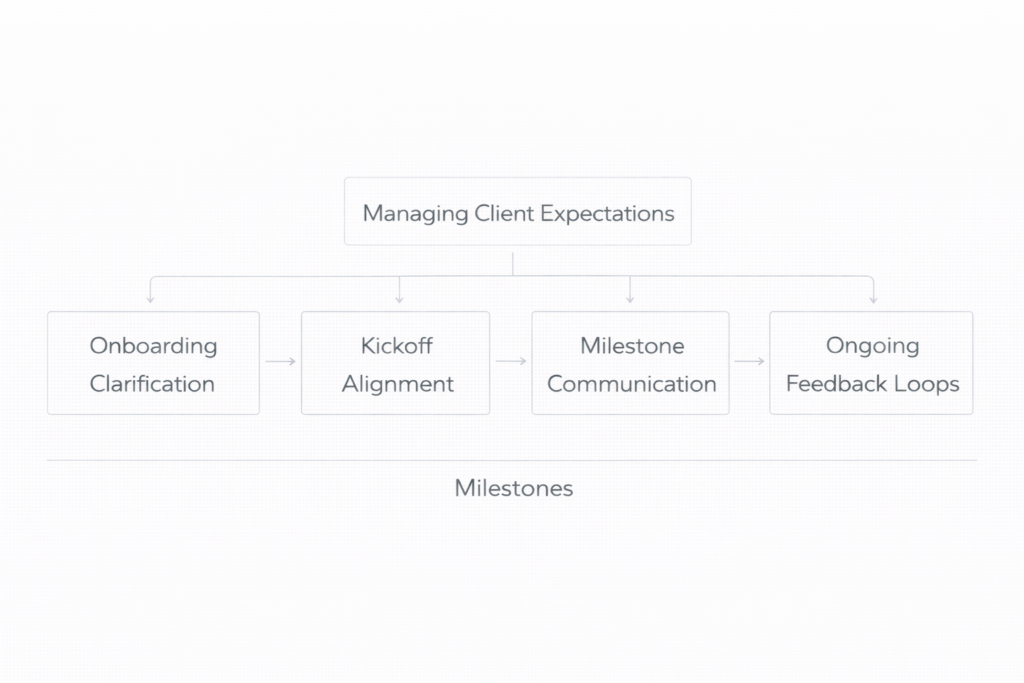
A structured expectation management framework typically includes four operational components.
1. Initial Expectation Alignment
Expectation management begins before delivery starts.
Freelancers should confirm:
- the problem the project addresses
- expected outcomes
- deliverable structure
This stage ensures that both consultant and client share a common understanding of the project’s purpose.
2. Delivery Structure Communication
Clients should understand how the project will progress.
This includes:
- milestone timelines
- review sessions
- feedback cycles
Clear delivery structure helps clients anticipate when their input will be required.
This connects directly to:
→ Project Planning for Freelancers
3. Communication Norms
Expectation management also includes defining communication patterns.
Freelancers may clarify:
- response time expectations
- meeting frequency
- preferred communication channels
Clear communication norms reduce operational friction.
4. Ongoing Alignment
Expectations should be revisited throughout the project.
Milestone reviews provide opportunities to confirm:
- project progress
- alignment with objectives
- necessary adjustments
Continuous alignment prevents misunderstandings from accumulating.
Operational Impact
Effective expectation management improves several operational aspects of freelance consulting engagements.
Reduced Delivery Friction
Clear expectations minimize misunderstandings.
Faster Feedback Cycles
Clients know when and how feedback should be provided.
Stable Project Scope
Expectation clarity reduces the likelihood of uncontrolled scope expansion.
Stronger Client Relationships
Transparent communication improves trust and collaboration.
Expectation management therefore strengthens both operational stability and client experience.
System-Level Impact Across Processome
Expectation management influences coordination across the Processome operating architecture.
Client Pipeline System → opportunity expectations clarified during discovery and proposal stages
Capacity Planning System → project timelines align with realistic delivery capacity
Profit Tracking System → margin visibility improves through controlled scope expectations
Delivery & Operations System → execution stability through consistent client alignment
Clear expectations ensure that consulting engagements remain aligned with operational realities.
Common Failure Patterns
Freelancers often experience expectation misalignment because assumptions remain implicit.
Several patterns frequently appear.
Vague Deliverable Descriptions
Deliverables are described broadly without defining what they include.
Unclear Timelines
Clients expect faster delivery than the project structure allows.
Undefined Communication Norms
Clients contact freelancers frequently because expectations were not clarified.
Delayed Alignment
Expectation discussions occur only after delivery issues appear.
These patterns increase operational friction and reduce delivery stability.
Strategic Outcome
When expectation management frameworks are implemented consistently, consulting engagements become significantly more stable.
Instead of resolving misunderstandings during delivery, freelancers establish clarity early and maintain alignment throughout the project.
This produces several advantages.
Stronger collaboration
Clients understand how the project will operate.
Reduced operational friction
Clear expectations minimize repeated clarification.
Stable project progress
Delivery follows defined milestones and feedback cycles.
Improved client satisfaction
Transparent communication strengthens trust.
Expectation management transforms collaboration from assumption into structure.
Final Perspective
Freelancers often focus on delivering high-quality work while overlooking the importance of expectation alignment.
However, even excellent work can create friction if expectations remain unclear.
Within the Processome operating model, the → Delivery & Operations System ensures that consulting engagements operate through clear communication, structured milestones, and transparent expectations.
Clear expectations create stable collaboration.