Freelance Client Onboarding Checklist
Introduction
Winning a new client represents a critical moment in the freelance consulting process. However, the transition from signed agreement to active delivery often receives far less operational attention than the sales phase.
Without a structured onboarding process, projects may begin with missing information, unclear expectations, and inconsistent communication structures.
Within the Processome operating model, onboarding belongs to the → Delivery & Operations System, the operational framework responsible for ensuring that consulting engagements begin with clear structure and execution readiness.
A client onboarding checklist converts onboarding from an informal conversation into a repeatable operational process.
Instead of improvising project initiation, freelancers ensure that every new engagement begins with the same structured preparation steps.
Consistency at the beginning of a project improves delivery stability throughout the entire engagement.
The Core Problem
Many freelance consulting projects begin informally.
Once a proposal is accepted, the freelancer and client may schedule a kickoff meeting and begin exchanging information.
However, important onboarding steps are often overlooked.
Common problems include:
- missing background information
- incomplete access to project resources
- unclear stakeholder roles
- undefined communication expectations
When these issues appear during delivery, freelancers must pause execution to resolve them.
This creates several operational risks.
Slow Project Start
Projects lose momentum while basic information is collected.
Misaligned Expectations
Clients and freelancers may interpret deliverables differently.
Operational Friction
Repeated clarification slows delivery progress.
Increased Delivery Risk
Projects begin without the information required for effective planning.
These problems arise not because onboarding is complex, but because it is rarely systematized.
Concept Explanation
A client onboarding checklist is a structured list of operational steps that must be completed before project delivery begins.
The checklist ensures that both consultant and client share the necessary information, expectations, and operational structure required for successful execution.
Typical onboarding checklist categories include:
- confirming project scope and deliverables
- gathering required project inputs
- identifying stakeholders and communication channels
- establishing project timelines and milestones
The checklist serves as an operational safeguard that ensures every engagement begins with the same structured preparation.
It complements broader onboarding frameworks such as:
→ Client Onboarding System for Freelancers
While the onboarding system defines the process, the checklist ensures that all operational steps are completed consistently.
Freelance Client Onboarding Checklist Framework
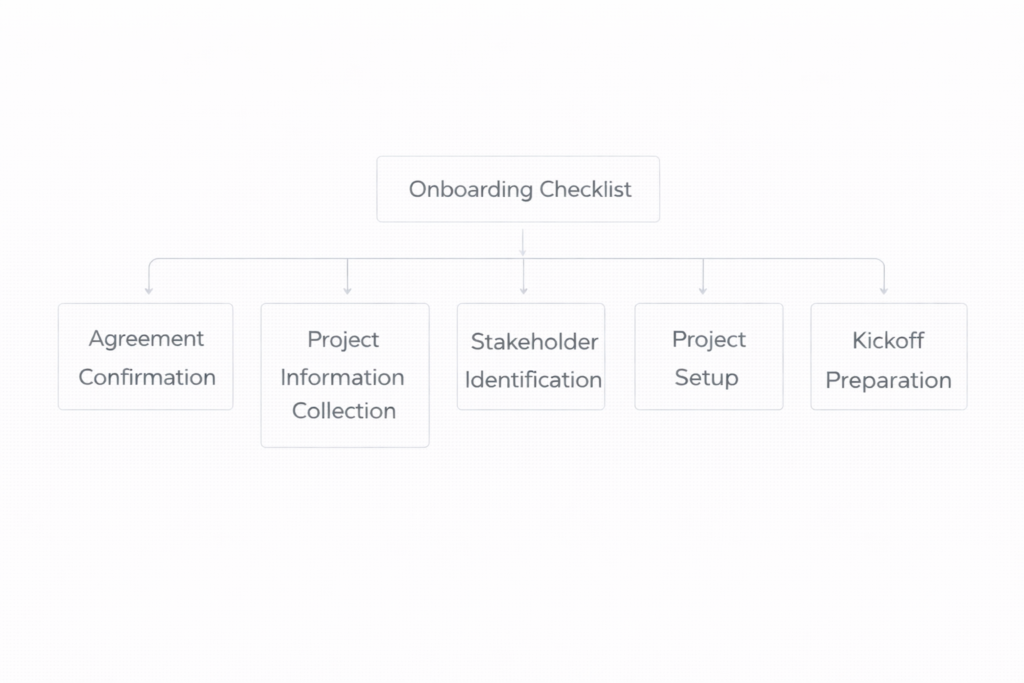
A structured onboarding checklist typically includes four operational categories.
1. Agreement Confirmation
The onboarding process begins by confirming the project agreement.
Checklist items may include:
- reviewing project deliverables
- confirming timelines and milestones
- verifying pricing and payment terms
This step ensures that both consultant and client begin the project with shared expectations.
2. Information Collection
Effective delivery requires access to the information and resources necessary for the project.
Typical checklist items include:
- collecting relevant project documents
- obtaining data or system access
- gathering background information about the client’s business context
Collecting this information early prevents delays during execution.
3. Stakeholder Alignment
Many consulting engagements involve multiple stakeholders.
The onboarding checklist should identify:
- primary decision makers
- operational contacts
- stakeholders responsible for feedback or approvals
Clarifying stakeholder roles improves communication and reduces confusion during delivery.
4. Project Setup
Before execution begins, the project environment should be prepared.
Typical checklist steps include:
- creating project documentation
- organizing deliverable structures
- scheduling kickoff meetings or milestone reviews
This stage transforms the signed agreement into an operational project.
Operational Impact
A structured onboarding checklist improves several operational dimensions of freelance consulting engagements.
Faster Project Initiation
Projects begin with all required inputs and resources available.
Reduced Miscommunication
Clear expectations reduce misunderstandings during delivery.
Improved Delivery Structure
Freelancers begin projects with defined operational processes.
Stronger Client Experience
Structured onboarding signals professionalism and operational discipline.
Onboarding checklists therefore improve both execution efficiency and client confidence.
System-Level Impact Across Processome
Client onboarding checklists influence coordination across the Processome operating architecture.
Client Pipeline System → qualified opportunities transition smoothly into delivery
Capacity Planning System → project timelines align with available delivery capacity
Profit Tracking System → margin visibility improves through structured project setup
Delivery & Operations System → execution stability through structured onboarding preparation
Effective onboarding ensures that consulting engagements begin with operational clarity.
Common Failure Patterns
Freelancers often underestimate onboarding because the process appears straightforward.
Several recurring patterns occur.
Skipping Structured Onboarding
Projects begin immediately after contract signature without preparation.
Gathering Information Gradually
Freelancers collect project inputs during execution rather than beforehand.
Informal Kickoff Conversations
Kickoff meetings occur without structured preparation.
Missing Stakeholder Identification
Important project participants are discovered late in the process.
These patterns increase operational friction and slow delivery progress.
Strategic Outcome
When freelancers implement structured onboarding checklists, project execution becomes significantly more organized.
Instead of improvising project initiation, consultants follow a consistent operational process.
This produces several advantages.
Faster project momentum
Projects begin with the required information already in place.
Reduced delivery friction
Operational issues are resolved before execution begins.
Stronger client relationships
Clear onboarding improves communication and trust.
Higher delivery reliability
Projects follow structured preparation processes.
Onboarding checklists transform project initiation into a repeatable operational routine.
Final Perspective
Freelancers often view onboarding as a brief administrative step before delivery begins.
In reality, the quality of onboarding strongly influences the success of the entire engagement.
Within the Processome operating model, the → Delivery & Operations System ensures that projects begin with structured preparation and operational clarity.
A well-designed onboarding checklist transforms project initiation from improvisation into process.
Strong beginnings create stable delivery.