Profit Leakage in Freelance Businesses (Where Your Profit Is Disappearing)
Introduction
Profit leakage in freelance businesses explains why strong revenue does not always result in strong profit.
Freelancers often focus on increasing revenue as the primary path to improving financial performance. More clients, larger projects, and higher invoice totals appear to indicate business growth.
However, strong revenue does not automatically translate into strong profitability.
Many freelance businesses experience profit leakage—situations where revenue is generated but a significant portion of potential profit is lost due to operational inefficiencies, pricing issues, or delivery practices.
Within the Processome operating model, identifying profit leakage belongs to the → Profit Tracking System—the financial intelligence layer responsible for understanding how revenue converts into profit.
Profit leakage analysis reveals where financial value is lost between revenue generation and final profit.
Revenue creates opportunity.
Profit leakage determines how much of that opportunity is retained.
What is Profit Leakage?
Profit leakage refers to the gap between the potential profit of an engagement and the actual profit realized after delivery.
This gap often emerges from operational behaviors rather than explicit financial costs.
Examples include:
- unpaid work beyond scope
- inefficient project execution
- excessive coordination overhead
- pricing that does not reflect delivery complexity
These factors increase the effective cost of delivering client work.
Profit leakage directly impacts key financial metrics such as:
→ Contribution Margin in Freelance Businesses
→ Effective Hourly Rate Calculation Framework
When delivery effort increases without corresponding revenue adjustments, profit margins decline.
Identifying these patterns allows freelancers to improve financial efficiency.
The Core Problem
Freelancers often evaluate performance through revenue.
Typical indicators include:
- total monthly revenue
- project value
- number of clients
While these metrics show activity, they rarely expose inefficiencies in how revenue is generated.
Several structural issues reduce profitability even when revenue appears strong.
Unpaid Delivery Effort
Additional revisions and client requests extend project scope without increasing revenue.
Inefficient Pricing Structures
Prices do not reflect the real delivery effort required.
Operational Friction
Poor workflows, unclear scope, or weak project management increase delivery cost.
Administrative Overhead
Communication, reporting, and coordination consume non-billable time.
These issues gradually erode profitability without affecting revenue totals.
Profit Leakage Framework
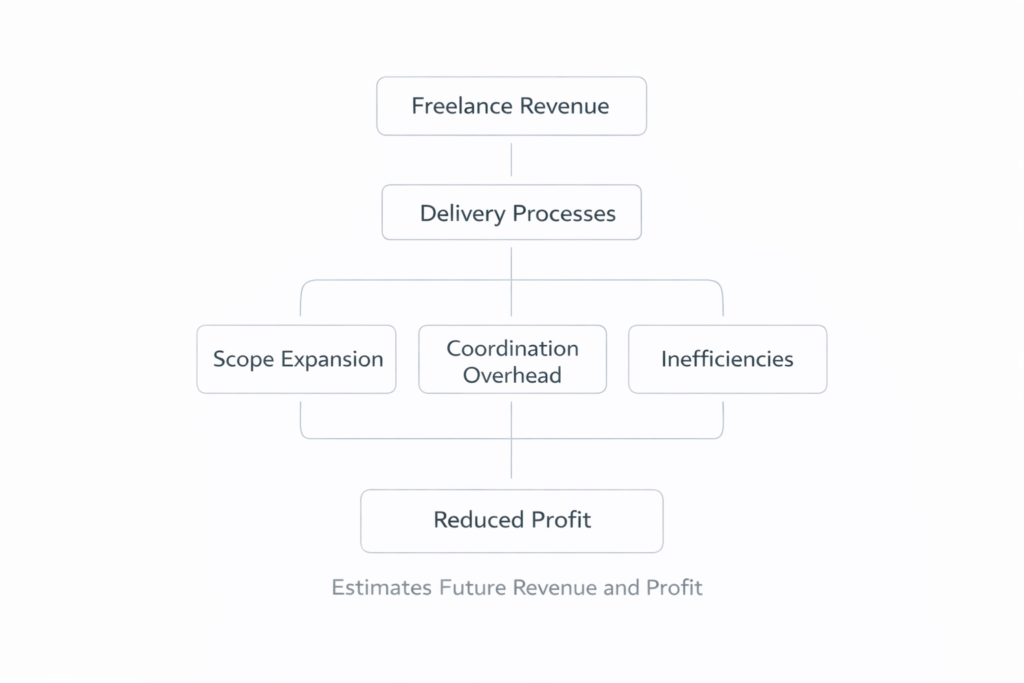
Profit leakage typically originates from several operational sources.
1. Scope Expansion
Projects grow beyond their original definition without price adjustments.
Examples:
- additional revisions
- extra deliverables
- extended consulting discussions
Over time, this reduces contribution margin.
→ Delivery & Operations System
2. Coordination Overhead
Freelance work often includes:
- meetings
- email communication
- stakeholder coordination
Excessive communication increases non-billable effort and reduces effective hourly yield.
3. Pricing Misalignment
Pricing does not reflect delivery complexity.
Examples:
- underpriced projects
- fixed pricing for variable scope
- outdated pricing structures
→ Freelance Pricing Strategy Framework
4. Operational Inefficiencies
Inefficient workflows increase delivery time.
Examples:
- unclear scope definitions
- poor onboarding
- lack of process structure
→ Delivery & Operations System
Operational Impact
Identifying profit leakage improves several strategic areas.
Margin Improvement
Reducing inefficiencies increases profit without increasing revenue.
Pricing Discipline
Pricing can be aligned with real delivery effort.
Operational Efficiency
Improved workflows reduce wasted time.
Financial Forecasting
Profit projections become more accurate.
Evaluate Your Profit Leakage
To understand where profit may be leaking in your current work:
→ Client Profitability Calculator
This helps translate revenue and delivery effort into clear profitability insights per client and project.
System-Level Impact Across Processome
Profit leakage analysis influences multiple systems.
- Client Pipeline System → qualification of better-structured projects
- Capacity Planning System → improved allocation of delivery effort
- Profit Tracking System → visibility into margin erosion
- Delivery & Operations System → process improvements
Reducing leakage strengthens both financial performance and operations.
Common Failure Patterns
Profit leakage often accumulates gradually.
Accepting Extra Work Informally
Small additions go unpriced.
Ignoring Time Tracking
Without data, inefficiencies remain invisible.
Weak Scope Definitions
Unclear boundaries invite scope creep.
Prioritizing Client Satisfaction Over Pricing Discipline
Extra work is accepted to maintain relationships.
These patterns significantly reduce profitability over time.
Strategic Outcome
When freelancers identify and reduce profit leakage, profitability improves without increasing workload or client volume.
This produces several advantages.
- Higher margins → more revenue converts into profit
- Better pricing decisions → pricing reflects real effort
- Improved efficiency → structured delivery processes
Over time, freelancers shift from revenue growth to profit optimization.
Final Perspective
Revenue growth is often treated as the primary goal.
However, financial sustainability depends on how efficiently revenue converts into profit.
Within the Processome operating model, the → Profit Tracking System reveals where value is lost between revenue generation and final profit.
Freelancers who monitor profit leakage carefully can improve profitability without increasing workload.
Revenue creates opportunity.
Efficiency determines how much value remains.