Income Stability for Freelancers (How to Create Predictable Income)
Introduction
Income stability for freelancers depends on how revenue is structured—not just how much is earned.
Freelancers often experience fluctuating income. Project-based work, irregular sales cycles, and varying client demand can create significant financial volatility from month to month.
While some variation is inevitable, the structure of a freelancer’s revenue model plays a major role in determining how stable income becomes.
Within the Processome operating model, revenue stability analysis belongs to the → Profit Tracking System—the financial intelligence layer responsible for evaluating how revenue structures influence financial sustainability.
Income stability models help freelancers design revenue structures that reduce volatility while maintaining profitability and operational flexibility.
Income volatility is not only a market condition.
It is often a structural design choice.
What are Income Stability Models?
An income stability model describes how a freelancer structures revenue streams to balance predictability and profitability.
Different revenue structures produce different stability patterns.
For example:
| Revenue Structure | Stability Pattern |
|---|---|
| Pure project work | High volatility |
| Retainer-based revenue | High stability |
| Hybrid model | Moderate stability |
Income stability depends on how revenue is distributed across engagement types.
Several financial frameworks influence stability analysis:
→ Retainer Profitability vs Projects
→ Revenue Concentration Risk for Freelancers
These frameworks reveal how revenue structure affects financial risk.
Income stability models combine these insights into practical revenue design strategies.
The Core Problem
Many freelancers accept revenue structures that produce unpredictable income patterns.
Common causes include:
- relying entirely on project-based work
- inconsistent pipeline activity
- irregular client acquisition cycles
- fluctuating project sizes
These conditions create several financial challenges.
Cash Flow Volatility
Income may vary dramatically from one month to the next.
Planning Difficulty
Unpredictable revenue makes it difficult to forecast expenses, taxes, or investments.
Sales Pressure
Periods without active projects increase urgency for new clients.
Emotional Stress
Income uncertainty affects decision-making and long-term planning.
These challenges often result from revenue structure design—not performance.
Income stability models address this structural issue.
Freelance Income Stability Framework
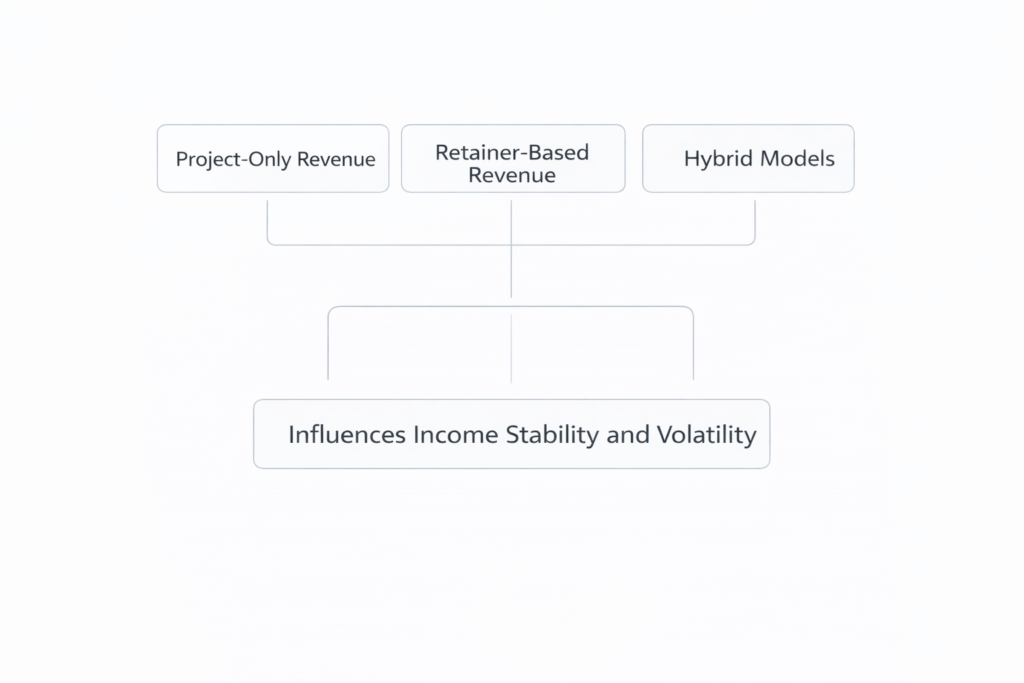
Several structural models commonly appear in freelance consulting businesses.
1. Project-Driven Model
Most revenue comes from discrete projects.
Characteristics:
- large revenue spikes
- gaps between projects
- high dependence on pipeline activity
This model can produce strong margins but often leads to volatility.
2. Retainer-Based Model
Recurring revenue forms the majority of income.
Characteristics:
- predictable monthly income
- reduced sales pressure
- ongoing client relationships
However, retainers introduce trade-offs such as reduced flexibility and potential dependency.
→ Retainer Profitability vs Projects
3. Hybrid Revenue Model
A combination of revenue streams creates balance.
Examples:
- retainers for baseline stability
- projects for higher-margin work
- advisory engagements for flexibility
Hybrid models balance stability with profitability potential.
→ Revenue Mix Design for Solo Consultants
Operational Impact
Income stability models influence several operational dimensions.
Financial Planning
Stable income simplifies budgeting and forecasting.
Pipeline Management
Project-heavy models require stronger pipeline consistency.
Capacity Allocation
Recurring work consumes fixed capacity, while projects create workload peaks.
Risk Management
Balanced revenue structures reduce exposure to volatility.
Designing revenue structure deliberately improves both stability and control.
System-Level Impact Across Processome
Income stability interacts with multiple systems within the Processome architecture.
- Client Pipeline System → consistent flow of new opportunities
- Capacity Planning System → balance between recurring and project work
- Profit Tracking System → monitoring revenue distribution and volatility
- Delivery & Operations System → structuring engagements for predictability
Revenue structure connects financial stability with operational design.
Common Failure Patterns
Freelancers often attempt to stabilize income without considering broader trade-offs.
Overreliance on Retainers
High stability may introduce client dependency risk.
Pure Project Dependence
Revenue volatility remains high without recurring income.
Ignoring Margin Differences
Stable revenue may still produce weak profitability.
Fragmented Client Portfolios
Too many small clients increase coordination overhead.
Balancing stability with profitability is essential.
Strategic Outcome
When freelancers design income stability models deliberately, financial volatility decreases and planning improves.
Instead of reacting to fluctuations, consultants structure their revenue to produce predictable outcomes.
This produces several advantages.
- Reduced financial stress → predictable income improves planning
- Balanced workload → hybrid models distribute effort more evenly
- Improved resilience → diversified revenue reduces risk
Over time, freelancers build revenue systems that combine stability with profitability.
Final Perspective
Freelance income volatility is often treated as unavoidable.
In reality, revenue structure plays a major role in determining how predictable income becomes.
Within the Processome operating model, the → Profit Tracking System provides the frameworks required to design revenue architectures that support both stability and profitability.
Freelancers who design their income structure deliberately gain greater control over both financial outcomes and workload patterns.
Revenue volatility can be reduced.
But it requires structural design.