Hourly vs Project Pricing for Freelancers (Which Model Is More Profitable?)
Introduction
Hourly vs project pricing determines how your time, effort, and outcomes translate into revenue and profit.
Freelancers often choose between two common pricing structures: charging by the hour or charging a fixed price for a defined project.
At first glance, the difference appears simple. Hourly pricing compensates time, while project pricing compensates completed deliverables.
However, the choice between these models affects more than invoicing format. Pricing structure influences how revenue scales, how delivery effort translates into profit, and how workload interacts with financial performance.
Within the Processome operating model, pricing structure belongs to the → Profit Tracking System—the financial intelligence layer responsible for evaluating how revenue converts into profitability.
Understanding the economic differences between hourly and project pricing allows freelancers to design engagement structures aligned with both capacity and financial goals.
Pricing structure determines how effort becomes income.
What is Hourly vs Project Pricing?
Hourly pricing and project pricing represent two different economic models.
- Hourly pricing charges clients based on time spent delivering services
- Project pricing charges a fixed amount for delivering a defined outcome
The key difference lies in how revenue is generated and how risk is distributed.
| Pricing Model | Revenue Driver | Risk Distribution |
|---|---|---|
| Hourly Pricing | Time spent | Client carries delivery risk |
| Project Pricing | Defined outcome | Freelancer carries delivery risk |
This distinction determines how profitability behaves in practice.
Financial performance under each model can be evaluated using:
→ Effective Hourly Rate for Freelancers
→ Contribution Margin in Freelance Businesses
The Core Problem
Many freelancers choose pricing models based on habit rather than economic structure.
Common patterns include:
- defaulting to hourly pricing because it feels transparent
- offering fixed prices to match client expectations
- switching between models without evaluating profitability
While both models are widely used, they produce very different financial outcomes.
Several structural issues emerge when the pricing model is chosen without analysis.
Income Ceiling
Hourly pricing ties revenue directly to available time.
Margin Uncertainty
Project pricing introduces risk when delivery effort exceeds estimates.
Efficiency Misalignment
Hourly pricing penalizes efficiency, while project pricing rewards it.
Capacity Constraints
Each model interacts differently with workload and delivery capacity.
Understanding these dynamics is essential for sustainable pricing decisions.
Hourly vs Project Pricing Framework
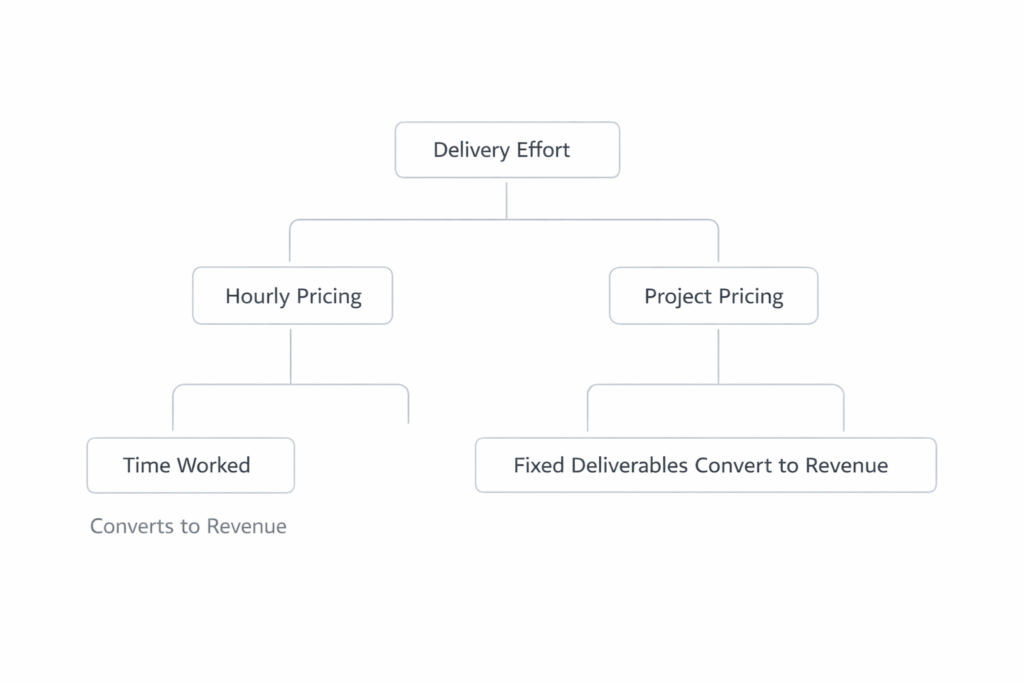
Several operational differences distinguish the two pricing models.
1. Revenue Structure
Hourly pricing generates revenue based on time spent.
Characteristics:
- revenue proportional to hours worked
- flexible scope adjustments
- straightforward billing
Project pricing defines revenue based on a predefined scope.
Characteristics:
- fixed project fees
- defined deliverables
- milestone-based payments
Revenue predictability differs significantly between these models.
2. Delivery Risk
Pricing models determine who carries delivery risk.
Hourly pricing:
- client absorbs uncertainty
- additional work → additional billing
Project pricing:
- freelancer absorbs uncertainty
- inefficient delivery reduces profit
Scope clarity becomes critical in project pricing.
→ Delivery & Operations System
3. Efficiency Incentives
Each model creates different incentives.
Hourly pricing:
- rewards time spent
- reduces benefit of efficiency
Project pricing:
- rewards efficiency
- increases profit when work is delivered faster
To evaluate which model is actually more profitable in your situation, you can use:
→ Client Profitability Calculator
This helps compare revenue, effort, and real financial return across pricing models.
4. Capacity Interaction
Pricing models interact differently with delivery capacity.
- Hourly pricing → linear capacity usage
- Project pricing → variable workload depending on scope
Aligning pricing structure with capacity improves workload sustainability.
Operational Impact
Choosing between hourly and project pricing affects several operational outcomes.
Profitability
Project pricing can produce stronger margins when scope is controlled.
Workload Planning
Hourly work offers flexibility, while projects may create delivery peaks.
Client Expectations
Pricing structure influences how clients request work and manage scope.
Revenue Forecasting
Project pricing creates larger revenue spikes; hourly pricing produces steadier income.
To maintain visibility into how different pricing models affect your financial performance over time, structured Profit Tracking Tools for Freelancers can help track revenue and delivery effort.
System-Level Impact Across Processome
Pricing models influence multiple systems within the Processome architecture.
- Client Pipeline System → qualification based on pricing structure
- Capacity Planning System → workload allocation per model
- Profit Tracking System → comparison of margin performance
- Delivery & Operations System → management of scope and execution
Pricing structure connects revenue generation with delivery execution.
Common Failure Patterns
Freelancers often struggle when applying pricing models without structure.
Several patterns appear frequently.
Underestimating Project Scope
Fixed-price projects become unprofitable when delivery effort expands.
Overreliance on Hourly Pricing
Limits scalability as expertise increases.
Mixing Models Without Strategy
Switching models without evaluating financial performance.
Ignoring Profitability Metrics
Without measuring effective hourly rate, pricing decisions remain unclear.
These issues reduce financial clarity and profitability.
Strategic Outcome
When freelancers understand the economic differences between hourly and project pricing, engagement structures become more deliberate.
Consultants can select pricing models based on:
- project complexity
- delivery predictability
- desired financial outcomes
This produces several advantages.
- Improved pricing alignment → match pricing to work structure
- Better margin control → choose models that support profitability
- Greater workload control → align engagements with capacity
Over time, freelancers often combine pricing models strategically across their client portfolio.
Final Perspective
Pricing models determine how effort converts into revenue.
Hourly pricing compensates time.
Project pricing compensates outcomes.
Within the Processome operating model, the → Profit Tracking System evaluates how different pricing structures influence profitability, workload patterns, and long-term sustainability.
Freelancers who understand these dynamics can design engagement structures that support both efficiency and growth.
Pricing structure shapes the economics of freelance consulting.