Freelance Pricing Strategy (How to Design Profitable Pricing)
Introduction
Freelance pricing strategy determines how your services convert into profit—not just what you charge.
Freelancers often treat pricing as a tactical decision made during client negotiations. Prices are adjusted based on perceived client budgets, market benchmarks, or competitive pressure.
However, pricing is not simply a negotiation variable.
Pricing determines how revenue converts into profit, how delivery effort is compensated, and how consulting capacity generates economic return.
Within the Processome operating model, pricing decisions belong to the → Profit Tracking System—the financial intelligence layer responsible for aligning revenue structures with profitability.
A structured pricing strategy ensures that engagements support financial sustainability rather than simply generating revenue.
Pricing is not only about how much to charge.
It is about designing a revenue structure that supports long-term profitability.
What is Freelance Pricing Strategy?
A freelance pricing strategy defines how consulting services are translated into revenue in a way that supports profitability and sustainability.
Rather than relying on ad-hoc negotiation, pricing strategies align several economic factors:
- delivery effort
- contribution margin
- market positioning
- client value perception
Pricing strategy sits at the intersection of financial planning and market positioning.
Financial metrics used to evaluate pricing decisions include:
→ Contribution Margin in Freelance Businesses
→ Effective Hourly Rate for Freelancers
These metrics reveal whether pricing produces sustainable financial outcomes.
The Core Problem
Many freelancers set prices reactively.
Common patterns include:
- matching competitor rates
- adjusting prices based on client budgets
- negotiating discounts to secure projects
These decisions often occur without evaluating how pricing interacts with delivery effort, capacity constraints, or profit margins.
Several structural issues emerge when pricing lacks strategy.
Revenue Without Margin Visibility
Freelancers may generate strong revenue while profitability remains weak.
Capacity Saturation
Low prices require higher workload to maintain income targets.
Pricing Inconsistency
Different clients may pay significantly different prices for similar work.
Negotiation Pressure
Without pricing structure, freelancers may feel compelled to discount.
A pricing strategy framework introduces structure to these decisions.
Freelance Pricing Strategy Framework
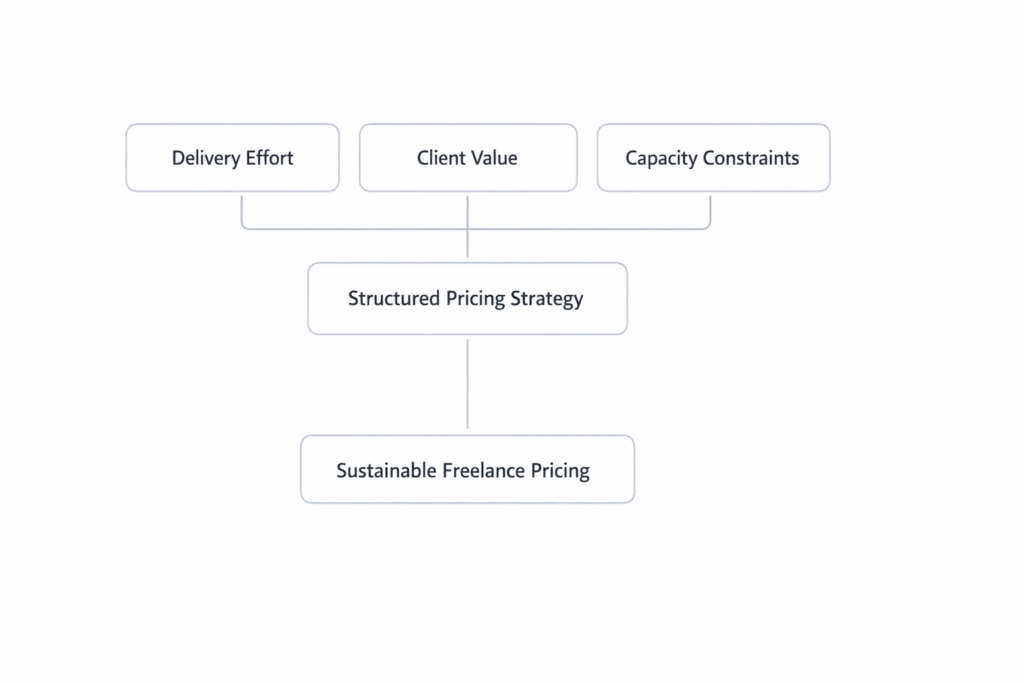
A structured pricing strategy typically considers three dimensions.
1. Delivery Effort
Pricing must reflect the effort required to deliver the service.
This includes:
- delivery hours
- coordination and communication
- revision cycles
- project management effort
Without estimating delivery effort, pricing decisions become speculative.
Delivery effort directly affects contribution margin and effective hourly yield.
2. Client Value
Pricing should reflect the value created for the client.
Examples include:
- revenue impact
- cost savings
- operational improvements
- strategic insights
Services that generate significant business value can justify higher prices than purely execution-based work.
Understanding value creation allows freelancers to move beyond purely time-based pricing.
3. Capacity Constraints
Freelancers operate within finite delivery capacity.
When demand exceeds available capacity:
- prices should increase
- qualification criteria should tighten
- lower-value engagements may be declined
Capacity constraints influence optimal pricing levels.
Pricing must reflect both value and capacity limitations.
Operational Impact
A structured pricing strategy improves several operational outcomes.
Profitability
Pricing aligned with delivery effort and value improves contribution margins.
Workload Sustainability
Higher prices reduce the need for excessive workload to maintain income targets.
Client Selection
Pricing structures naturally filter opportunities aligned with positioning.
Financial Forecasting
Predictable pricing improves revenue and profit forecasting accuracy.
If you want to evaluate whether your current pricing actually produces strong financial outcomes, you can use:
→ Client Profitability Calculator
This helps connect pricing decisions directly to delivery effort and profitability.
System-Level Impact Across Processome
Pricing strategy influences multiple operational systems within the Processome architecture.
- Client Pipeline System → qualification of opportunities aligned with pricing strategy
- Capacity Planning System → alignment of prices with available delivery capacity
- Profit Tracking System → evaluation of margin performance and revenue efficiency
- Delivery & Operations System → structuring projects around clearly priced deliverables
Pricing connects revenue generation with execution feasibility and profitability.
Common Failure Patterns
Freelancers often weaken their pricing strategy through reactive decision-making.
Several patterns appear frequently.
Market-Based Pricing Only
Freelancers rely on competitor pricing without considering their own cost structure.
Discounting Under Pressure
Prices are reduced to secure projects during periods of low pipeline activity.
Ignoring Capacity Constraints
Prices remain unchanged even when demand exceeds available delivery capacity.
Underestimating Delivery Effort
Projects are priced based on optimistic workload assumptions.
These behaviors gradually erode profitability.
Strategic Outcome
When freelancers implement a structured pricing strategy, financial performance becomes more predictable.
Instead of negotiating prices case by case, consultants design pricing structures that support sustainable operations.
This produces several advantages.
- Improved profit margins → prices reflect delivery effort and value
- Better workload balance → replace low-margin work with higher-value engagements
- Stronger positioning → pricing aligns with expertise and market perception
Over time, pricing evolves from reactive negotiation into deliberate economic design.
Final Perspective
Freelancers often believe pricing success depends on charging higher rates.
In reality, pricing success depends on aligning revenue structures with delivery capacity, client value, and profitability goals.
Within the Processome operating model, the → Profit Tracking System evaluates how pricing decisions influence financial outcomes.
A structured pricing strategy transforms pricing from guesswork into financial architecture.
Pricing shapes the economics of the freelance business.