Best Tools for Freelance Delivery & Operations
Introduction
Freelance consulting businesses often rely on multiple operational activities simultaneously. Projects must be planned, deliverables created, client communication managed, and project progress monitored.
Without appropriate operational tools, freelancers may struggle to maintain visibility across these activities.
However, tools alone do not create effective operations.
Without structured delivery frameworks, software simply organizes tasks rather than stabilizing execution.
Within the Processome operating model, operational stability is governed by the → Delivery & Operations System, the framework responsible for ensuring that consulting engagements progress through structured processes.
Tools support these processes by improving visibility, coordination, and documentation.
They do not replace operational systems.
The Core Problem
Many freelancers attempt to improve project organization by adopting new productivity tools.
They experiment with platforms that promise to:
- organize projects
- manage tasks
- coordinate communication
- track deadlines
While these tools may provide useful features, they cannot solve underlying operational problems.
For example, tools cannot answer questions such as:
- How should project milestones be structured?
- When should deliverables be reviewed with clients?
- How should scope changes be evaluated?
These decisions must be defined operationally.
Tools become valuable only when they support clearly defined delivery systems.
Concept Explanation
Operational tools support the management of consulting projects and delivery workflows.
These tools typically assist with several functions:
- project planning
- task organization
- documentation management
- communication coordination
When used effectively, they improve visibility into project progress and help freelancers maintain structured workflows.
Operational tools should therefore complement frameworks such as:
→ Project Planning for Freelancers
→ Client Onboarding System for Freelancers
These frameworks define how delivery should occur. Tools provide the infrastructure for implementing those processes.
Delivery & Operations Tool Framework
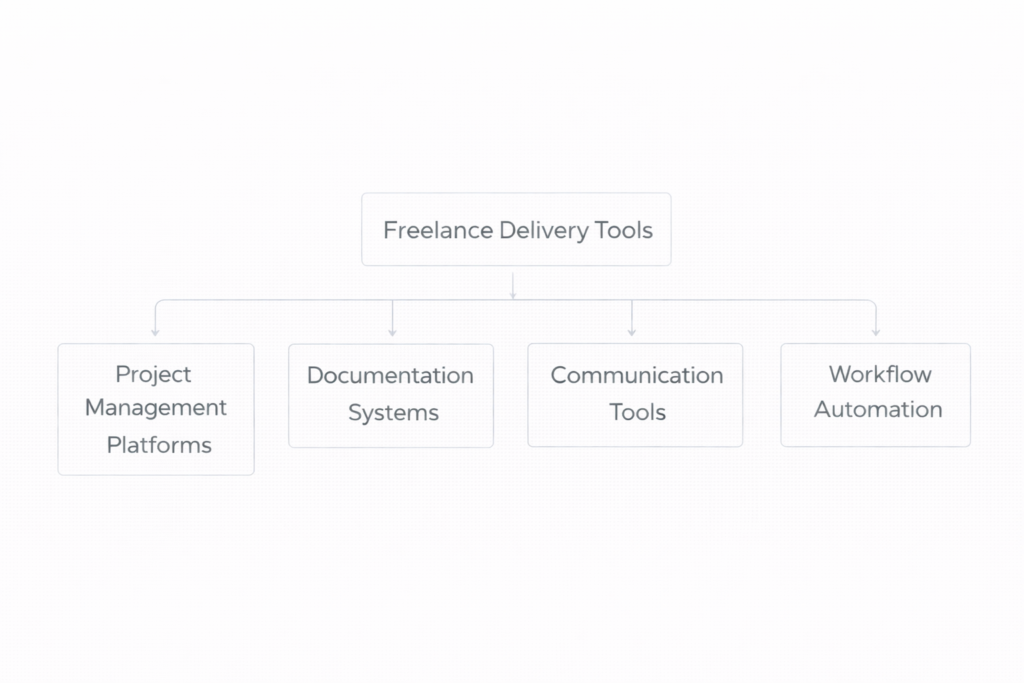
Operational tools for freelance delivery typically fall into four categories.
1. Project Management Tools
Project management platforms help freelancers organize projects, track tasks, and monitor progress.
Common capabilities include:
- project timelines
- task management
- milestone tracking
- workload visibility
Examples frequently used by freelancers include:
ClickUp
A flexible project management platform that supports task planning, project tracking, and workflow organization.
Asana
A structured project management tool designed for managing tasks, milestones, and project collaboration.
These tools provide visibility into project execution.
2. Documentation and Knowledge Tools
Consulting work often requires documentation of frameworks, research, and deliverables.
Documentation platforms help organize knowledge and maintain structured project records.
Examples include:
Notion
A versatile workspace for documentation, SOP libraries, and internal project information.
Coda
A collaborative documentation platform that combines structured documents with operational workflows.
These tools support frameworks such as:
→ SOP Library Structure for Freelancers
3. Client Communication Tools
Clear communication systems help maintain alignment between freelancers and clients.
Communication platforms may include:
- messaging tools
- video conferencing platforms
- structured communication channels
Examples include:
Slack
Used for ongoing client collaboration and project discussions.
Zoom
Commonly used for project meetings, reviews, and milestone discussions.
Structured communication improves delivery coordination.
4. Workflow Automation Tools
Automation tools help reduce manual operational tasks.
They can assist with:
- workflow automation
- document generation
- notification systems
Examples include:
Zapier
Automation platform connecting multiple software tools to streamline workflows.
Make (formerly Integromat)
Advanced automation platform used to connect project management, communication, and documentation systems.
Automation improves operational efficiency as consulting businesses grow.
Operational Impact
When operational tools support structured delivery systems, several operational improvements occur.
Improved Project Visibility
Freelancers gain a clearer overview of project progress and deadlines.
Better Task Coordination
Project tasks can be organized systematically across engagements.
Reduced Administrative Overhead
Automation reduces repetitive operational work.
Stronger Delivery Structure
Tools support consistent operational workflows.
Technology therefore strengthens the implementation of operational systems.
System-Level Impact Across Processome
Operational tools support coordination across the Processome architecture.
Client Pipeline System → smoother transition from signed proposal to project execution
Capacity Planning System → improved visibility into active delivery workload
Profit Tracking System → clearer insight into project effort and operational efficiency
Delivery & Operations System → structured workflows supported by operational tools
Tools provide the infrastructure required to implement structured consulting operations.
Common Failure Patterns
Freelancers often adopt tools without addressing the underlying operational systems.
Several patterns frequently appear.
Tool Overload
Freelancers adopt many platforms simultaneously without integrating them.
Feature Complexity
Tools with excessive features may increase administrative overhead.
Missing Operational Frameworks
Software is adopted before defining delivery processes.
Inconsistent Tool Usage
Freelancers use tools inconsistently, reducing operational visibility.
Operational discipline is more important than tool sophistication.
Strategic Outcome
When freelancers select tools that support structured delivery systems, consulting operations become significantly more organized.
Instead of managing projects through scattered communication and informal notes, freelancers operate through integrated workflows.
This produces several advantages.
Clear project visibility
Project status and milestones remain transparent.
Efficient operational processes
Automation reduces manual coordination work.
Improved client collaboration
Communication becomes more structured.
Scalable consulting operations
Systems support growth without increasing operational chaos.
Tools therefore enhance operational execution when aligned with structured delivery frameworks.
Final Perspective
Freelancers often search for the perfect project management platform to organize their consulting work.
However, operational clarity begins with structured delivery systems.
Within the Processome operating model, the → Delivery & Operations System defines how consulting engagements should be executed.
Tools simply provide the infrastructure that supports those systems.
Strong systems make tools effective.