Retention Systems for Solo B2B Freelancers
Introduction
Freelance consulting businesses often focus heavily on acquiring new clients. Lead generation, proposals, and sales pipelines receive significant attention.
However, many freelancers overlook a second driver of revenue stability: client retention.
When clients repeatedly return for new engagements or extend existing collaborations, revenue becomes significantly more predictable and acquisition pressure decreases.
Within the Processome operating model, client retention belongs to the → Delivery & Operations System, the framework responsible for maintaining stable client relationships after projects are delivered.
Retention is not simply the result of good work. It is the result of structured relationship management and consistent delivery experience.
Without retention systems, freelancers rely on occasional repeat work.
With retention systems, long-term client relationships become intentional.
The Core Problem
Many freelancers assume that delivering high-quality work automatically results in repeat engagements.
While delivery quality is essential, it does not guarantee ongoing collaboration.
Several structural issues often prevent repeat work.
Lack of Relationship Continuity
After project completion, communication with the client gradually stops.
No Structured Follow-Up
Freelancers may not proactively explore additional opportunities with past clients.
Missed Expansion Opportunities
Clients may have new needs that remain undiscovered because discussions do not continue.
Dependence on New Acquisition
Without repeat work, freelancers must constantly generate new opportunities to maintain revenue.
These challenges are rarely caused by weak delivery.
They arise from the absence of structured retention processes.
Concept Explanation
A retention system is the operational structure that maintains and expands relationships with existing clients after project delivery.
Instead of treating engagements as isolated transactions, retention systems create continuity between projects.
Retention systems typically involve:
- structured follow-up conversations
- periodic relationship check-ins
- identification of additional opportunities
- consistent communication with past clients
These practices ensure that the consulting relationship continues beyond a single project.
Retention systems complement client acquisition processes such as:
→ Freelance Lead Generation System
→ Client Pipeline System
While the pipeline system generates new opportunities, retention systems preserve and expand existing relationships.
Client Retention System Framework
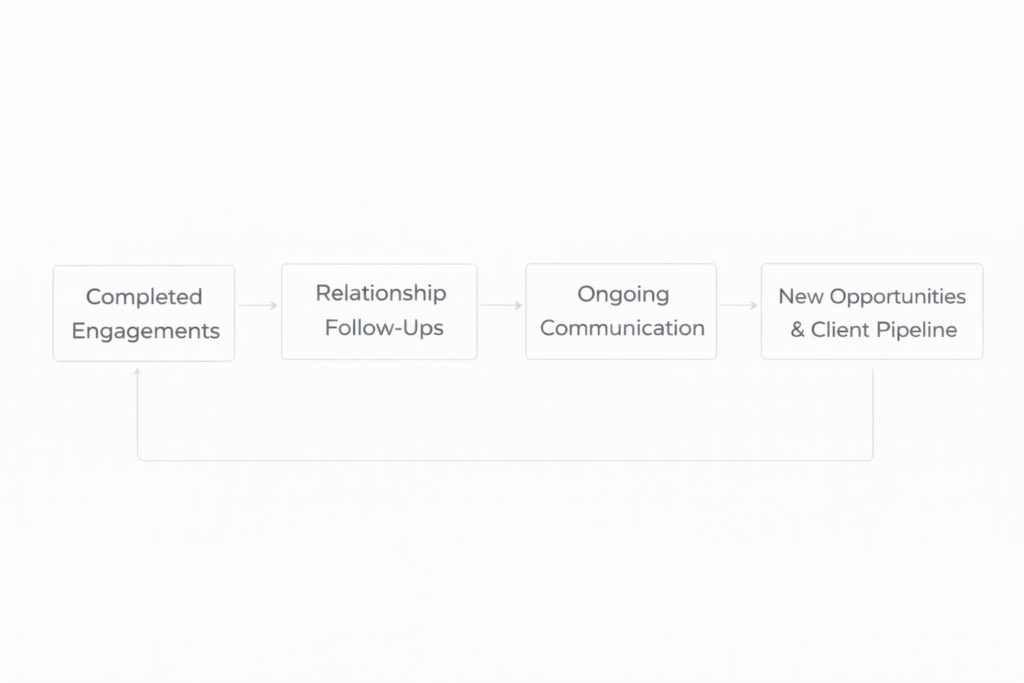
A structured retention system typically includes four operational components.
1. Post-Project Review
Retention begins immediately after project completion.
A structured review may include:
- discussing project outcomes
- evaluating results and insights
- identifying potential future improvements
Post-project reviews reinforce the value delivered and open conversations about future work.
This stage connects to:
→ Project Retrospectives for Consultants
2. Relationship Maintenance
Client relationships should remain active even when no immediate project exists.
Relationship maintenance may involve:
- periodic check-in conversations
- sharing relevant insights or updates
- informal discussions about industry developments
These interactions maintain professional visibility and strengthen trust.
3. Opportunity Identification
During ongoing conversations, new opportunities often emerge.
Clients may face:
- new strategic initiatives
- operational challenges
- evolving market conditions
Retention systems encourage freelancers to identify these opportunities early.
When opportunities emerge, they can enter the pipeline through structured processes such as:
→ Sales Pipeline Stages for Freelancers Explained
4. Re-Engagement
Once a new opportunity is identified, the engagement process begins again.
Re-engagement may include:
- exploratory discussions
- discovery conversations
- proposal development
Because the relationship already exists, re-engagement cycles are often faster and more efficient than new client acquisition.
Operational Impact
A structured retention system improves several operational aspects of freelance consulting businesses.
Revenue Stability
Repeat clients create more predictable income patterns.
Reduced Acquisition Pressure
Freelancers rely less on constant lead generation.
Stronger Client Relationships
Long-term collaboration increases trust and mutual understanding.
Higher Lifetime Value
Existing clients often generate multiple engagements over time.
Retention therefore strengthens both financial stability and business resilience.
System-Level Impact Across Processome
Client retention systems influence multiple operational systems within the Processome architecture.
Client Pipeline System → returning clients create recurring opportunities
Capacity Planning System → predictable engagements improve workload forecasting
Profit Tracking System → long-term clients often produce stronger margins
Delivery & Operations System → consistent delivery experience strengthens relationships
Retention systems therefore connect client relationships with both financial performance and operational stability.
Common Failure Patterns
Freelancers frequently struggle with client retention because relationship management is treated informally.
Several recurring patterns appear.
No Post-Project Follow-Up
Once a project is completed, communication stops entirely.
Passive Relationship Management
Freelancers wait for clients to initiate new conversations.
Short-Term Project Focus
Consultants treat engagements as isolated projects rather than ongoing relationships.
Lack of Visibility
Clients may forget the freelancer’s services when new needs arise.
These patterns reduce repeat work even when delivery quality is strong.
Strategic Outcome
When retention systems are implemented effectively, freelance consulting businesses experience significantly greater stability.
Instead of relying solely on new client acquisition, freelancers maintain ongoing relationships that generate recurring opportunities.
This produces several advantages.
Predictable revenue
Existing clients often generate repeat engagements.
Shorter sales cycles
Re-engagement discussions require less qualification.
Stronger trust
Long-term relationships improve collaboration quality.
Higher business resilience
Revenue becomes less dependent on constant prospecting.
Retention systems transform completed projects into long-term professional relationships.
Final Perspective
Freelancers often view project completion as the end of a client engagement.
In reality, it should mark the beginning of an ongoing professional relationship.
Within the Processome operating model, the → Delivery & Operations System ensures that client relationships remain active beyond individual projects.
Client acquisition begins relationships.
Retention systems sustain them.