Delivery Milestones & Payment Alignment
Introduction
Many freelance consulting projects begin with clear deliverables but unclear financial structure. Payments may be scheduled according to arbitrary dates rather than aligned with the actual progress of the work.
This misalignment creates financial and operational risk. Freelancers may deliver significant portions of the project before receiving payment, while clients may lack clear checkpoints for reviewing progress.
Within the Processome operating model, delivery structure belongs to the → Delivery & Operations System, the operational framework responsible for ensuring execution stability and predictable project management.
Aligning payment schedules with delivery milestones ensures that financial flow reflects project progress. Instead of treating payment and delivery as separate processes, this framework integrates them into a single operational structure.
When payment and delivery remain disconnected, risk increases.
When they are aligned, both execution and financial stability improve.
The Core Problem
Freelancers often structure payment schedules independently from delivery stages.
Common arrangements include:
- fixed monthly payments unrelated to project progress
- a large payment at project completion
- informal invoicing after work has already been delivered
These approaches introduce several operational risks.
Financial Exposure
Freelancers may complete substantial portions of a project before receiving payment.
Delivery Pressure
Projects may progress rapidly while financial compensation lags behind the effort invested.
Client Review Gaps
Without defined milestones, clients may delay feedback until the end of the project.
Cash Flow Volatility
Payment timing may not reflect the actual workload required during delivery.
These issues are not caused by pricing alone.
They emerge when financial structure is disconnected from delivery structure.
Concept Explanation
Delivery milestone alignment is the practice of structuring project payments around defined stages of delivery progress.
Instead of linking payments to calendar dates, payments correspond to completed milestones within the project.
Typical milestones may include:
- project initiation
- completion of major deliverables
- review and revision phases
- final project completion
This structure creates synchronization between:
- project progress
- client review cycles
- financial compensation
Milestone alignment ensures that payment reflects actual delivery effort.
This framework connects closely with operational planning concepts such as:
→ Project Planning for Freelancers
→ Scope Control Framework for Solo Consultants
Milestones define the structure of delivery. Payment alignment ensures that financial flow mirrors that structure.
Delivery Milestones & Payment Alignment Framework
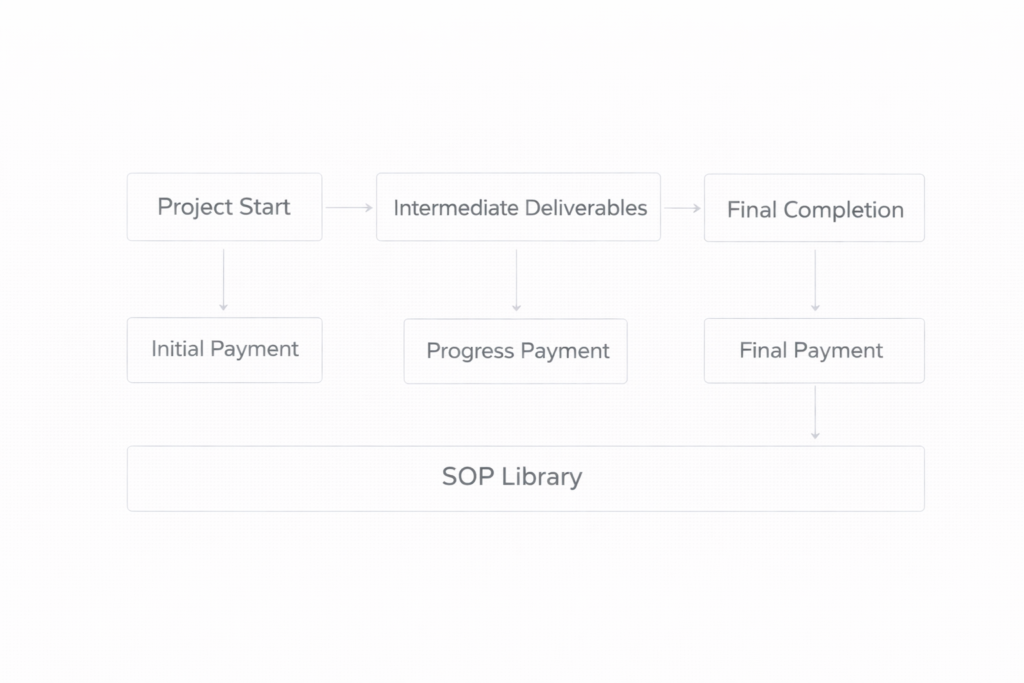
A structured milestone-payment model typically includes four stages.
1. Project Initiation Payment
The first payment occurs when the project begins.
This payment typically covers:
- initial planning
- research preparation
- project setup activities
Upfront payments reduce financial exposure and confirm client commitment.
2. Midpoint Delivery Milestone
Projects often include intermediate deliverables that represent significant progress.
Examples include:
- strategic frameworks
- preliminary analysis
- initial deliverable drafts
Linking payments to these milestones ensures that compensation reflects work already completed.
3. Review and Revision Stage
Many consulting projects involve iterative review cycles.
Payment structures should account for these phases by linking compensation to:
- milestone reviews
- revision stages
- final deliverable preparation
This ensures that revision cycles remain financially aligned with delivery effort.
4. Final Delivery Completion
The final payment corresponds to project completion.
At this stage:
- final deliverables are provided
- documentation may be transferred
- the project is formally concluded
Final payment should not represent the majority of project compensation, as most work has already been performed earlier in the timeline.
Operational Impact
Aligning delivery milestones with payment schedules improves several operational aspects of freelance consulting projects.
Cash Flow Stability
Payments occur progressively as work is delivered.
Reduced Financial Risk
Freelancers avoid situations where significant work is delivered without compensation.
Structured Client Feedback
Milestones create natural checkpoints for reviewing project progress.
Delivery Discipline
Clear milestones help maintain project momentum and structure.
Financial alignment therefore strengthens both operational stability and project management clarity.
System-Level Impact Across Processome
Milestone-payment alignment influences coordination across the Processome operating architecture.
Client Pipeline System → project structures defined clearly during proposal negotiation
Capacity Planning System → workload distribution aligned with milestone timelines
Profit Tracking System → revenue recognition aligned with delivery effort
Delivery & Operations System → execution stability through milestone-based project management
Integrating delivery milestones with financial structure improves coordination between project execution and business operations.
Common Failure Patterns
Freelancers often encounter problems when payment structures fail to reflect delivery progress.
Several patterns frequently appear.
Large Final Payments
A significant portion of project revenue may be scheduled at completion, increasing financial exposure.
Calendar-Based Payment Schedules
Payments occur on fixed dates regardless of delivery progress.
Informal Invoicing
Invoices may be issued after major work has already been completed.
Weak Milestone Definitions
Projects lack clearly defined checkpoints for evaluating progress.
These patterns weaken financial stability and reduce delivery discipline.
Strategic Outcome
When delivery milestones and payment structures are aligned, freelance projects become both financially and operationally more stable.
Instead of separating financial management from delivery planning, freelancers integrate both into a unified project structure.
This produces several advantages.
Improved financial predictability
Payments follow the actual progression of work.
Lower financial risk
Freelancers avoid delivering large amounts of unpaid work.
Clearer project structure
Milestones define natural checkpoints within the delivery process.
Stronger client collaboration
Clients engage with the project through structured review phases.
Milestone alignment transforms payment scheduling into an operational design decision.
Final Perspective
Freelancers often view payment structure as a financial detail rather than a delivery design decision.
In reality, payment structure strongly influences project risk, client collaboration, and financial stability.
Within the Processome operating model, the → Delivery & Operations System ensures that project delivery and financial flow remain aligned.
When payment follows delivery milestones, consulting projects become more stable, predictable, and sustainable.