SOP Library Structure for Freelancers
Introduction
As freelance consulting businesses grow, operational complexity increases. Projects involve recurring activities such as onboarding clients, preparing deliverables, managing communication, and handling project administration.
When these activities are performed differently each time, delivery becomes inconsistent and inefficient.
Within the Processome operating model, operational standardization belongs to the → Delivery & Operations System, the framework responsible for ensuring execution stability and repeatable delivery processes.
A structured Standard Operating Procedure (SOP) library allows freelancers to document and organize the recurring processes that support their consulting work.
Instead of relying on memory or improvisation, freelancers create documented procedures that guide how operational tasks should be performed.
Standardization transforms operational experience into reusable systems.
The Core Problem
Many freelancers rely heavily on personal knowledge and informal routines to manage their consulting work.
Operational processes such as:
- client onboarding
- proposal preparation
- project setup
- reporting and deliverable formatting
may exist only in the freelancer’s memory.
While this approach may function initially, it introduces several operational challenges.
Inconsistent Workflows
Tasks may be performed differently across projects, reducing efficiency.
Cognitive Overload
Freelancers must repeatedly decide how to execute routine activities.
Slower Project Setup
Each engagement requires rebuilding operational steps from scratch.
Limited Scalability
Without documented processes, expanding workload or delegating work becomes difficult.
These problems emerge when operational knowledge remains undocumented.
A structured SOP library converts implicit knowledge into explicit operational systems.
Concept Explanation
A Standard Operating Procedure (SOP) library is a structured repository of documented workflows that describe how recurring tasks should be executed.
Each SOP defines:
- the purpose of the task
- the sequence of steps required
- relevant tools or resources
- expected outputs
Instead of reinventing processes repeatedly, freelancers can reference documented procedures that guide operational execution.
SOPs are particularly useful for processes that occur frequently across projects.
Examples include:
- onboarding new clients
- setting up project documentation
- preparing client reports
- conducting project retrospectives
These workflows often connect with other operational frameworks such as:
→ Client Onboarding System for Freelancers
→ Project Planning for Freelancers
An SOP library therefore becomes an operational backbone supporting consistent delivery.
SOP Library Structure Framework
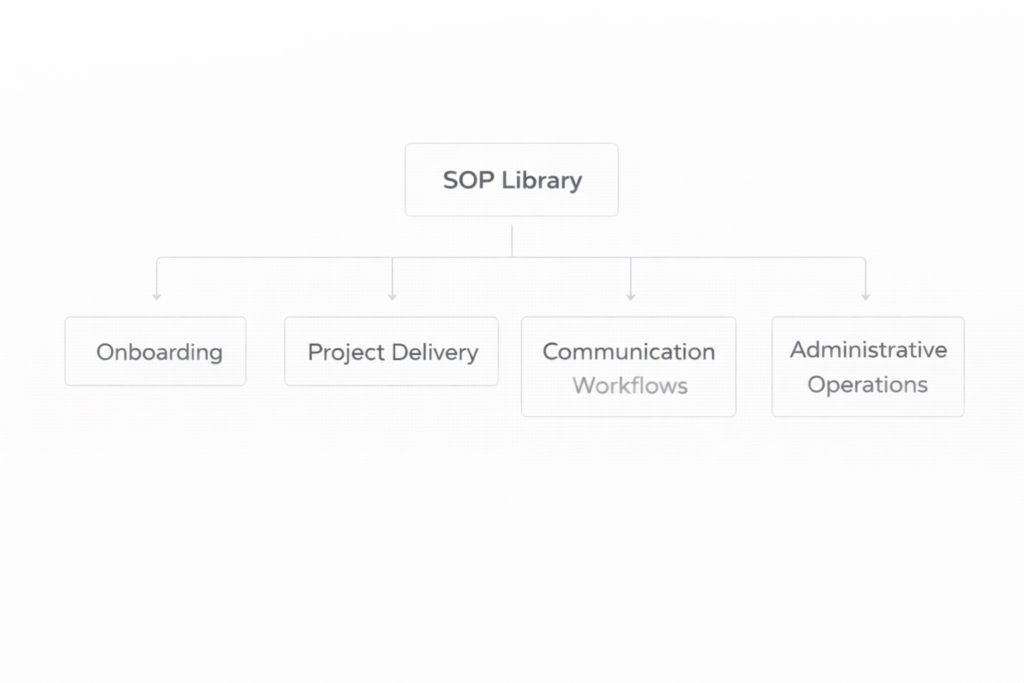
A well-designed SOP library typically organizes procedures into several operational categories.
1. Client Processes
These procedures govern activities related to managing client relationships.
Examples include:
- client onboarding procedures
- project kickoff preparation
- client communication workflows
- feedback and review processes
Standardizing these steps ensures consistent client experience across engagements.
2. Project Delivery Processes
These SOPs describe how consulting work is executed.
Examples include:
- project planning procedures
- deliverable creation workflows
- revision management processes
- project completion checklists
Delivery SOPs ensure that consulting work progresses through predictable operational stages.
3. Operational Administration
Administrative processes support the broader consulting business.
Examples include:
- proposal preparation workflows
- invoicing procedures
- documentation management
- internal project tracking
Documenting administrative workflows reduces operational friction.
4. Knowledge and Quality Control
These SOPs help maintain quality and institutional knowledge.
Examples include:
- project retrospectives
- documentation standards
- deliverable templates
- internal review procedures
Quality-oriented SOPs improve delivery consistency over time.
Operational Impact
A structured SOP library improves several operational aspects of freelance consulting businesses.
Execution Consistency
Projects follow repeatable processes rather than improvisational workflows.
Reduced Decision Fatigue
Freelancers rely on documented procedures rather than constantly rethinking routine tasks.
Faster Project Setup
Standardized procedures accelerate onboarding and project preparation.
Scalability
Documented processes make it easier to delegate tasks or expand operations.
SOP libraries therefore increase operational efficiency and delivery stability.
System-Level Impact Across Processome
Operational documentation influences multiple systems within the Processome architecture.
Client Pipeline System → standardized processes for proposals and client interactions
Capacity Planning System → reduced operational friction improves workload efficiency
Profit Tracking System → consistent delivery processes improve margin visibility
Delivery & Operations System → execution stability through repeatable workflows
Structured operational documentation improves coordination across consulting systems.
Common Failure Patterns
Freelancers often delay building SOP libraries because operational processes feel intuitive or easy to remember.
Several patterns frequently occur.
Relying on Memory
Freelancers assume they will remember recurring workflows.
Overcomplicating Documentation
Some consultants attempt to document every minor task rather than focusing on high-impact processes.
Creating SOPs That Are Never Used
Procedures may be documented but not integrated into daily workflows.
Delaying Documentation
SOPs are often created only after operational problems appear.
Effective SOP libraries evolve gradually as operational experience accumulates.
Strategic Outcome
When freelancers implement structured SOP libraries, operational execution becomes significantly more predictable.
Instead of relying on individual memory and improvisation, consulting operations are supported by documented procedures.
This produces several advantages.
Faster execution
Recurring tasks follow established workflows.
Higher delivery consistency
Processes produce reliable outcomes across projects.
Lower operational friction
Freelancers spend less time reinventing procedures.
Improved scalability
Documented workflows make future delegation possible.
Over time, the SOP library becomes a central operational resource within the consulting business.
Final Perspective
Freelancers often believe that documented procedures are unnecessary for solo operations.
However, operational complexity increases as consulting businesses grow.
Within the Processome operating model, the → Delivery & Operations System ensures that recurring workflows are documented, organized, and repeatable.
A well-structured SOP library transforms individual experience into durable operational knowledge.
Consistency emerges from documentation.