Close-Lost Analysis Framework for Freelancers (Why Deals Are Lost and How to Fix It)
Introduction
Freelance consultants typically focus most of their attention on successful deals. Winning opportunities generate revenue, strengthen client relationships, and often dominate pipeline reviews.
However, understanding why deals are lost as a freelancer is just as important.
Every lost opportunity contains information about:
- pricing alignment
- qualification accuracy
- client fit
- proposal effectiveness
Without a structured approach, these insights are lost.
A close-lost analysis framework for freelancers provides a systematic way to analyze lost deals and improve future pipeline performance.
Within the Processome operating model, close-lost analysis belongs to the → Client Pipeline System, the system responsible for managing how opportunities move through the freelance sales pipeline.
Instead of treating lost deals as isolated events, this framework turns them into structured learning inputs.
What Is Close-Lost Analysis?
Close-lost analysis is the process of evaluating why a pipeline opportunity did not convert into a client engagement.
In a structured freelance pipeline, a close-lost deal refers to any opportunity that does not result in a signed project.
This may occur because:
- the client selected another provider
- the project was postponed or cancelled
- the opportunity became inactive
This stage is defined within:
→ Sales Pipeline Stages for Freelancers
Rather than simply marking deals as “lost,” freelancers should capture structured reasons behind the outcome.
Over time, this enables pipeline loss analysis and reveals patterns that improve decision-making.
The Core Problem
Many freelancers analyze lost deals informally or not at all.
Typical explanations include:
- “The client chose someone else”
- “The budget was too low”
- “The timing wasn’t right”
While these may be accurate individually, they do not reveal patterns across the pipeline.
Without structured freelance sales loss analysis, several problems emerge.
Repeated Qualification Mistakes
Freelancers continue pursuing opportunities that consistently fail.
Pricing Misalignment
It becomes difficult to assess whether pricing fits the market.
Weak Positioning Signals
Competitive losses are not translated into positioning improvements.
Missed Learning Opportunities
Insights from lost deals are never captured or reused.
Without structure, pipeline history becomes noise instead of insight.
The Close-Lost Analysis Framework
A structured close-lost analysis framework for freelancers groups lost deals into four primary categories.
This makes it easier to identify patterns and improve pipeline performance.
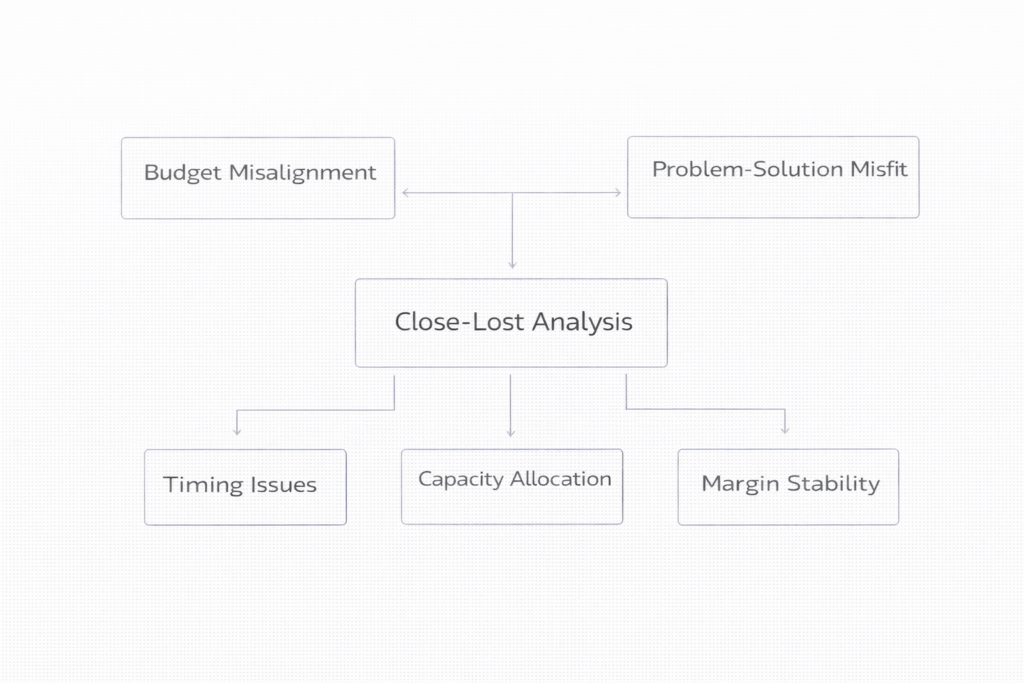
1. Budget Misalignment
Budget misalignment occurs when the client’s available investment does not match the proposed engagement.
Common signals include:
- hesitation after pricing discussions
- requests for discounts
- comparisons with lower-priced alternatives
These losses may indicate:
- weak qualification
- incorrect client targeting
- unclear value communication
Improving qualification reduces these issues:
→ How to Qualify Freelance Leads Strategically
→ Client Qualification Framework for Freelancers
2. Problem–Solution Misfit
This occurs when the freelancer’s expertise does not fully align with the client’s problem.
Indicators include:
- vague client engagement
- extended clarification cycles
- hesitation after reviewing the proposal
This often signals weak positioning or misaligned opportunities.
3. Timing and Priority Issues
Some deals are lost due to shifting client priorities.
Examples:
- postponed initiatives
- internal budget changes
- leadership shifts
These are not structural losses.
They should be tracked separately, as they may re-enter the pipeline later.
4. Competitive Loss
In some cases, the client selects another provider.
Reasons may include:
- lower competitor pricing
- stronger perceived specialization
- existing relationships
These losses provide insight into:
- market positioning
- differentiation
- pricing strategy
Operationalizing Close-Lost Analysis
Close-lost analysis only becomes valuable when it is applied consistently.
Freelancers should:
- record structured loss reasons for each deal
- categorize losses using a consistent framework
- review patterns across multiple opportunities
Without structured tracking, these insights are difficult to capture.
To support this, freelancers can use the tools available in:
→ Client Pipeline System Tools
These tools help track deal outcomes, standardize loss categories, and improve visibility across the pipeline.
Operational Impact
Implementing close-lost analysis for freelancers improves several operational dimensions.
Improved Client Qualification
Patterns reveal which opportunities should be filtered earlier.
Stronger Market Positioning
Competitive insights help refine specialization and messaging.
Better Proposal Alignment
Recurring issues highlight weaknesses in proposal structure.
Improved Pipeline Quality
Weak opportunities are identified and reduced over time.
System-Level Impact Across Processome
Close-lost analysis influences multiple systems:
- Client Pipeline System → qualification refinement
- Capacity Planning System → improved intake control
- Profit Tracking System → pricing feedback
- Delivery & Operations System → client alignment
Learning from lost deals improves overall system performance.
Common Failure Patterns
Several mistakes reduce the effectiveness of close-lost analysis.
Recording Vague Reasons
“Client chose someone else” provides little insight.
Ignoring Patterns
Insights emerge across multiple deals, not individual ones.
Over-Focusing on Pricing
Losses often involve multiple factors, not just cost.
Failing to Review Data
Without regular review, insights remain unused.
These issues prevent meaningful pipeline loss analysis.
Strategic Outcome
When freelancers implement structured close-lost analysis, several advantages emerge.
Improved Pipeline Quality
Misaligned opportunities are filtered earlier.
More Effective Positioning
Freelancers understand which clients value their expertise.
Higher Proposal Conversion Rates
Better alignment improves deal success.
More Reliable Forecasting
Pipeline quality improves forecasting accuracy.
Over time, the pipeline becomes a learning system that continuously improves performance.
Final Perspective
Freelancers often interpret lost deals as failures. In reality, they are feedback signals.
A structured close-lost analysis framework for freelancers transforms lost opportunities into actionable insights.
Within the Processome operating model, this strengthens the Client Pipeline System by improving qualification, positioning, and conversion performance.
Winning deals generate revenue.
Understanding lost deals generates improvement.