Client Profitability for Freelancers (How to Identify Your Most Profitable Clients)
Introduction
Freelancers often evaluate clients based on revenue. Larger projects and higher-paying clients appear more valuable because they generate more income.
However, revenue alone does not reveal whether a client relationship is financially efficient.
Client profitability for freelancers measures how much value each client generates relative to the time and effort required to deliver the work. Two clients may produce identical revenue but require very different levels of coordination, revisions, and delivery effort.
Understanding client profitability is essential for making better decisions about pricing, capacity allocation, and client selection.
Within the Processome operating model, financial visibility belongs to the → Profit Tracking System — the financial intelligence layer responsible for measuring the real profitability of consulting work.
Instead of focusing only on revenue, freelancers need to evaluate efficiency.
Revenue indicates scale.
Profitability indicates efficiency.
What is Client Profitability?
Client profitability for freelancers evaluates how much financial return each client relationship produces relative to the delivery effort required.
This analysis combines several operational variables, including:
- total revenue generated by the client
- delivery hours required to serve that client
- coordination and administrative workload
The objective is to identify the financial efficiency of each client relationship.
For example:
| Client | Annual Revenue | Hours Worked | Effective Hourly Yield |
|---|---|---|---|
| Client A | €30,000 | 300h | €100 |
| Client B | €30,000 | 450h | €66.7 |
Although both clients generate identical revenue, their profitability differs significantly.
This analysis relies on:
→ Effective Hourly Rate Calculation Framework
Understanding client-level profitability allows freelancers to identify which engagements produce the strongest financial return.
To calculate this more accurately, you can use:
→ Client Profitability Calculator
This helps translate revenue and delivery effort into clear profitability insights for each client.
The Core Problem
Many freelancers evaluate client relationships primarily through revenue.
Typical questions include:
- How much does this client pay per project?
- How large is the monthly retainer?
- How much annual revenue does this client generate?
While these metrics are useful, they ignore the delivery effort required to produce that revenue.
Several structural issues emerge when revenue becomes the only evaluation metric.
Hidden Delivery Effort
Some clients require extensive revisions, research, and additional meetings.
Communication Overhead
Frequent coordination and stakeholder communication increase delivery time.
Scope Expansion
Projects often grow beyond the initial scope, increasing workload without increasing revenue.
Opportunity Cost
Time spent on low-profit clients reduces the capacity available for higher-value engagements.
Without profitability analysis, freelancers may allocate large portions of their schedule to relationships that generate relatively low financial return.
Client Profitability Framework
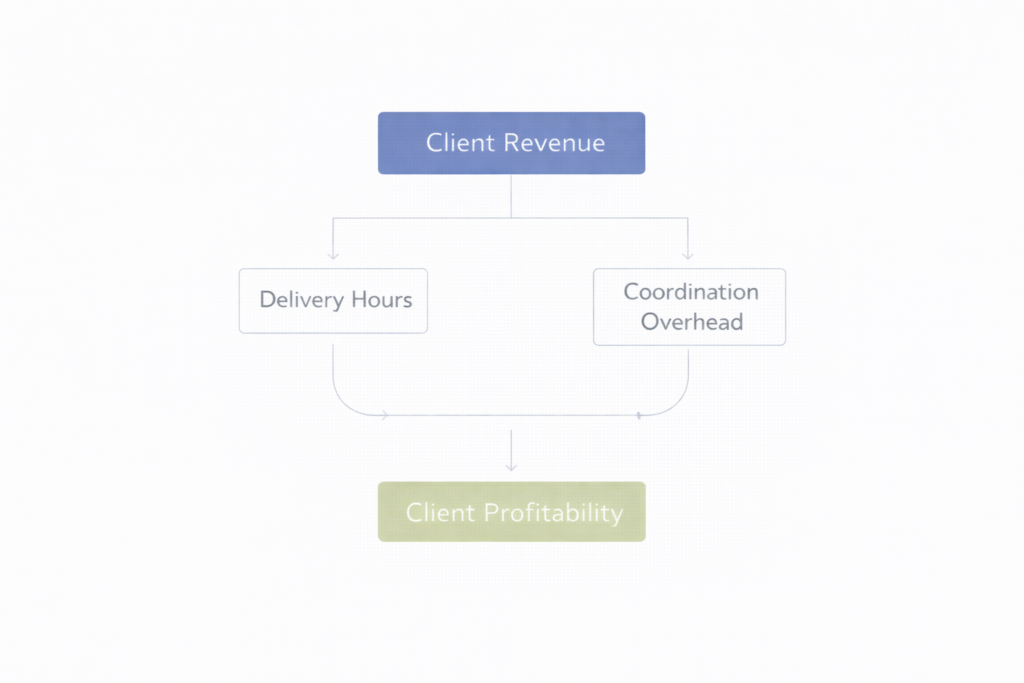
Client profitability analysis typically evaluates three operational dimensions.
1. Revenue Contribution
The first step is calculating how much revenue each client generates.
Revenue may include:
- project fees
- recurring retainers
- advisory engagements
- additional work or change requests
Revenue contribution reveals the financial scale of the client relationship—but not its efficiency.
2. Delivery Effort
Delivery effort represents the total time required to complete the client’s work.
This includes:
- core delivery work
- revisions and adjustments
- meetings and coordination
- project management
Some clients require significantly more delivery effort than others.
Measuring delivery time accurately requires structured tracking:
→ Time Tracking vs Capacity Planning
3. Coordination Complexity
In addition to delivery hours, client relationships differ in coordination complexity.
Factors include:
- number of stakeholders involved
- frequency of communication
- feedback cycles and approvals
- reporting requirements
Clients with high coordination complexity may consume significant mental and administrative capacity.
These hidden costs affect overall profitability.
Operational Impact
Client profitability analysis improves several strategic decisions within a freelance consulting business.
Capacity Allocation
Freelancers can prioritize clients that generate higher financial return per hour of work.
Client Portfolio Design
Balanced client portfolios reduce dependency on low-margin relationships.
Pricing Strategy
Consultants can adjust pricing for clients that require unusually high delivery effort.
Revenue Optimization
Freelancers may increase profitability without increasing total workload.
To support ongoing profitability tracking across multiple clients, you can explore:
→ Profit Tracking Tools for Freelancers
These help maintain consistent visibility into margins, delivery effort, and overall performance.
System-Level Impact Across Processome
Client profitability analysis influences several operational systems within the Processome architecture.
- Client Pipeline System → prioritization of high-value clients during qualification
- Capacity Planning System → allocation of delivery time toward profitable engagements
- Profit Tracking System → visibility into financial performance by client relationship
- Delivery & Operations System → control of scope expansion and delivery effort
Profitability insights improve coordination between client acquisition, workload planning, and financial strategy.
Common Failure Patterns
Freelancers often overlook client profitability because revenue metrics appear more visible.
Several patterns contribute to this problem.
Evaluating Clients by Revenue Only
Large projects may appear attractive despite requiring excessive delivery effort.
Ignoring Communication Overhead
Frequent meetings and coordination tasks often go untracked.
Allowing Scope Expansion
Clients may request additional work without corresponding pricing adjustments.
Retaining Low-Yield Clients
Freelancers sometimes continue working with low-profit clients due to long-standing relationships.
Without structured analysis, these patterns gradually reduce profitability.
Strategic Outcome
When freelancers analyze client profitability systematically, consulting capacity can be allocated more strategically.
Instead of focusing exclusively on revenue growth, consultants evaluate which client relationships produce the strongest financial return.
This produces several advantages.
- Improved pricing discipline → prices reflect actual delivery effort
- Better client portfolio composition → low-profit engagements become visible
- Higher financial efficiency → improve profitability without increasing workload
Over time, client profitability analysis transforms freelance consulting from revenue-based decision making to efficiency-based portfolio management.
Final Perspective
Freelancers often measure business performance through total revenue.
However, revenue alone does not reveal how efficiently consulting capacity is used.
Within the Processome operating model, the → Profit Tracking System provides the financial intelligence required to evaluate the real performance of client relationships.
Client profitability analysis reveals which engagements produce sustainable financial return relative to delivery effort.
Revenue measures scale.
Profitability measures value.