Client Retention Strategies for Freelancers
Introduction
Many freelancers focus heavily on acquiring new clients. Lead generation, proposals, and sales activities often receive significant attention because they directly influence revenue growth.
However, long-term consulting stability depends not only on acquiring clients but also on maintaining productive relationships with existing ones.
Client retention reduces the need for constant pipeline pressure and allows freelancers to build deeper, more valuable engagements over time.
Within the Processome operating model, client retention belongs to the → Delivery & Operations System, the operational framework responsible for maintaining stable client relationships after projects have begun.
Retention systems ensure that successful engagements evolve into ongoing relationships when appropriate.
Strong delivery creates satisfied clients.
Structured retention systems transform satisfaction into long-term collaboration.
The Core Problem
Freelancers often approach client relationships on a project-by-project basis.
Once a deliverable has been completed, the engagement may end without further structured follow-up.
This pattern introduces several operational challenges.
Constant Client Acquisition Pressure
Freelancers must continuously generate new leads to replace completed projects.
Short-Term Engagement Cycles
Relationships may remain transactional rather than evolving into longer collaborations.
Missed Expansion Opportunities
Additional consulting opportunities within existing client relationships may remain unexplored.
Revenue Volatility
A portfolio composed primarily of one-off projects may produce fluctuating income.
These issues rarely result from poor delivery.
They often reflect the absence of structured retention strategies.
Concept Explanation
Client retention strategies are the operational processes used to maintain and extend consulting relationships after initial projects have been delivered.
Retention does not simply mean keeping clients indefinitely.
Instead, it focuses on maintaining relationships in which continued collaboration creates value for both parties.
Retention systems may include:
- post-project follow-up processes
- ongoing communication after delivery
- identifying opportunities for additional engagements
- maintaining long-term client relationships
These processes help ensure that successful projects lead to continued collaboration when appropriate.
Retention strategies connect closely with:
→ Project Retrospectives for Consultants
→ Managing Client Expectations
Strong delivery experiences and aligned expectations create the foundation for long-term relationships.
Retention Framework
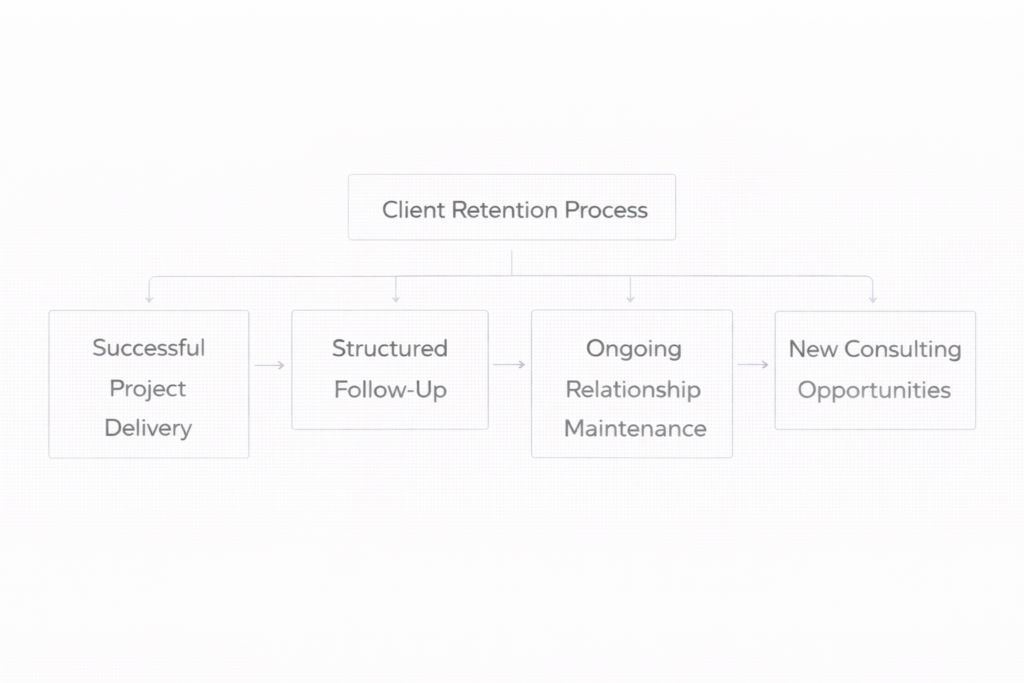
A structured retention framework typically includes four operational components.
1. Successful Delivery Experience
Retention begins with delivery quality.
Clients are more likely to continue working with freelancers who provide:
- clear insights or recommendations
- reliable communication
- consistent deliverable quality
Strong delivery builds trust and credibility.
This connects directly to:
→ Quality Assurance for Freelancers
2. Post-Project Follow-Up
After a project concludes, freelancers should maintain contact with the client.
Follow-up may include:
- reviewing project outcomes
- discussing implementation progress
- identifying new challenges or opportunities
Follow-up conversations often reveal additional consulting needs.
3. Relationship Maintenance
Maintaining client relationships does not require constant engagement.
Instead, freelancers may maintain periodic communication through:
- occasional check-ins
- updates on relevant insights
- discussions about evolving business needs
This keeps the relationship active without requiring immediate projects.
4. Opportunity Identification
Over time, freelancers may identify opportunities for additional work.
These opportunities may include:
- follow-up consulting engagements
- expanded project scope
- ongoing advisory support
Identifying these opportunities allows freelancers to deepen relationships with existing clients.
Operational Impact
Implementing structured retention strategies improves several operational dimensions of freelance consulting businesses.
Reduced Pipeline Pressure
Freelancers rely less on constant lead generation.
Stronger Client Relationships
Long-term collaboration builds trust and mutual understanding.
Higher Lifetime Client Value
Clients may generate multiple engagements over time.
Greater Revenue Stability
A balanced portfolio of new and returning clients stabilizes income.
Retention therefore complements client acquisition as a core operational capability.
System-Level Impact Across Processome
Client retention systems strengthen coordination across the Processome operating architecture.
Client Pipeline System → returning clients supplement new opportunity inflow
Capacity Planning System → recurring engagements improve workload predictability
Profit Tracking System → long-term clients often produce higher profitability
Delivery & Operations System → strong delivery systems support lasting relationships
Retention therefore contributes directly to operational stability.
Common Failure Patterns
Freelancers often overlook retention opportunities because their focus remains on project completion.
Several patterns frequently appear.
No Post-Project Follow-Up
Freelancers move immediately to the next project.
Transactional Engagements
Relationships remain limited to individual projects.
Missed Expansion Opportunities
Freelancers do not explore additional consulting needs.
Overreliance on New Clients
Revenue growth depends entirely on new client acquisition.
These patterns increase sales pressure and reduce relationship stability.
Strategic Outcome
When retention systems are implemented consistently, freelance consulting businesses become significantly more stable.
Instead of relying solely on new client acquisition, freelancers build portfolios that include ongoing relationships.
This produces several advantages.
Reduced acquisition pressure
Returning clients generate repeat work.
Higher relationship quality
Freelancers develop deeper understanding of client businesses.
Improved revenue stability
Client portfolios become more balanced.
Greater long-term value
Successful engagements evolve into long-term partnerships.
Retention transforms project-based consulting into relationship-based consulting.
Final Perspective
Freelancers often treat client acquisition as the primary driver of business growth.
However, long-term consulting stability depends equally on maintaining strong relationships with existing clients.
Within the Processome operating model, the → Delivery & Operations System ensures that successful projects evolve into structured client relationships when appropriate.
Strong delivery creates satisfied clients.
Retention systems convert satisfaction into lasting collaboration.