Revenue Concentration Risk for Freelancers (How to Avoid Client Dependency)
Introduction
Revenue concentration risk for freelancers explains how dependence on a small number of clients can create hidden financial vulnerability.
Many solo B2B freelancers associate stability with large clients. A single client generating a significant share of monthly revenue can feel reassuring because it reduces sales pressure and simplifies client management.
However, large clients introduce a different type of financial risk.
Revenue concentration increases dependency on a small number of clients. If one relationship changes or ends unexpectedly, the financial impact can be immediate.
Within the Processome operating model, this analysis belongs to the → Profit Tracking System—the financial intelligence layer responsible for evaluating how revenue structure affects long-term business stability.
Revenue stability and revenue concentration are not the same concept.
Stable revenue can still hide structural fragility if most income originates from a single client.
What is Revenue Concentration Risk?
Revenue concentration measures how much of total income originates from the largest client relationships.
Instead of evaluating revenue only by total volume, freelancers examine how revenue is distributed across the client portfolio.
For example:
| Client | Revenue Share |
|---|---|
| Client A | 55% |
| Client B | 20% |
| Client C | 15% |
| Client D | 10% |
Although multiple clients exist, the business remains heavily dependent on Client A.
Revenue concentration evaluates distribution, not simply the number of clients.
A simple metric for measuring concentration is the revenue concentration ratio:
Revenue Concentration Ratio = Largest Client Revenue ÷ Total Revenue
Typical interpretation:
| Ratio | Interpretation |
|---|---|
| Below 25% | Diversified client base |
| 25–40% | Moderate dependency |
| Above 40% | High concentration risk |
These thresholds are guidelines rather than strict rules, but they reveal structural dependency patterns.
The Core Problem
Freelancers often evaluate stability by asking questions such as:
- Is my monthly income predictable?
- Do I have long-term clients?
- Is my workload consistent?
While these indicators are useful, they do not reveal whether revenue is structurally dependent on one relationship.
Several risks emerge when a single client represents a large share of income.
Financial Shock Risk
If a dominant client leaves, revenue can decline sharply.
Negotiation Imbalance
Pricing discussions become sensitive because losing the client carries significant financial consequences.
Scope Pressure
Freelancers may accept additional work or expanded scope to maintain the relationship.
Strategic Constraint
When one client consumes a large portion of revenue, the ability to pursue new opportunities becomes limited.
These effects occur even when revenue appears stable.
The underlying problem is dependency disguised as stability.
Revenue Concentration Risk Framework
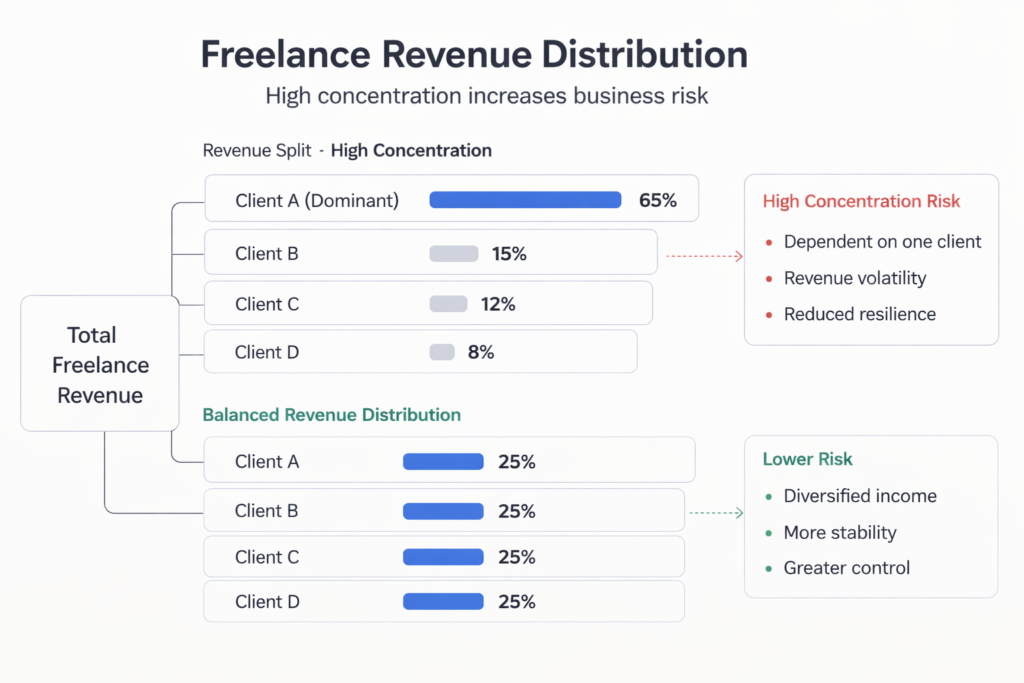
Revenue concentration risk can be evaluated through three dimensions.
1. Revenue Distribution
The first step is analyzing how revenue is divided among clients.
A balanced portfolio distributes revenue across several relationships rather than relying on a single dominant client.
This distribution determines the level of financial dependency.
2. Capacity Allocation
Large clients often consume a significant share of delivery capacity.
Dominant clients frequently require:
- priority scheduling
- faster response times
- increased coordination
This reduces available capacity for new clients or strategic opportunities.
Capacity allocation frameworks are discussed in:
Revenue structure and capacity structure are closely connected.
3. Negotiation Leverage
High concentration reduces negotiating power.
When a freelancer depends heavily on a single client:
- pricing negotiations become difficult
- declining additional work becomes risky
- scope expansion becomes harder to resist
Diversified revenue increases independence in client discussions.
Operational Impact
Monitoring revenue concentration improves several strategic decisions within a freelance consulting business.
Financial Stability
Diversified revenue reduces the financial impact of losing any individual client.
Negotiation Power
Freelancers gain greater freedom to adjust pricing and scope.
Portfolio Balance
Consultants can structure client portfolios that balance stability with flexibility.
Strategic Growth
Reduced dependency allows freelancers to pursue new opportunities without risking financial disruption.
Revenue distribution becomes a key component of financial planning.
System-Level Impact Across Processome
Revenue concentration influences multiple operational systems within the Processome architecture.
- Client Pipeline System → diversification of incoming client opportunities
- Capacity Planning System → allocation of delivery capacity across multiple clients
- Profit Tracking System → visibility into revenue dependency and financial risk
- Delivery & Operations System → balanced workload across the client portfolio
Monitoring concentration improves coordination between client acquisition, capacity allocation, and financial stability.
Common Failure Patterns
Freelancers often drift into revenue concentration gradually.
Several patterns contribute to this shift.
The Anchor Client Effect
A single long-term client gradually expands their share of revenue.
Pipeline Neglect
Freelancers reduce client acquisition efforts during periods of stable income.
Scope Expansion
Dominant clients gradually increase their workload share through additional requests.
Comfort-Based Decision Making
Freelancers delay diversification because the current relationship feels secure.
These behaviors increase dependency without obvious warning signs.
Strategic Outcome
When revenue concentration is monitored intentionally, freelancers gain greater control over financial stability.
Instead of reacting to sudden client losses, consultants design client portfolios that remain resilient over time.
This produces several advantages.
- Reduced financial fragility → diversification reduces revenue shocks
- Improved negotiation position → greater independence in client relationships
- Sustainable growth → pursue new opportunities without dependency risk
Over time, revenue diversification transforms freelance consulting from client dependency into portfolio resilience.
Final Perspective
Revenue stability is valuable.
However, stability built on a single client relationship can create hidden structural risk.
Within the Processome operating model, the → Profit Tracking System provides the financial intelligence required to evaluate how revenue distribution affects long-term sustainability.
Freelancers who monitor concentration risk actively maintain stronger financial independence.
Revenue size matters.
Revenue distribution matters just as much.